





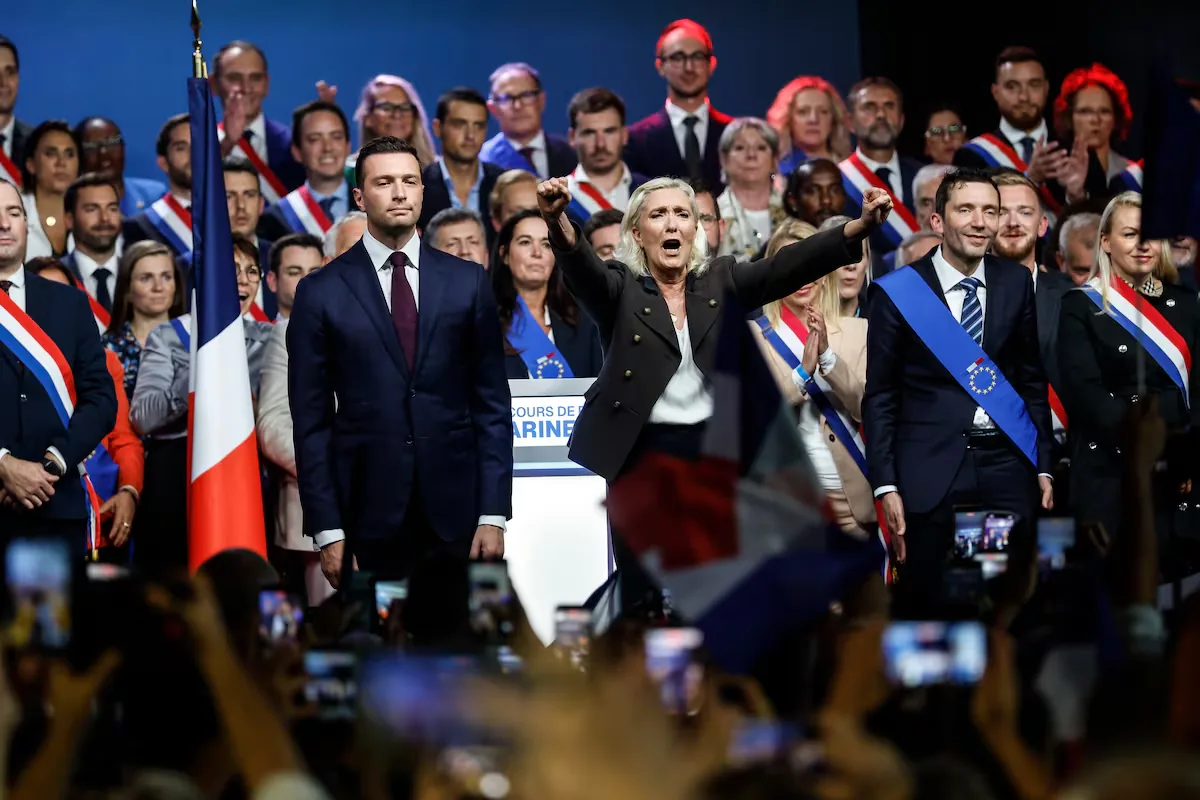
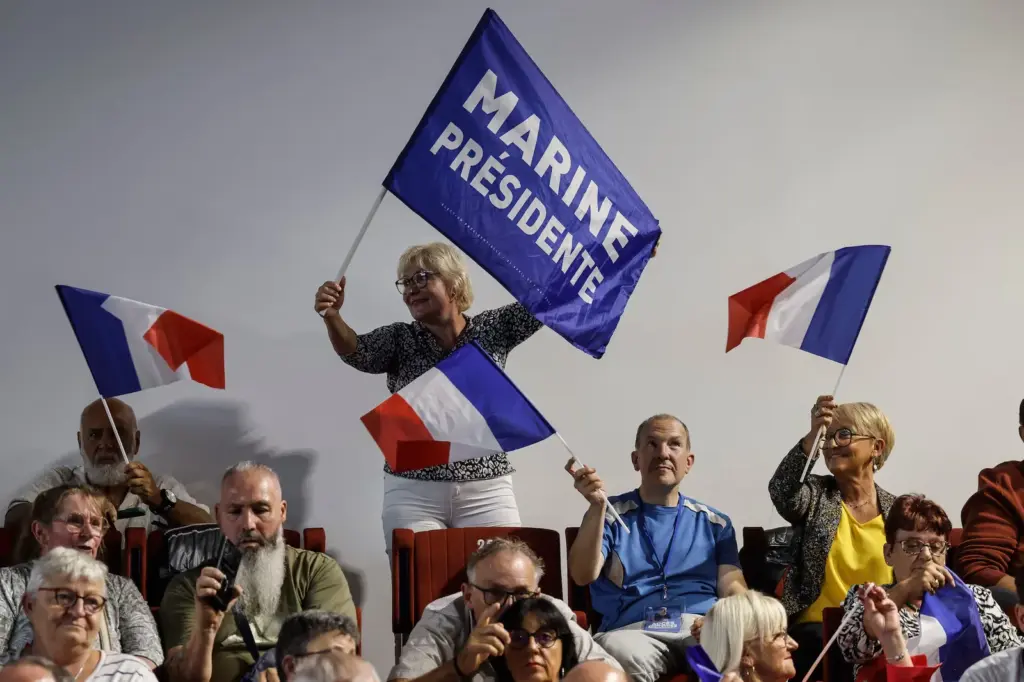
At the end of the A21, a few kilometers from Hénin-Beaumont, several terrils, mountains up to 132 meters high made from the waste of the coal mines of Pas-de-Calais, rise up. They were erected in the sixties, during the industrial boom in northern France. But they were finished in the late eighties, with the decline of a region ruled with an iron fist by the left and the birth of an unstoppable political project that, even under the baton of the anti-Semite Jean-Marie Le Pen, would attract old working-class voters to the far right. Since then, each year a little more, Hénin-Beaumont (26,000 inhabitants) has become a symbol of Marine Le Pen’s political project, deputy for this constituency. “The French will have priority in their home,” she declared this Sunday before an audience of about 3,000 people who were eagerly waiting to hear her first political speech of the term.
Read more Madrid conquers Formula 1 with 350,000 attendees at the Madring debut in the World Championship
Polls indicate that if the presidential elections were held now, the leader of the National Rally (RN) would be by far the most voted candidate in the first round with almost a third of the votes, and would win the second round regardless of the opponent. “This presidential election will decide everything: we will either let our country sink into the quicksand of customs and turmoils or we will make the turnaround we desire, the one that will lead to the rebirth of France,” she proclaimed.
The rentrée had not been easy so far for Le Pen. After a dizzying start to the summer, when she managed to avoid political disqualification and definitively become a candidate for the presidential elections next April (despite the risk that the appeal to the Supreme Court with which she has gained time ends with the imposition of an electronic bracelet), the political term had started strangely for the far-right RN. The leader and her protégé, Jordan Bardella, frustrated for not being the candidate after the court ruling, had distanced themselves. There were frictions on major economic issues, also on key matters such as the ban on the veil, which ended with the main advisor of the young politician being shown the door. That is why returning home, where the project began, was so important to exorcise the demons in a key year. And to do it together.
However, Bardella, who turned 31 on Sunday, did not open his mouth, as he did last year at all rallies. He applauded, smiled while the audience shouted “Marine, president!”. It’s time to return to the bench. “If anyone thinks I will be disloyal to Marine, it means they don’t know me,” he had said days before.
Le Pen was supported in the auditorium by local fans and press from all over the world. She spoke about housing for many minutes. More than ever. “In the name of supposed ecology, the real estate market has been forced into a logic of restrictions and prohibitions and, therefore, into a spiral of recession,” she said while proposing to repeal the law that obliges cities to maintain 25% of social housing.
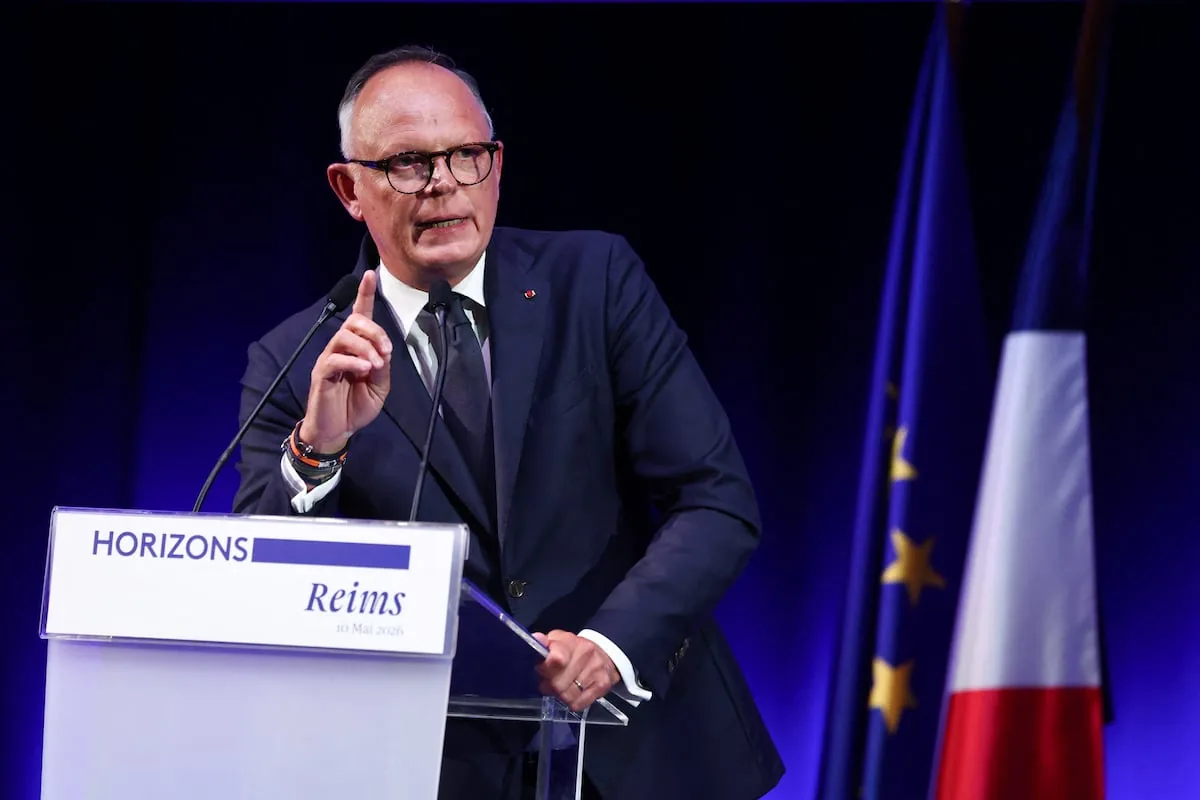
She also highlighted problems in the labor market and purchasing power. She announced a tax cut if she wins. Also a lowering of the retirement age. “Here we know what it means to work. Days that start early and end late. Waiting impatiently for the salary, the reimbursement of bills. We know what factories closing means, bleak prospects for the future of our youth.” And she remembered her rivals in the center-right, Édouard Philippe and Gabriel Attal, both prime ministers with Emmanuel Macron. “They think they can run away from their past responsibilities.”
The far right in Europe is advancing firmly. Alternative for Germany (AfD) presents a stronger candidacy than ever, Vox strengthens in the polls with the Ceuta crisis, and Giorgia Meloni already has the longest-lasting government in modern Italy. Many of the EU’s answers now pass through France, but Le Pen, who now quotes Charles De Gaulle after her party denounced him for years, tries to make it clear that she goes her own way: she has distanced herself from AfD because of their pro-Nazi tendencies. “I left terrified from my meeting with their representatives,” Jean-Philip Tanguy, a heavyweight of RN, said a week ago on BFMTV television.
Tanguy was asked about his assessment of AfD’s electoral victory in the federal state of Saxony-Anhalt, where 44% voted for them last Sunday: “I am appalled: that so many people supported a party that relativizes Nazism and even said you could be in the SS and be a good person. And their proposals for what they call re-emigration, even expelling Germans of foreign origin… We quickly decided to break all relations with them.”
Hénin-Beaumont is light years away from that phenomenon. It is the zero zone of the political narrative about Marine Le Pen’s social disenchantment, who yesterday again recalled the demands of the yellow vests (“they were never addressed”). But lepenism today is divided into two major political and cultural models. Also geographical, which in France are jokingly called the far right with butter or olive oil.
Read more Spain wins bronze at the World Cup with a golden generation
On one side, a deindustrialized north, whose epicenter is in cities like Hénin-Beaumont, with a population still marked by the abandonment of the left, as the retiree Pascal Renoir recalls at the entrance to the event. “My two grandfathers were miners. Heroes forgotten by the left. When the mines closed we had many problems. No one remembered us and the left, which governed here, dedicated itself to stealing instead of helping us.”
On the other, an impoverished south suffering from some integration problems attributed to immigration. “We will establish priority for the French. No French person will lose rights. They will also have priority for social housing,” Le Pen said to please that part of the party.
The far-right leader assumed the presidency of the formation in 2011 and began a strategy that the movement itself called dédiabolisation: breaking with part of the image inherited from her father, presenting the party as a government option and expanding its electoral base towards the popular classes that had traditionally voted left and had been victims of deindustrialization and globalization. An assault in working-class vote pools cooked up in laboratories like Hénin-Beaumont. “There is a heartless right that confuses social with socialism, which will reproach me for being the latter,” she said. Beside her, Bardella, perhaps the greatest representative of that other current, applauded silently.
Le Pen arrived here in 2007 with Steeve Briois and Bruno Bilde, two militants who had been working politically in the territory for years. Pas-de-Calais offered something the FN needed: a working-class, deindustrialized region deeply marked by the crisis of the left. Briois, who is now entering his third term as mayor, had started working in Hénin in the nineties and knew the terrain long before Le Pen became the current national figure. “It is important that she came today. It is a tradition for us to start the political term here and she is a deputy for this constituency. She always comes one Sunday in September to participate in the city fair,” the mayor explains to EL PAÍS.
Last year, however, it was not like that. Le Pen preferred to start the term in Bordeaux, away from the working-class, popular, and socially punished universe of the mining basin. Political strategy. But it was also the response to some frictions between Bardella and Briois, who disputed the party presidency, finally falling in favor of the former. “They can’t stand each other. Bardella doesn’t like coming here. For him, it is too working-class, popular, social. He is more into immigration issues from the south,” says Gianni Ranieri, city councilor for the Communist Party at the party’s political stall, marginalized from the central area of the market where everyone was this Sunday.
The RN’s bet consisted of something relatively simple but politically ambitious: to demonstrate that it could stop being a protest party and become a governing one. To do this, it needed to win a city, administer it, and demonstrate that its representatives could behave like “normal” politicians. But Le Pen still gets fired up when she arrives here and hits a wall (she arrived, ate, spoke, and left). “We must face this toxic system where everything is done to endure in power. Malevolent forces that want to lead our beautiful France to decline. We cannot lose this battle. We must lead patriots like you to victory!”
The problem, precisely, may now arise from the fear inspired by some of her European partners and international issues, such as the traditional closeness of the Le Pens with Russia or their Euroscepticism. There was no allusion to these topics this Sunday. And the big question, still impossible to answer, is whether Le Pen, if she governs, would behave more pragmatically, as Meloni has done in Italy. Or if she would give free rein to the impulses emanating from the original ideas of the party’s founders, collaborators with Nazi Germany and members of the OAS, the terrorist group opposed to Algerian independence that tried several times to assassinate De Gaulle.