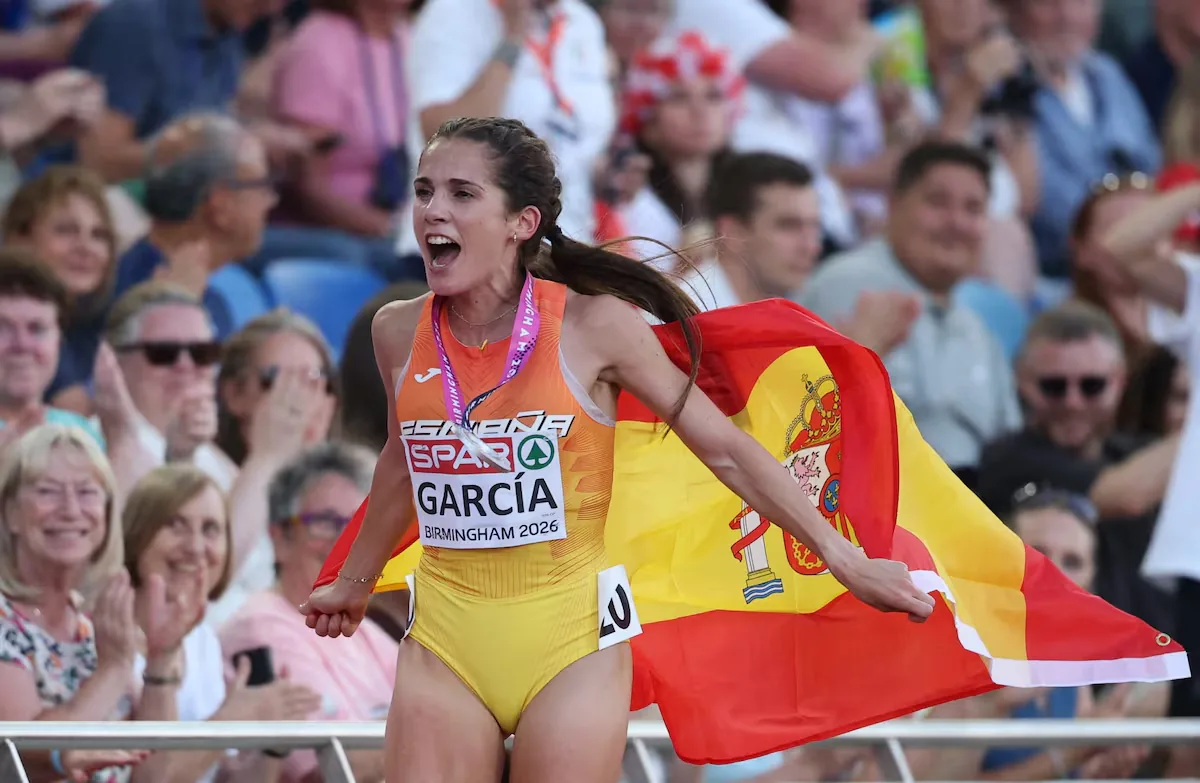
Marta García is wisdom for navigating the crowded long-distance races and a force that makes you dream, and speed, and when in the last 200 meters (29s) she launches behind the final, definitive attack of the great Nadia Battocletti, more than defending the silver medal she can already consider hers, it seems she is thinking about gold, about dethroning the Italian, the only European athlete who competes head-to-head with the phenomenal Kenyans and Ethiopians in World Championships and Games. The Alexander Stadium rises to its feet, an English crowd that knows about athletics and long-distance events, as if hypnotized by the energetic movements of the Spanish runner’s long ponytails. The Castile and León athlete (born in León, raised in Palencia, grown in Valladolid), 28 years old, did not catch Battocletti (15m 37.84s, with a last kilometer in 2.40), who already took the first step to repeat the 5,000m-10,000m double she achieved in Rome two years ago, but she secured the silver medal, the first for Spanish athletics in Birmingham (15m 39.98s). Third was another Italian, Micol Majori (15m 40.65s).
Read more Venezuela and Israel resume their consular services 17 years later
García, already bronze in Rome two years ago, forgets the disqualification she suffered in the 3,000m at the World Indoor Championships in Torun last March, and fully justifies the sacrifice of her life, the completed Medicine degree and the profession set aside, and so many months a year concentrated with the On group, running around the little lake of Saint Moritz, sharing with other athletes, like Moha Attaoui, the apartments that the workers of the exclusive ski resort leave free in spring. And then, in Buitrago de Lozoya, another lake, another life with her husband, with whom she spends hours watching athletics, analyzing, studying. “Everything very deep,” she says. And also, with her powerful and energetic stride, she confirms herself as the second European athlete at the distance, a title she unofficially already reached at the last outdoor World Championships in Tokyo: three Europeans participated; Battocletti, who is always in all her rankings, like an inevitable nightmare, was second, she was seventh.
The race, on a warm evening in the second most populated city in England, a fresh breeze, was as slow as it was complicated to interpret. The first two kilometers behind the jog (3.20 per kilometer pace) of the Kosovar Gresa Bakraçi, who later withdrew vomiting, an acceleration by the impatient lanky Dutch Maureen Koster (the one from whom García, in a stunning finish, snatched the bronze in Rome), and the awakening of the Spanish runner, who until then traveled calmly among the last of the pack of 23 that, like a bellows, rhythmically swelled and shrank, like the athletes’ hearts, systole, diastole. Battocletti changed pace for the first time with 1,400m to go. García, calm, entered the group chasing her, four or five. She studied them. She measured them. She checked that Koster, the most dangerous, had run out of bullets. Her lack of a final kick condemned her. She waited for her moment. “I was inspired by how Jakob Ingebrigtsen moved the day before,” she said later. “But I also imagined the race would go like this. I thought a lot about it with my coach [the German Thomas Dreissigacker] and in my head I already had planned where I had to be at each moment.”
She is seventh when the bell rings, when everyone gets excited. It is not her moment yet. The moment came with 200m to go, when Battocletti had already made the definitive surge. She enters the curve already second, unstoppable, one of her best finishes. She does not catch the Italian. No one catches her.
Read more Luca Hoek transports to Spain the first world of speed
She does not arrive as a favorite. She has not run well all year. But on the D day, the H hour, she is where she wants, how she wants. “The previous months were very strange, but when I saw myself here, I went all out,” she assures.
The Segovian Idaira Prieto, coached by her father, the great Antonio Prieto, was ninth (15m 44.89s) and the young 23-year-old from Huelva, María Forero, who accumulates experience and knowledge in every race, finished eighth (15m 44.25s), a finalist position.