









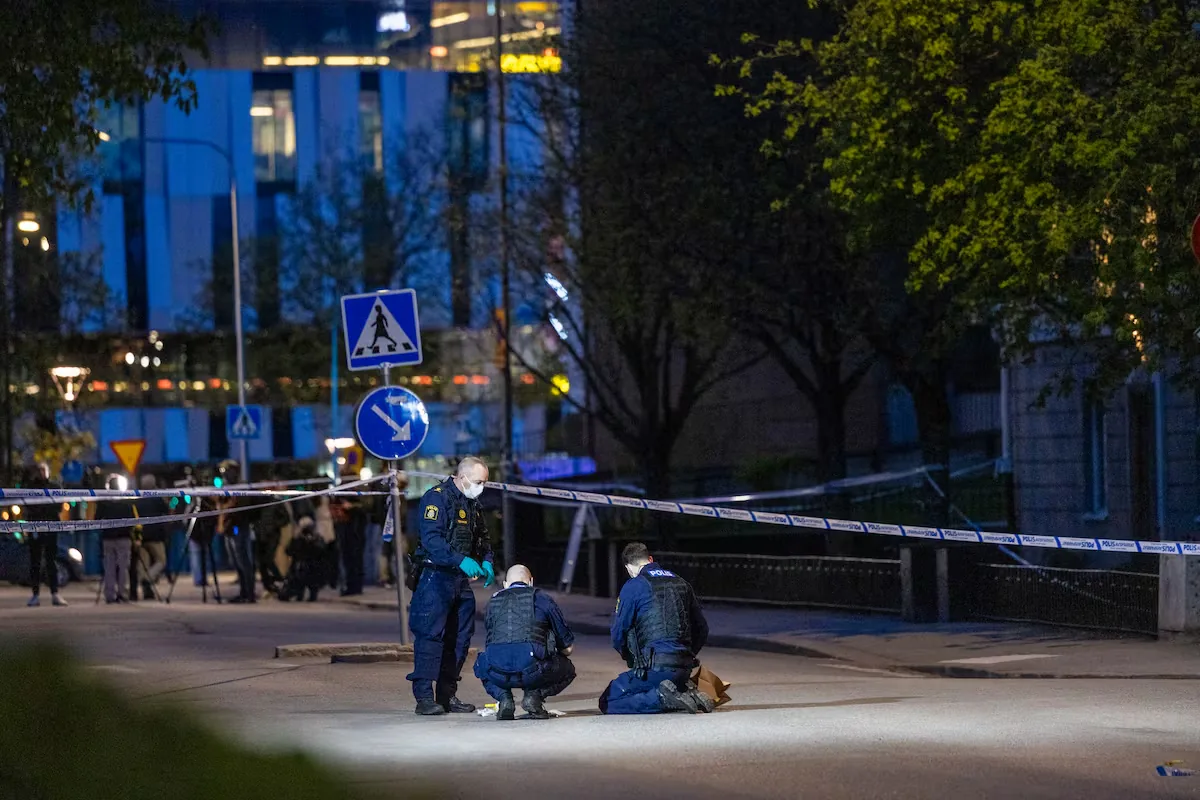
One cold afternoon last November, a 12-year-old girl boarded a bus in Gothenburg with two hand grenades hidden in her sweatshirt. For more than an hour, she traveled 60 kilometers to carry out a task she had accepted through social media. “I don’t think they’re going to give me the money. I completely failed,” the teenager wrote to a friend after throwing the devices without enough force at the house they had pointed out as the target. She did not receive the 80,000 Swedish kronor (about 7,300 euros) that had been promised to her, but she also did not face any punishment: she was too young to be held accountable by the justice system. Her case made headlines amid the debate over whether Sweden should lower the age of criminal responsibility from 15 to 13 to combat gang violence.
Read more Trump assures that talks with Iran will resume this Monday
The discussion goes beyond Sweden. Italy has just toughened its juvenile criminal legislation; in France and Germany, proposals that until recently belonged almost exclusively to the far right have gained weight in the political debate. Similar trends are seen in Latin America and in Asian countries such as the Philippines or South Korea. Driven by concerns about juvenile delinquency and an agenda increasingly focused on security, they all share the same idea: that some crimes committed by teenagers require faster and harsher responses from the state.
Although it is a global trend, in no other European country has the debate on juvenile delinquency gained as much political importance as in Sweden. The expansion of criminal gangs over the last decade has been accompanied by a series of shootings and bomb attacks that have made the Scandinavian country one of the most violent in Europe. Dozens of teenagers, some as young as 11, have been involved in murder cases. Those who support lowering the age of criminal responsibility argue that criminal organizations take advantage of the legal protection of minors to recruit them as perpetrators of serious crimes. The government announced at the beginning of the year its intention to lower the age of criminal responsibility from 15 to 13. Without sufficient support, it reversed course in June and proposed setting it at 14 years. It aims to pass the reform before the legislative elections in September. But for Jerzy Sarnecki, emeritus professor of Criminology at Stockholm University, the reduction is only “a minor, even symbolic element” of a much deeper transformation.
The coalition government formed by conservatives, Christian Democrats, and liberals has promoted a general toughening of criminal legislation over the past four years, especially regarding juvenile delinquency and immigration. In recent months, it has accelerated this shift, pressured by the Sweden Democrats, the far-right party whose support it depends on in Parliament. One of the most significant reforms came into effect in July: minors between 15 and 17 years old convicted of very serious crimes serve their sentences in prison instead of specialized centers. The first minors have already been transferred to a juvenile unit set up in Kumla prison, although they remain separated from adult inmates. “They are changing the legislation from a Scandinavian model to something much harsher, more typical of Belarus or Turkey,” says Sarnecki. “It’s a real atrocity, a tragedy,” summarizes the criminologist.
The proposal to lower the age of criminal responsibility to 13 met more resistance than expected. Academics, child protection organizations, and several bodies expressed their opposition. The liberals, the coalition’s minority partner, also showed reservations. In contrast, the Social Democratic Party, favored in polls for the September elections, was willing to support a reduction to 14 years. For Sarnecki, this move reflects how much the toughening of criminal law has ceased to be the exclusive domain of the populist right. “The Sweden Democrats are increasingly powerful. In this political climate, the Social Democrats do not want to appear too lenient with juvenile offenders or immigrants,” the expert argues.
European average age
Reservations about lowering the criminal age are based on scientific evidence. Various studies indicate that minors between 12 and 14 years old are more impressionable, impulsive, and prone to risk-taking, as well as having a more limited capacity to anticipate the consequences of their actions. For this reason, the United Nations recommends that the minimum age of criminal responsibility not be set below 14 years, a threshold that coincides with the European average.
Sarnecki cites the case of Denmark, which lowered the age of criminal responsibility from 15 to 14 in 2010 through a reform promoted by the far-right Danish People’s Party. Two years later, the measure was repealed. “An evaluation was done and showed that it had no positive effects. Everything got worse, not better,” says the criminologist.
Among the major European countries, Italy has become the main exponent of this punitive shift. Last week, Giorgia Meloni’s far-right government approved a reform establishing the presumption of imputability for adolescents between 14 and 17 years old. Until now, judges had to determine on a case-by-case basis whether the minor fully understood the scope of their actions; under the new rule, the defense will have to prove otherwise. “Those who make mistakes must be held accountable for their actions. Even when they are minors,” Meloni defended.
For Antonella Inverno, head of child policy at Save the Children in Italy, the reform has more symbolic than practical scope. In recent years, only a few dozen minors avoided prosecution because judges considered they did not have sufficient maturity to fully understand their actions. “It is not a reasonable reform,” she summarizes. The activist argues that the measure is part of a broader trend of toughening juvenile justice. The result, she warns, is an increasingly rigid system closer to that of adults. “The idea until now was that deprivation of liberty should be a last resort. A teenager is at a crucial stage of life in which there is still a wide margin for reintegration.”
In France, the National Assembly approved a juvenile justice reform last year that introduced accelerated procedures for certain serious crimes, limited some mitigations related to minority, and toughened sanctions against parents. The far-right Alternative for Germany (AfD) proposes lowering the age of criminal responsibility from 14 to 12 years, while Chancellor Friedrich Merz’s CDU questions what it considers a too lenient response to certain crimes committed by teenagers. In Spain, the Congress rejected last November a Vox initiative to lower the age of criminal responsibility from 14 to 12 years and facilitate the expulsion of foreign minors convicted of crimes.
The trend also extends through South America. In Argentina, Congress approved a reform lowering the age of imputability from 16 to 14 years. “Adult crime, adult penalty,” summarized populist Javier Milei. In Brazil, far-right candidate Flávio Bolsonaro, running in the October presidential elections, advocates harsher penalties for teenagers involved in murders, rapes, or drug trafficking. In Chile, José Antonio Kast’s government is promoting a reform so that minors aged 16 and 17 can be tried as adults for some of the most serious crimes. In Colombia, Abelardo de la Espriella, the far-right lawyer who will assume the presidency next Friday, also supports that in certain cases teenagers be subjected to ordinary justice.
The expansion of these reforms reflects a paradigm shift in how juvenile delinquency is addressed. In many countries, the idea, established for decades, that minors should receive differentiated treatment due to their greater potential for social reintegration and lesser capacity to anticipate the consequences of their actions is giving way to a view that prioritizes the seriousness of the crime over the age of the perpetrator.