







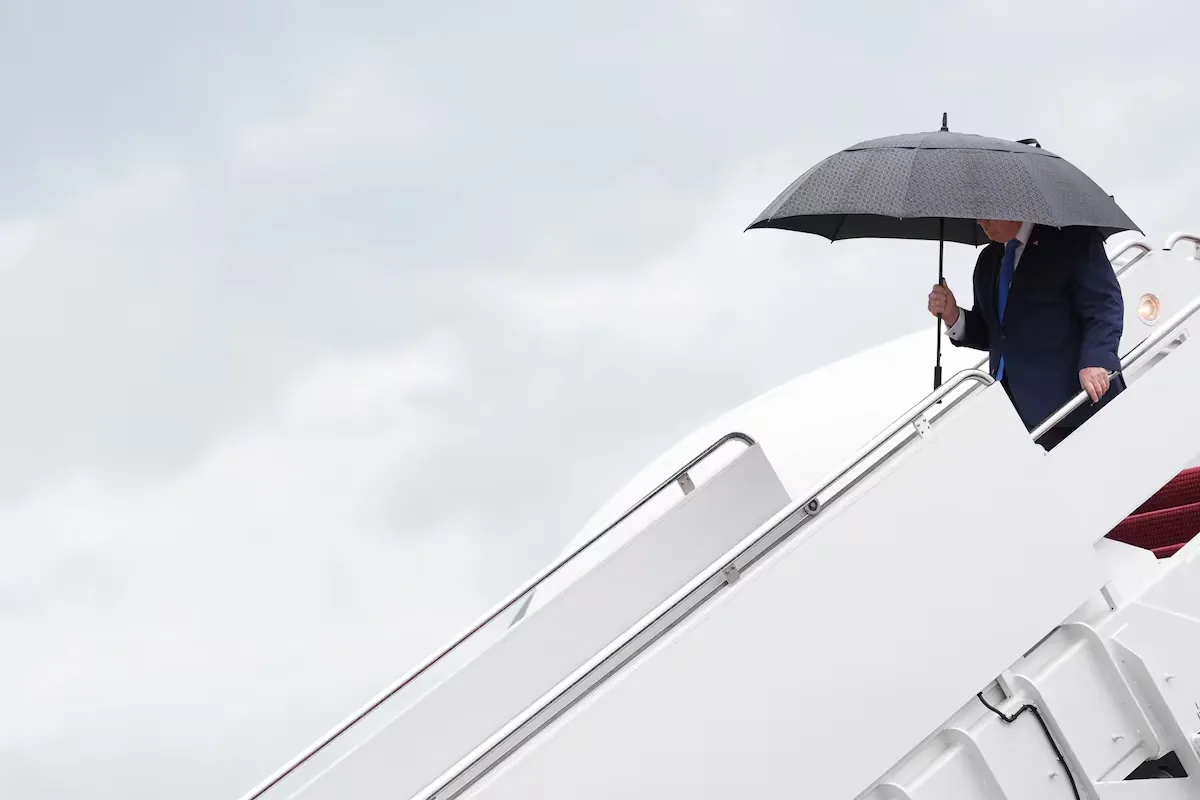
The President of the United States, Donald Trump, said late Sunday that talks with Iran will resume this Monday. He made these statements from the presidential plane en route to Egypt, after holding talks with the leaders of Saudi Arabia, the United Arab Emirates, and Qatar, who, according to him, asked him to “cancel” attacks on the Islamic Republic because they believe there is room for an agreement.
A few hours later, Esmaeil Baghaei, spokesperson for the Iranian Ministry of Foreign Affairs, declared however: “We will not receive any delegation nor be invited by any country during these days.”
Trump’s statement, amended from Tehran, is another flip-flop after weeks of back and forth in which the President of the United States has oscillated between conciliatory language seeking an agreement and threats and announcements of military operations in response to Iranian attacks on their bases in the region.
“We were prepared, but the allies asked for it to be canceled. The reason they asked is because they believe an agreement can be reached on the Strait of Hormuz,” Trump assured.
Trump’s words on Sunday join a message he had written on Saturday on his social network, Truth, in which he announced that he had frozen the attacks to try to seek an agreement. He said he did so at the request of Tehran and other countries in the region that he did not specify.
“The United States is armed and ready to act against the Islamic Republic of Iran, with levels of power, strength, and military capability of terror not seen since World War II. Despite this, Iran and other countries in the Middle East have asked us to postpone any attack, since we have reached the general terms of an agreement,” Trump wrote on Truth late Saturday.
The problem with this message is that it sounds familiar. On other occasions, he has announced supposedly imminent agreements that either did not arrive or lasted very little time. Trump insists that the sine qua non condition for an agreement with Tehran is the full and immediate opening of the Strait of Hormuz, but the authorities of the Shiite theocracy have given ample evidence that they do not want to take that step, as they are aware that this is their great negotiating leverage.
When Israel and the United States launched Operation Epic Fury last February 28, they presented it as something surgical intended to last days or weeks. Instead, it has already lasted five months with no short-term exit in sight. This new turn by the United States shows the strength of Iran’s negotiating position, which has withstood the attacks and made it clear that time is on its side at a moment of growing internal weakness for Trump due to the low popularity of the war and the proximity of the midterm elections on November 3.
Saturday’s announcement was published after Trump spoke by phone with the Crown Prince of Saudi Arabia, Mohammed bin Salman, one of his main Washington allies in the region and an enemy of Iran, but who is aware of the risks involved in an open war.