





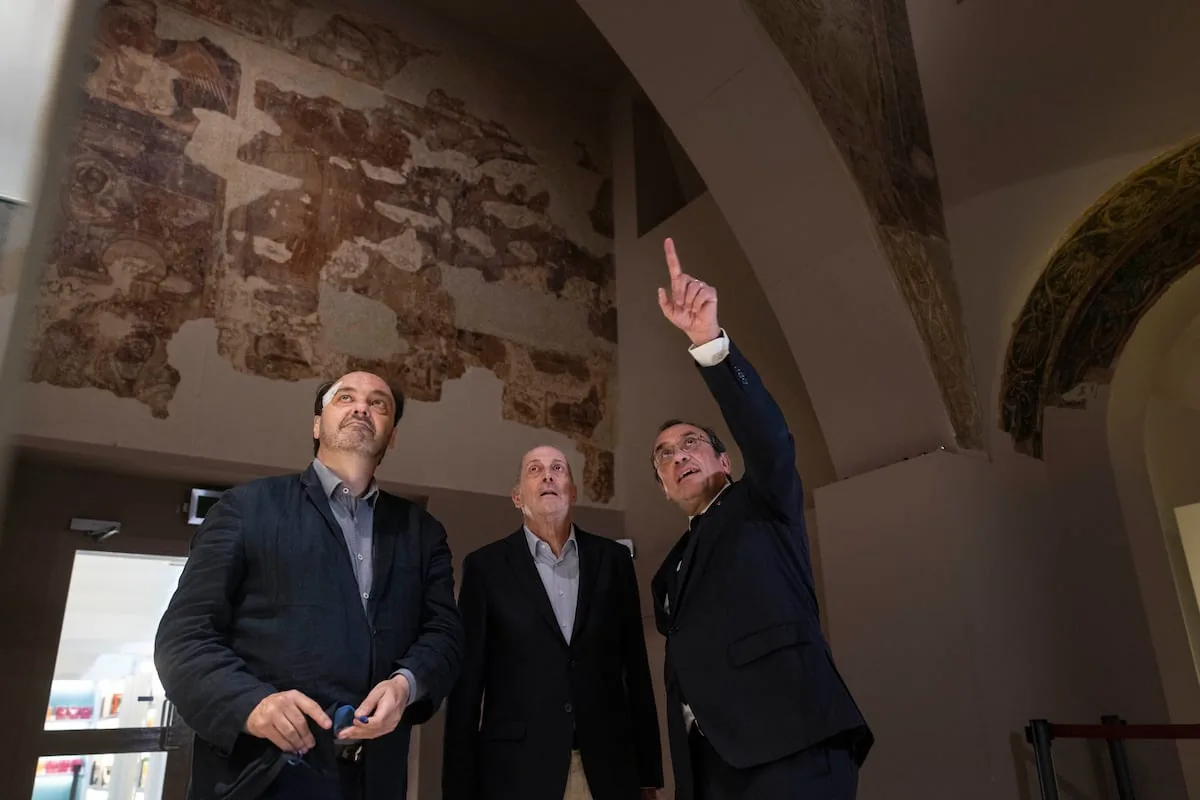
The National Art Museum of Catalonia (MNAC) assumes it must comply with the ruling, but it is not giving in and insists that it is unaware of the technical procedure that would allow the Sijena mural paintings to be returned without causing them new damage. This is the basis of the appeal it filed this Wednesday, exhausting all deadlines, before the Huesca judge in charge of executing the sentence that obliges the restitution of the murals painted in the 12th century to the Monastery of Santa María de Sijena, after the definitive ruling of the Supreme Court last May. In this last step, the museum’s legal services regret that the court has ignored the different reports that advise against the transfer, urge the creation of a commission of experts on the matter, and demand to know the conditions of the place that will house the paintings and from when, because this conditions the dismantling and configuration of the boxes to protect the paintings. In summary, they regret that, in their opinion, the “overwhelmingly technical component” of moving the paintings has not been taken into account.
Read more A cruise ship rescues five bodies of immigrants off the coast of Cartagena
The lawyers of the museum center, controlled by the Generalitat but also involving the Barcelona City Council and the Ministry of Culture, have been working on the appeal for reconsideration for the last week. It seems a priori the last possible move to try to stop the transfer of the work. However, in the last order, the head of Huesca’s Court of Instruction number 2, Pilar Vargas, already made it clear that she had no intention of changing her decision to force the return and that it should be done within a maximum period of 56 weeks, one year and one month. If so, according to the timeline presented by the MNAC, the handling of the paintings could begin in November, after tendering a competition to find a specialized company willing to do the work.
The text questions the judge’s decision. Firstly, because in the order that settled the matter, it stated that during the 2016 trial, no expert had expressed “the impossibility” of carrying out the restitution, a matter that the MNAC lawyers consider a decontextualized statement, since, in their opinion, the technicians warned of the implicit risks of a supposed transfer due to the weakness of the works, although they assumed that if the paintings were intended to be moved, they could be transported. To that effect, they recall that the MNAC has presented in recent months different reports signed by experts and institutions specialized in heritage preservation that highlight the poor health of the paintings and demand, at least, a prior risk report. Of these works, the judge is said to have “absolutely disregarded them without any evaluation.”
“She has dismissed them and acted as if they did not exist,” summarizes the document, which also recalls “the obligation to guarantee the conservation and promotion of the enrichment of the historical, cultural, and artistic heritage of the peoples of Spain and the assets that comprise it.”
Likewise, there is an express request for the judge to convene the commission of experts that she proposed to establish in October to decide on the transfer and which she said a week ago could only be created if the different parties agreed. The acrimony between the MNAC and the plaintiffs, the Government of Aragon and the Villanueva de Sijena City Council, is of such magnitude that they will hardly agree on any matter. The Catalan museum argues that the viability of this group is the judge’s responsibility and that, by not establishing it, “the Court is neglecting the exercise of functions that constitutionally correspond to it.” And it goes further, stating: “The MNAC sincerely does not understand what reason or reasons (neither explained nor motivated) justify the Court’s reluctance to order the establishment of the commission of experts.”
Read more Iran captures two ships attempting to cross the Strait of Hormuz
Another point on which the MNAC disagrees with the judge is about the need or not to know the conditions of the place where the paintings will be reinstalled, the chapter house of the Sijena monastery where they were until 1936, and how long it will take until they can be located there. Although the judge indicated that it was not a crucial issue, the museum considers these factors essential since they condition the type of dismantling and packaging of the 134 square meters of murals, given that the configuration of the boxes will be different if the paintings have to be inside for one, three, or the months that the Aragonese Government deems necessary. Likewise, it considers that the conditions of the installation site are taken into account in all risk analyses of cultural heritage movement. It also denies knowing whether the room meets “the requirements for structural safety and climate conditioning.”
In a response in Congress, the Minister of Culture, Ernest Urtasun, defended the work of the technicians in the conservation of the Sijena frescoes and assured that his cabinet “watches over and will watch over” them as well. But when questioned by ERC deputy Francesc-Marc Àlvaro, he was emphatic: “There is a firm ruling that we cannot ignore.”
The Shadow of Guernica
The Huesca judge closed the Sijena case last week just as another debate about the transfer of works of art was emerging, following the Basque Government’s request for the Guernica to travel for a temporary exhibition to Bilbao, which the Ministry has opposed, citing technical arguments. The judicial ruling makes the two cases different, but the arguments presented in their respective reports by both the Reina Sofía Museum and the MNAC do not differ much. Where the former speaks of “danger of paint detachment,” the latter refers to “risk of detachment,” because the painting “shows vertical cracks, lifting, and losses” and the ancient mural work “shows cracks and lifting.” While appealing to how “sensitive” the current Guernica is due, among other issues, to the 30 rollings it has undergone to allow its different transfers, “fragility” serves to describe the situation of the Sijena murals, torn off by the aggressive strappo technique in an urgent operation carried out in the midst of the Civil War and after a large fire that devastated the chapter house of the Huesca monastery and further weakened the 13th-century paintings, in addition to leaving them exposed to the elements.
The battle for the Sijena murals has taken on a strong political content in recent months. A group of five councilors filed a criminal complaint against the judge in charge of the case, considering that her decision would represent the destruction of artistic heritage. The High Court of Justice of Aragon has refused to admit it for processing.
Read more The judge revokes the conditional releases of former ETA leader Anboto and ETA member Carasatorre