







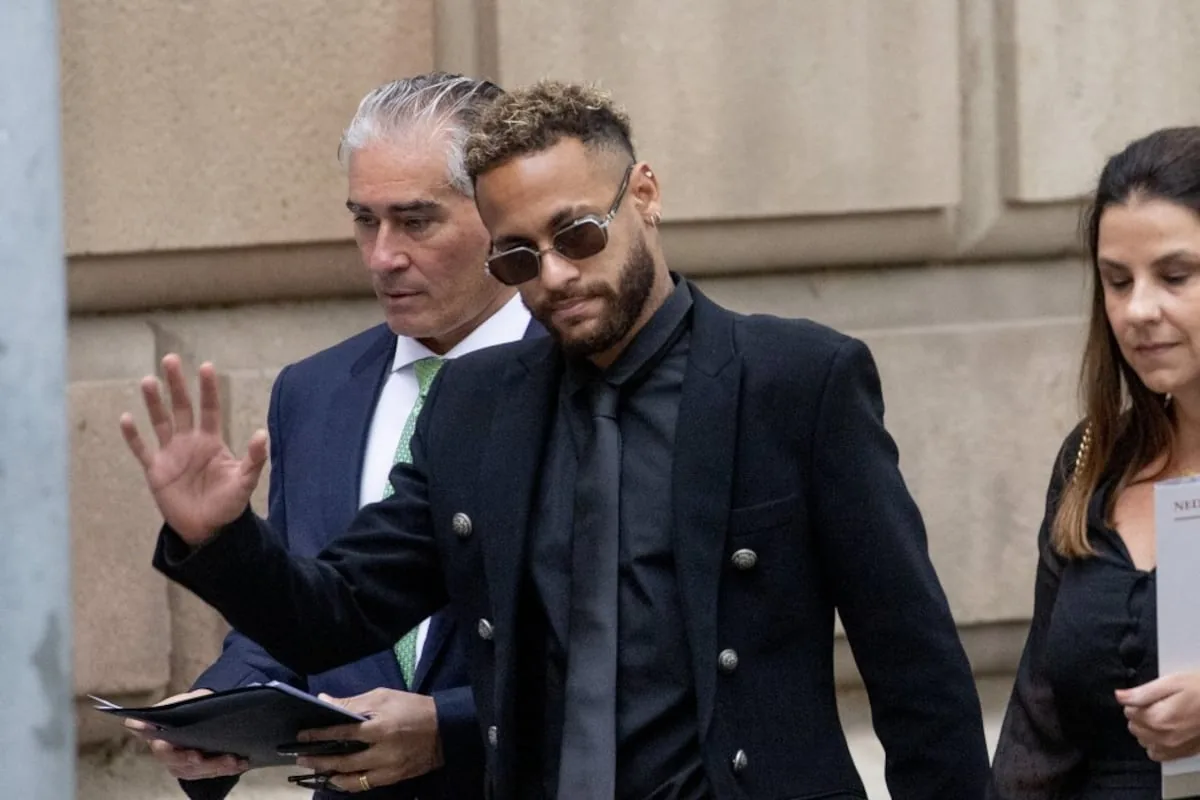
Footballer Neymar da Silva and former Barcelona directors Sandro Rosell and Josep Maria Bartomeu can now close the case in which they were accused of corruption and improper fraud in the form of a simulated contract in the signing of the Brazilian player by Barça in 2009. The Supreme Court has confirmed the acquittal — there is “inconsistency in the accusation,” it says — which the Barcelona Court already issued in 2022 in the so-called Neymar 2 case, in which the investment fund DIS claimed more money than the 6.8 million it received for the operation.
Read more MNAC insists before the judge on its technical inability to transfer the Sijena murals
The Supreme Court considers that the fund does not have this right because, despite actually having 40% of the economic rights over the player, it did not have the federative rights, which allow a player “to sign for a different team while having a valid contract.” The ruling considers that a criminal act cannot be understood to have occurred, if a sporting case, a field that falls within the framework of sports law and the rules of UEFA and FIFA, the two major associations of European and world football.
Federative rights belong to the club with which the player has a valid contract, but if the player is a free agent, they no longer need the club of origin, the sentence argues. Barcelona paid, although it had a commitment with Neymar for him to leave Santos freely when his contract concluded.
It would be, in any case, a breach of contract, says the ruling, which in any case considers that the amount paid by Barcelona to Santos was a premium. “Regardless of whether the player wished to play for FC Barcelona or not, it makes perfect sense that the player’s father, given this club’s desire to acquire his services, would demand a premium for the option,” the Supreme Court states in a statement.
Read more A cruise ship rescues five bodies of immigrants off the coast of Cartagena
Barça paid N&N Consultoria Esportiva 60 million for various concepts between 2011 and 2013. In addition, it paid Santos 25 million: 17.1 for the transfer and 7.9 for a purchase option for three of its young prospects, as well as for two friendly matches, of which only one was played. The prosecutor had already withdrawn his accusation in the case, considering that it had been built on circumstantial evidence. The Supreme Court maintains that this money was not a transfer, but “future rights.”
The Supreme Court considers that criminal intentions in the agreement sealed by the parties are not proven. The contracts sealed in 2011, they consider, do not fall within either contractual simulation or a crime.
The Barcelona Court did condemn Barcelona to pay a fine of 5.5 million euros for two tax offenses in the operation of the Brazilian player’s signing. The club admitted having committed them in the 2011 and 2013 fiscal years, although it exonerated former presidents Rosell and Bartomeu from responsibility.
Read more Iran captures two ships attempting to cross the Strait of Hormuz