






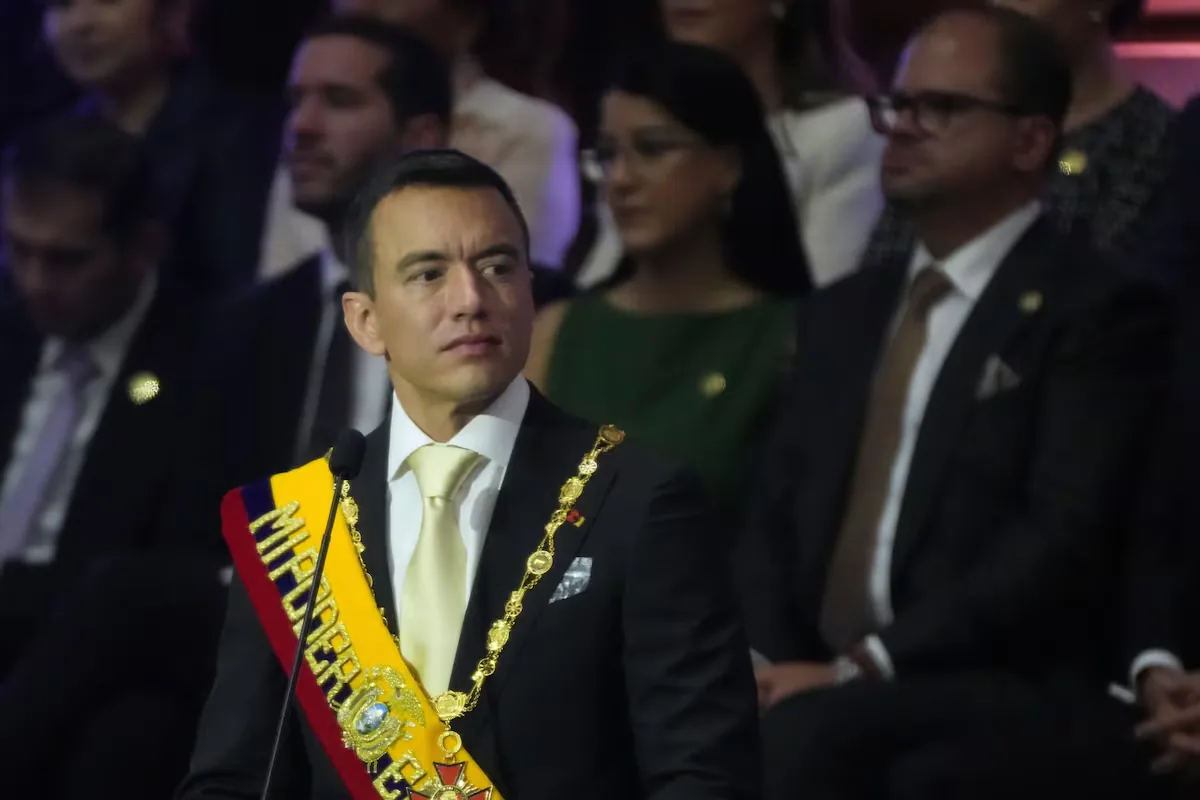
The war against organized crime has brought Ecuador and the United States closer than ever before. Since Daniel Noboa came to power, both countries have signed 67 bilateral commitments, double the number signed during the two previous governments, according to an analysis by the Ecuadorian Observatory of Conflicts. Security concentrates most of this relationship, becoming the axis of the official strategy after the declaration of the internal armed conflict in January 2024 and reinforced by Donald Trump’s return to the White House. This alliance, which the Government presents as indispensable to confront drug trafficking, now faces unprecedented scrutiny after a Human Rights Watch (HRW) report raises questions about the role of the United States in attacks against a farm in the Ecuadorian Amazon and in three incidents against fishing vessels in the Pacific.
Read more Kast’s government seeks to save salmon, cherries, and wine from US tariffs
The HRW report, titled A Dangerous Alliance, Abuses, Unanswered Questions, and Security Cooperation Between the United States and Ecuador, documents four military operations in which it identifies human rights violations and questions the lack of transparency, accountability, and control over security cooperation between the two countries.
The document records four incidents, the first occurred between March 1 and 6, 2026, in San Martín, a rural settlement of 27 families in the province of Sucumbíos, on the border between Colombia and Ecuador, whose livelihood depends on agricultural activities and which was bombed by Ecuadorian soldiers.
The Ecuadorian government showcased the operation as “successful” — also categorized as such by the United States — through a four-second trailer of images of a helicopter flying over the jungle, a group of soldiers, and then an explosion. A direct bomb on what the Government described as a rest and training center for drug traffickers of the criminal organization Comandos de la Frontera.
Days later, testimonies of what happened told another story. Four farm workers reported that they were detained and tortured at Jungle Battalion 56, a military compound located about 32 kilometers south of the farm, where they were transferred by Ecuadorian military personnel, according to a police report to which Human Rights Watch had access and documentation provided by the Attorney General’s Office. “They poured water on me and then shocked me,” one of them told the organization, referring to electric shocks. Another claimed that soldiers threatened him with a firearm and with cutting off his fingers or tearing out his nails. The men were released without charges being filed against them.
The Ecuadorian government stated that a prosecutor refused to press charges against the men “out of fear,” but what that prosecutor told HRW was quite different: “the soldiers did not provide sufficient information or evidence to accuse the workers, who had no criminal record,” the report describes. After reviewing the testimonies and available documentation, HRW concludes that neither the farm nor its workers had links with Comandos de la Frontera or other organized crime structures.
“This alliance to date has not made Ecuadorians safer,” says Juanita Goebertus, HRW’s Americas director. “Far from cooperation based on high-quality intelligence that would truly lead to the prosecution of organized crime structures, what there is is the use of US and Ecuadorian resources to bomb properties and torture four people. None of this contributed anything to dismantling an organized crime network,” she points out.
The opposition pressured ruling party legislators, who are the majority, to push for an investigation into what happened at the San Martín farm, explains Mariana Yumbay Yallico, an assembly member of the Pachakutik party, who is a member of the Assembly’s Security Commission, where the request was lodged. “An oversight process was initiated in the Commission but it has not been able to move forward, there has been no follow-up, in fact, it is paralyzed. When there is an interest from the ruling party not to investigate, requests are stalled,” she adds. It is a strategy that is repeated in several controversial cases involving the Executive. Ruling party legislators appear open to investigating, to “impose on the public’s imagination that they are overseeing,” says the legislator, but in reality, they are preventing the opposition from taking control of the oversight, and cases remain stagnant.
In other cases, ruling party assembly members have not even allowed a debate on the possibility of oversight regarding the limits of Ecuador’s agreements with the United States, notes Yumbay Yallico, such as the bombings of three Ecuadorian fishing vessels in the Pacific, near the Galapagos Islands. “They don’t even allow a change to the agenda to discuss other topics that are not of their interest,” she adds. Jahiren Noriega, from the Citizen Revolution party, who is also part of the commission’s minority, agrees with her. “On July 15, we made a new attempt to oversee security cooperation, which involves the United States, but they did not allow it.”
This newspaper tried to obtain the version of the president or vice president of the Security commission, who are from the ruling party, but by the close of the edition, they did not confirm the interview.
The other three cases documented by Human Rights Watch occurred between January and March 2026. Three fishing vessels, Fiorella, Negra Francisca Duarte II, and Don Maca, sailed from the Manabí ports of Manta and San Mateo. According to survivors’ testimonies, the vessels were monitored by drones and pursued by a ship they identified as flying a US flag before two of them were hit by explosives launched from drones. The organization collected testimonies, analyzed satellite images, reviewed official documents, and consulted independent forensic experts, who concluded that the injuries suffered by at least four fishermen were consistent with attacks by explosive-laden drones. “In all three cases, the modus operandi is the same,” Goebertus states.
“What is the use of resources in this alliance dedicated to this type of operation?” asks the organization’s director. “Both the Government of Ecuador and the United States have denied their involvement, but very serious questions persist about possible involvement of US authorities that should be resolved as soon as possible.”
Private companies
The report also explored the possible involvement of private security companies in maritime operations, including Vectus Global, linked to Erik Prince, founder of Blackwater. Noboa and Prince met in March 2025, in the midst of the election campaign, when the president announced a “strategic alliance” to strengthen the fight against narcoterrorism and combat illegal fishing. However, Prince responded to Human Rights Watch that “neither Vectus Global nor any of its affiliated entities had any involvement, direct or indirect, in the incidents or operations described.” He added a detail that had never been publicly clarified in Ecuador: “The alliance did not materialize after the elections,” which Noboa won. Since then, no operational involvement of Prince or his company in the country has been reported.
Ecuador’s relationship with its main ally, the United States, leaves several unanswered questions: what role did the United States play in the investigated operations, what are the limits of that cooperation, and who oversees the actions of foreign forces when they operate in support of the Ecuadorian strategy against organized crime.
The questions that remain open coincide with a key moment for Daniel Noboa’s security strategy. After 31 months in power, the Government published a National Security Plan for the first time, which makes international cooperation one of its pillars to combat organized crime. However, the document does not detail the oversight and accountability mechanisms that will govern this collaboration, precisely when the alliance with the United States faces the greatest scrutiny since the internal armed conflict began. Meanwhile, homicides continue at historically high levels, and complaints of alleged human rights violations are accumulating.