



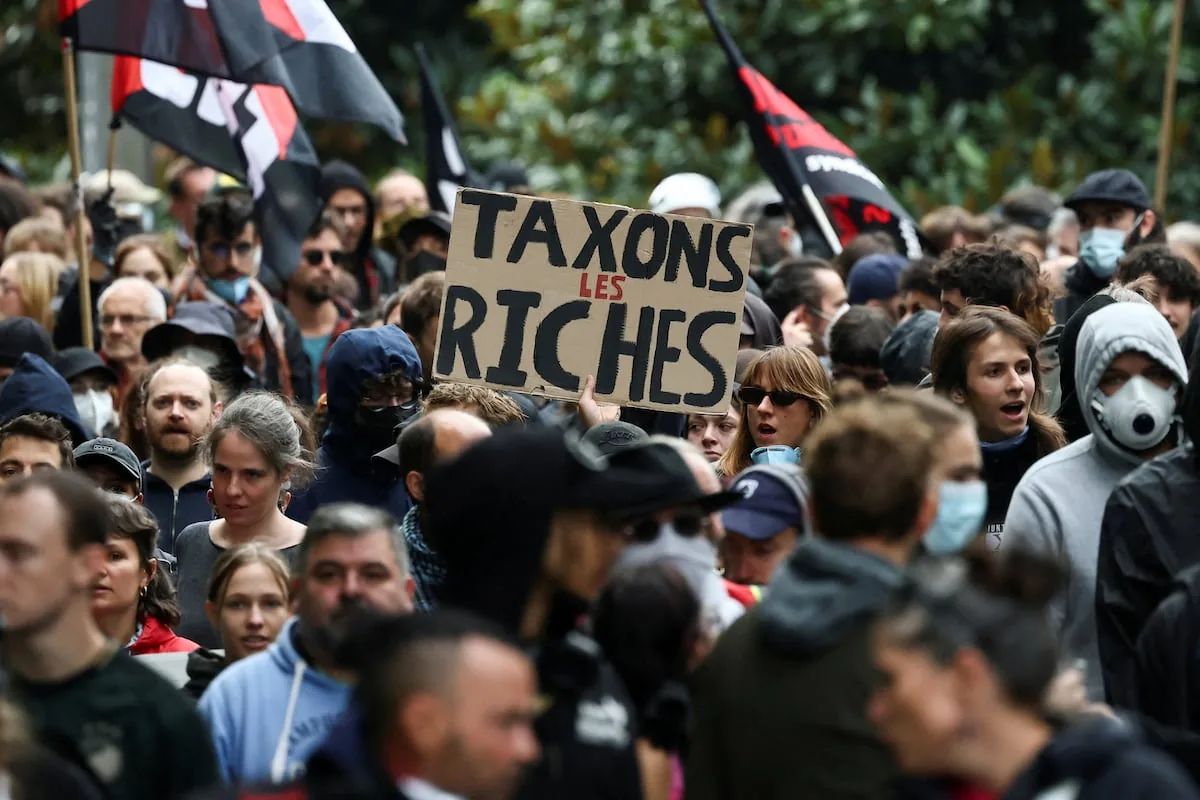
Today there are more income and wealth inequalities than ever before. In New York City, the median household income is $131,000. If that pronounced inequality did not exist, New Yorkers could live reasonably well. Instead, a handful of people at the top of the scale hoard immense wealth while millions of residents struggle simply to make ends meet. Some do not succeed. For them, New York has ultimately become unaffordable.
Read more The two Goyas that Seville commissioned in 1789 return definitively
This excessive degree of inequality has enormous economic, political, and social consequences. It undermines social and political cohesion, erodes trust in institutions, and pushes people to rightly think that the system is rigged.
Almost one-fifth of the richest Americans live in New York, which constitutes the largest concentration of wealth in the entire country. But inequality is not a problem exclusive to New York, nor even to the United States, although this country has more inequalities than almost any other advanced economy. It is a global crisis.
The global inequality report, commissioned during South Africa’s presidency of the G-20, revealed that between 2000 and 2024, the richest 1% captured 41% of all new wealth, while the poorest half of humanity only got 1%. This path is unsustainable.
One of the clearest symptoms of this imbalance is the increase in extreme wealth. In 1987, billionaires owned wealth equivalent to 3% of the world GDP. Today, that tiny elite — 0.0001% of the world population — owns wealth equivalent to no less than 16% of the world GDP.
As wealth concentrates, so does power: the power to influence elections, determine policies, tilt markets, and define the terms of public debate.
One of the main drivers of this trend is our collective inability to truly tax the richest. Until recently, it was difficult to measure the magnitude of the problem. Public data do not record the tax contributions of the ultra-rich. However, recently there has been a flood of studies analyzing precisely this aspect and reaching clear conclusions.
In the 1960s, the 400 richest Americans paid approximately 50% of their income in taxes to various public administrations. Today they pay .
This does not happen only in the United States. Throughout Europe — including France, Italy, and the Netherlands — and in countries like Brazil, researchers observe the same pattern: the effective tax rates paid by the richest are practically the lowest of all. They are not only good at generating wealth but also at avoiding and evading taxes.
Moreover, when they pay, they contribute much less than they should, despite being rich largely thanks to public investments: public contracts, a highly skilled workforce, a rule of law that facilitates business activity, good infrastructure, and even the basic technologies on which their “innovation” relies. The burden falls mainly on workers, whose taxes support those same systems that make extreme wealth possible.
Read more Alcaraz announces that he will not compete in the Mutua Madrid Open
It is time for all of us to address this problem.
We can disagree on how progressive tax systems should be: that is, on how much more of their income the rich should dedicate to paying taxes compared to the rest of the population. But there is nothing that justifies a regressive system in which the richest contribute less than others. That is how inequalities increase and perpetuate.
For a long time, the possibility of reforms was dismissed because they were thought to be too complex or politically unfeasible, despite voters of all political stripes enthusiastically supporting that the rich pay what they owe.
That is beginning to change.
In 2024, under Brazil’s presidency, the G-20 included this problem among its priorities and committed to implementing more effective taxation on people with disproportionate net worth. The group commissioned a proposing a minimum wealth tax of 2% for the richest, a simple way to ensure they meet their obligations to society.
The idea, of great significance, has had a domino effect. In 2025, Spain and Brazil committed to leading a coalition of countries to implement it. This weekend, the Spanish Prime Minister, Pedro Sánchez, and the President of Brazil, Luiz Inácio Lula da Silva, meet in Barcelona with the heads of state of South Africa, Mexico, Colombia, and many other countries to promote the project.
In France, the National Assembly approved a variant of this minimum tax, although the conservative Senate blocked it. Still, it remains a very present topic in the national debate; just as happened in its day with the income tax itself, which faced similar resistance from conservative forces before becoming law. In the United States, a paradigm shift is occurring. Next November, California voters will decide whether to establish a wealth tax on billionaires. The State of Washington has approved a 9.9% income tax on incomes over one million dollars, which will take effect in 2028. In New York, we are asking state authorities to increase taxes on the rich and large companies to close the city’s budget deficit and fund essential public services, such as affordable housing and childcare. And we are already making progress on a new tax on second homes in the city, which will apply to the ultra-rich and international elites.
These are just the first steps to restore a basic social principle: that those who have the most must contribute their fair share so that everyone can live with dignity.
The idea that billionaires should pay higher tax rates than workers is not a radical concept. What is radical is a system in which extreme wealth coexists with widespread hardship and in which those billionaires, in practice, manage not to contribute to the society that has allowed them to succeed.
The longer we take to solve this situation, the more entrenched wealth and economic and political power will become, and therefore, the more consolidated the privileges of the contemporary aristocracy will be.
Read more Stage and yellow ‘maillot’ for Adam Yates, who, responsibly, fulfills his duty in O Gran Camiño