







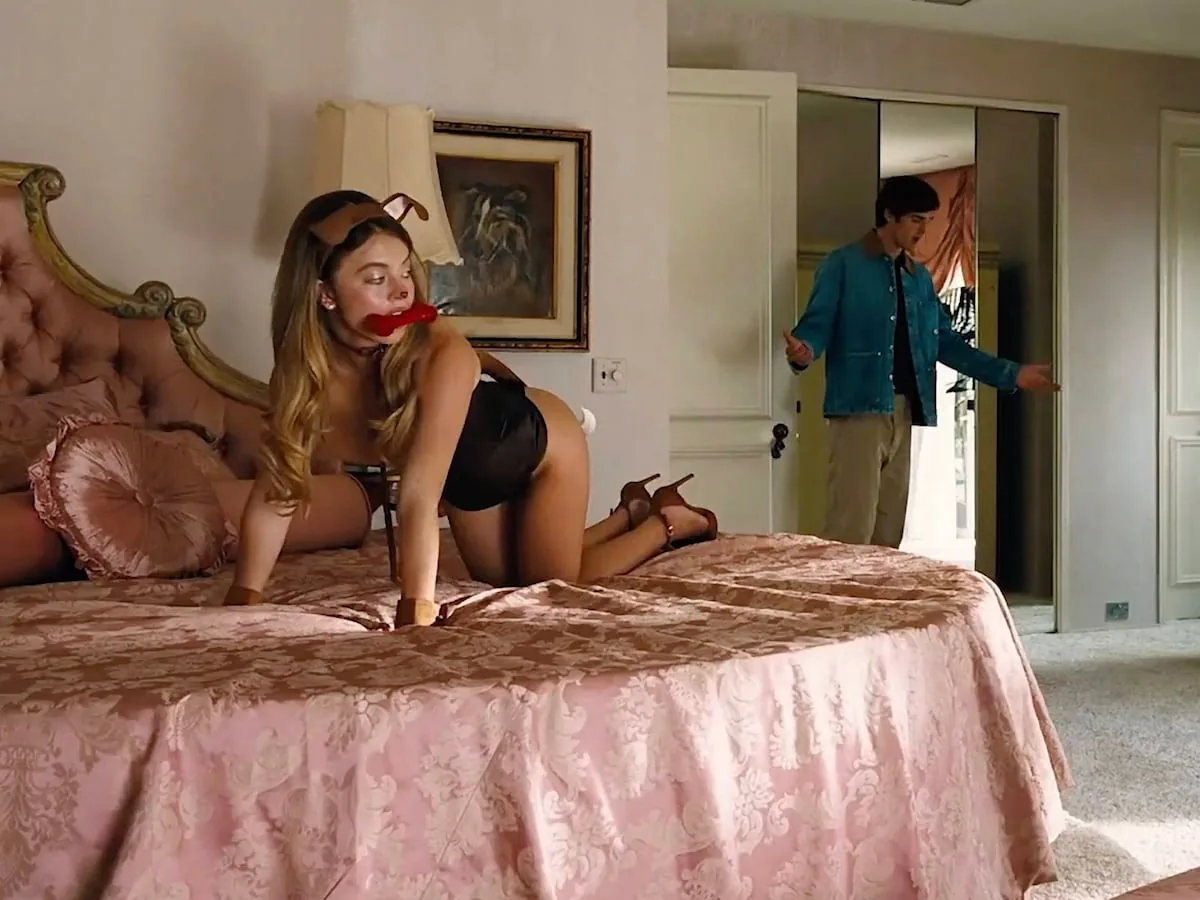
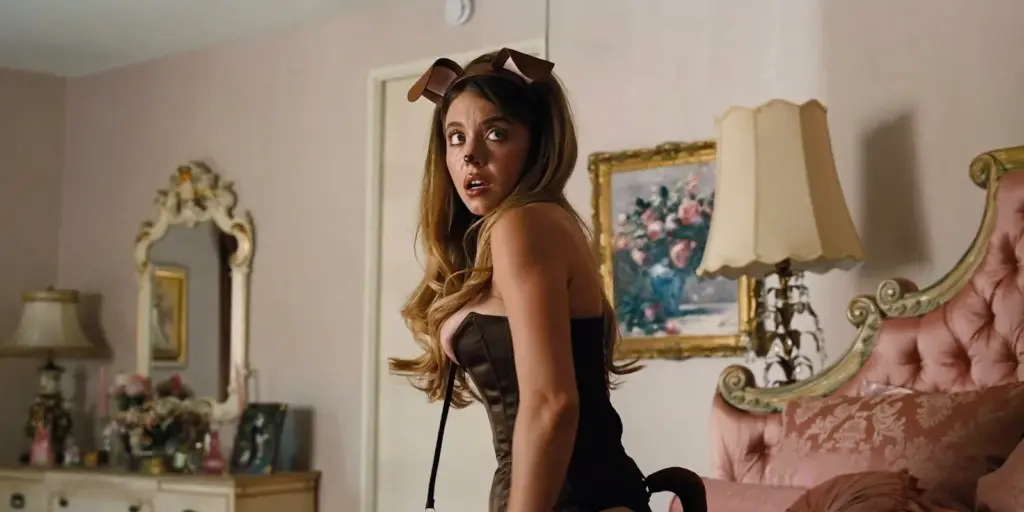
“Everyone thinks the doggy style is very vulnerable, but in reality it is the most stable position. Like a table. It’s hard to be knocked down when you’re on all fours,” writes Miranda July in On All Fours (Random House, 2025), one of last year’s big literary hits. Sydney Sweeney has also been portrayed in this controversial position in the third season of Euphoria. In the series directed by Sam Levinson, Sweeney emulates being a sensual doggy to make money through OnlyFans with the aim of affording an ostentatious wedding against the refusal of her fiancé, played by Jacob Elordi, who does not want to spend $50,000 on flowers on such a special day.
In another of the year’s big audiovisual hits, Wuthering Heights, it is also Jacob Elordi who plays Heathcliff, who controls the leash of his wife Isabella, played by Alison Oliver, who received the few good reviews of this project. But while in the book Emily Brontë criticizes romantic love by depicting how many women embarked on idealized marriages that end up being abusive and repressive, in the film the character appears sexualized and even ridiculed.
View this post on Instagram
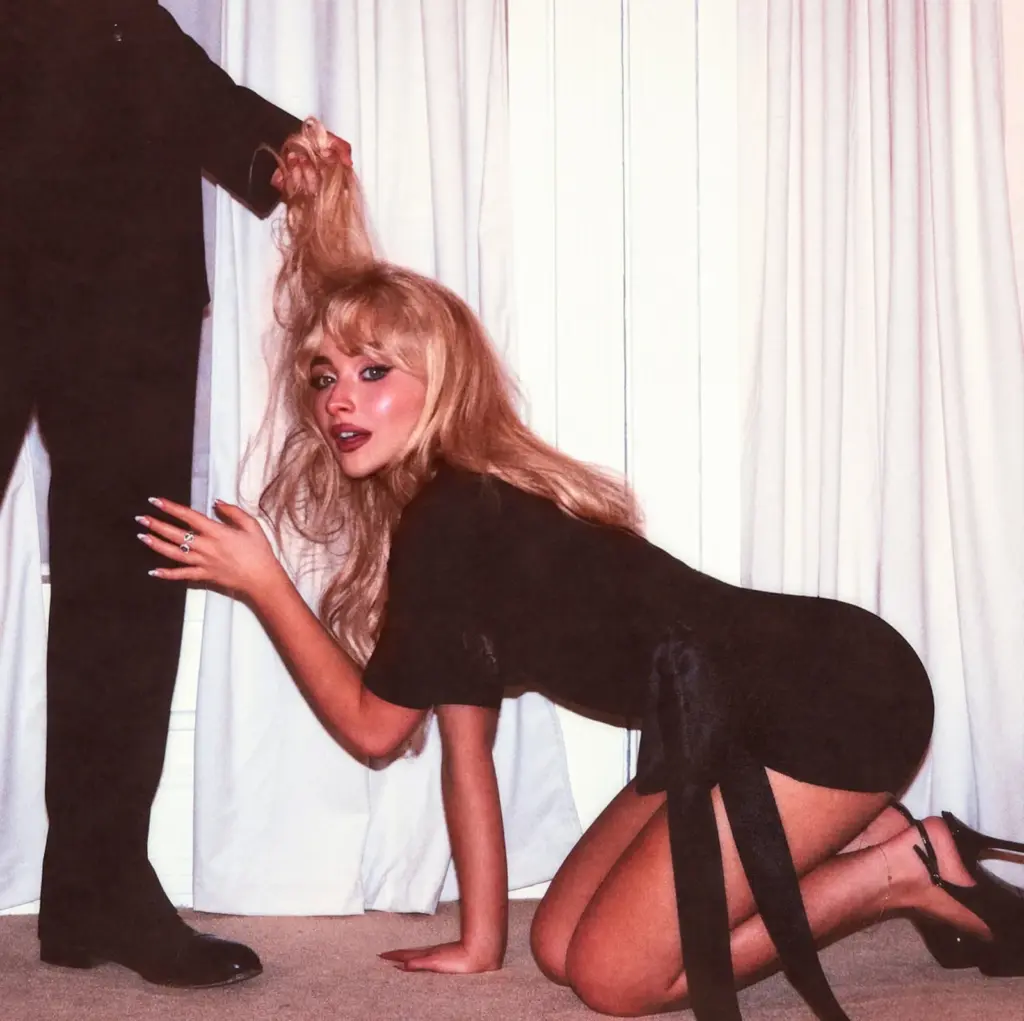
The music world has not escaped the ‘on all fours’ moment either. Sabrina Carpenter chose this position to be photographed on the cover of her latest album Man’s Best Friend. In Carpenter’s case, social media rushed to criticize the singer appearing on all fours with someone pulling her hair. “Sabrina can’t have it all. She can’t pose as a submissive woman just because it’s sexy,” said her detractors. “Actually, it’s about being aware of your lack of control and when you want to have it. I think when you’re a young woman, you’re aware of when you have it and when you don’t,” said the singer.
But what does it mean that putting women, literally, on all fours is repeated so much in so many ‘mainstream’ projects? Andrea García-Santesmases Fernández, author of A New Sexual Contract (Ariel, 2026), emphasizes that this position, which refers to the sexual, also alludes to the animal and the historical link between woman and nature, woman and irrationality, and woman and instinct. “I don’t think it’s a coincidence that these links reappear at a time of offensive against progress in equality, at a time of conservative reaction. It is undeniable that these images objectify the female body. This does not mean that the women who star in them do not feel comfortable, or even empowered, using their erotic capital to attract attention and make headlines,” she assures. She points out that Sydney Sweeney’s character is the perfect patriarchal archetype. “On the one hand, she is presented as a tradwife who doesn’t want to work and pressures her future husband to grant her all her whims while she leads an idle life. But they don’t even grant her the female selflessness typical of the traditional wife; instead, they present her as superficial and manipulative, without moral judgment, willing to commodify her body just to achieve the ideal floral arrangement for her wedding. She embodies the postfeminist ideal, the one that preaches that now that we have formal equality, we must abandon reflection and embrace our desires without reservations, whatever they may be,” she says.
Noemí López Trujillo, author of They Drew Me Like This (Península, 2025), considers that the fact that Emerald Fennell’s adaptation of Wuthering Heights or Cassie’s plot in Euphoria are sexually scandalous in 2026 is a clear symptom of the success of the far-right agenda and how reactionary discourses are permeating progressive spaces. “This throwing up hands at seeing two women on screen acting as insatiable bitches fits into a cultural moment that turns all pleasure into something that must be healthy, hygienic, light, and modest. There is no room for excess in any sense. Neither in food, nor in aesthetics, nor in sex,” says the journalist. “It’s trying to fool people into thinking you can settle for the fake Japanese cheesecake being a cake, for putting on makeup without it looking like it is transforming you, or for four badly given kisses, a thrust, and a slightly tight corset being something almost dirty and shameless. It lowers the standard of pleasure so much that everything becomes boring and conservative. Soon anything will seem excessive to us: showing breasts, eating a real cake, or painting your face as if you were an inflatable doll,” she adds.
The creator of the Not your polite feminist account points out that the character played by Sweeney has internalized the idea that her worth depends on the desire she arouses. “It’s not just that Cassie Howard is sexualized, but the way that sexualization is being constructed. She has positioned herself, literally, as an animal, as a dog. Add to that the degradation and the way humiliation increases. It’s hard to claim it’s a critique when it’s closer to a fantasy,” she assures.
While many people consider it a humiliating and codifying ritual, others have defended Euphoria’s foray into fetishism, accusing those who are scandalized of disdainfully pointing fingers at those with less conventional sexual preferences. “For me, Euphoria and Wuthering Heights are problematic not because they objectify or normalize gender violence (by the way, this is the discourse of Trumpist evangelicals like Allie Beth Stuckey), but because, for example, the enjoyment of BDSM is equated with being a girl with traumas (Isabella or Cassie are good examples). I think this is what heteronormative people believe non-normative sexual practices are,” says López Trujillo. “So while many feminists revel in the despair of a series that reinforces their counterrevolutionary ideas about female sexuality (having sex with men is putting yourself in the crosshairs of violence, being hyperfeminine is being alienated, charging for your sexuality is patriarchal), evangelicals in the U.S. rub their hands with the number of videos they will make warning about these same issues, but with a patina of spirituality,” she assures.
Read more The evangelical boom in Madrid: full stadiums, advertising on buses, and political connections
The validation of problematic narratives
Marina Marroquí, social educator, believes that when such relevant figures appear portrayed on all fours in sexualized scenes, the message is not neutral. “It indicates that the female body is still valid and rewarded when it fits into codes of submission that machismo has eroticized. Ana de Miguel in Sexual Neoliberalism. The Myth of Free Choice (Cátedra, 2025), describes it masterfully. “Freedom is not just being able to choose, but from where you are choosing. When you choose practices not for individual pleasure, but to give pleasure, to be accepted or chosen, it means the same submission as always. The thing is, they tell us it’s something liberating. This is not new: they have been saying for a long time that women are freer the more degrading practices we do,” says the author of That’s Not Sex. Another Sexual Education Is Urgent(Crossbooks, 2023).
“Culture and social media are perfectly synchronized for this new generation. The messages they receive through all cultural tools, such as cinema or music, go hand in hand with those videos they are bombarded with on TikTok and those messages that we are free to use our bodies and therefore, it’s a good idea to open an OnlyFans,” she adds.
In Wuthering Heights, by turning Isabella into a submissive who consents, Fennell implies that Heathcliff’s actions, although still perverse, are easier for the audience to digest by making his behavior seem less monstrous… and even sexy. Andrea García-Santesmases Fernández considers that the film uses consent to validate a type of relationship that would otherwise be despicable. “It’s not just a one-time sexual game, but from the very beginning Heathcliff tells Isabella that he will humiliate her, use her, degrade her. These threats seem to be diluted because they are accompanied by a ‘do you agree?’ to which she answers ‘yes’. Similarly, when we see her tied with a leash, on all fours, in the middle of filth, literally living like a dog, the violence of the image is softened because she implies that this is what she wants,” she assures.
For the sexologist, the problem lies in placing consent as not only a legal validation but also an ethical and even political validation of a relationship. “What happens between them is not a crime since it has been agreed upon by two adults, but that does not mean it is right, much less an expression of female empowerment or sexual freedom. In this sense, it is interesting to point out that in the book of Wuthering Heights this repeated reference to consent does not appear, so it is a contemporary strategy to validate problematic narratives,” she warns.
Noemí López Trujillo regrets that all female hypersexualization is always interpreted as a service to male sexuality. “With this essentialist discourse, we are again prevented from taking our sexuality out of that equation in which all our pleasure is made for them. But moreover, in this case anyone who knows Carpenter and follows her work will see that it is an exercise in irony — I can be a bitch in bed, but outside of it you are not my owner —.”
“The idea that empowerment processes are individual is the trap, whether dressing as a doggy or joining Crossfit. Empowerment is a collective process from which one can benefit personally — awareness, recovery of autonomy, improved self-esteem — but it is framed in a community liberation work. Trying to fit cultural productions into empowering/disempowering categories impoverishes art itself and nullifies our critical capacity,” she warns to conclude.