





Religious battles are no longer fought only in temples. They also circulate on buses. For days now, the advertising for the Festival of Hope with American preacher Franklin Graham has been traveling around Madrid on vehicles of the Municipal Transport Company (EMT). On the posters, which occupy the side of the vehicles, there is a direct invitation: “Share the love of Jesus Christ with people from all over Madrid.” The event, expected to be massive, will be held on May 30 and 31 at the Vistalegre Palace and, according to the website, will bring together evangelical churches from all over Spain around the son of the historic televangelist Billy Graham.
Bus in Madrid right now. The neo-Pentecostals have set their sights on Spain. Franklin Graham is not just anyone; he is the son of the legendary pastor Billy Graham, one of the most important evangelical leaders there has ever been. His son is more direct and political with his fundamentalism. pic.twitter.com/Sy8ZHp9eDh
— Eduardo Saldaña (@EduardoSaldania) May 5, 2026
In a video broadcast by the Qatari network Al Jazeera, Franklin Graham can be seen praying a few weeks ago at the White House alongside U.S. President Donald Trump. During the prayer, Graham made references to Iran and Jewish communities, including the following statement: “Iranians seek the destruction of Jews worldwide.” He also claimed that Trump had been “chosen by God” to lead the war against Iran.
In these parts, municipal sources state that the Municipal Transport Company has granted, through a public tender, the commercialization and management of the campaigns. According to this, the Festival of Hope “has been contracted and paid for by the advertiser on 12 buses of 12 lines in full rear format,” with an exhibition period “from May 4 to May 31 of this year.”
The scene sums up well a phenomenon that has been growing for years and is now beginning to become visible on a large scale: the rise of evangelism in Madrid. Spain already has around 1.5 million evangelicals, and growth has been steady over the past decades. “In 1998, barely 0.2% of the population identified with this confession. In 2018, the figure had already reached 2%,” according to data from the Observatory of Religious Pluralism. Evangelicals are today the largest minority confession in the country, ahead of Jehovah’s Witnesses and behind Muslims.
Behind this growth is an evident demographic reality: the migratory transformation of Madrid. “They bring with them religious practices, leaders, and networks already consolidated in their origin that reproduce themselves in neighborhoods and municipalities where they settle, and they find in Pentecostal churches a space to maintain identity continuity and, at the same time, mitigate the loneliness and vulnerability inherent in the migration process,” explains sociologist Paola García in the report Integration and Migration: Pentecostal Churches in Spain.
According to observatory data, evangelical churches have increased by about 30% in Madrid over the last decade: they have gone from 662 to 855 religious centers in the region. The so-called “evangelical mile” of Carabanchel reflects well this territorial expansion linked to cheaper rents and the concentration of migrant population. They function as meeting spaces, support networks, improvised dining rooms, job banks, and emotional shelters for thousands of newly arrived migrants. Also, in many of these meetings, politics is discussed and even votes are requested in elections. In districts such as Carabanchel, Usera, or Tetuán, temples multiply in former industrial warehouses, commercial premises, or converted ground floors.
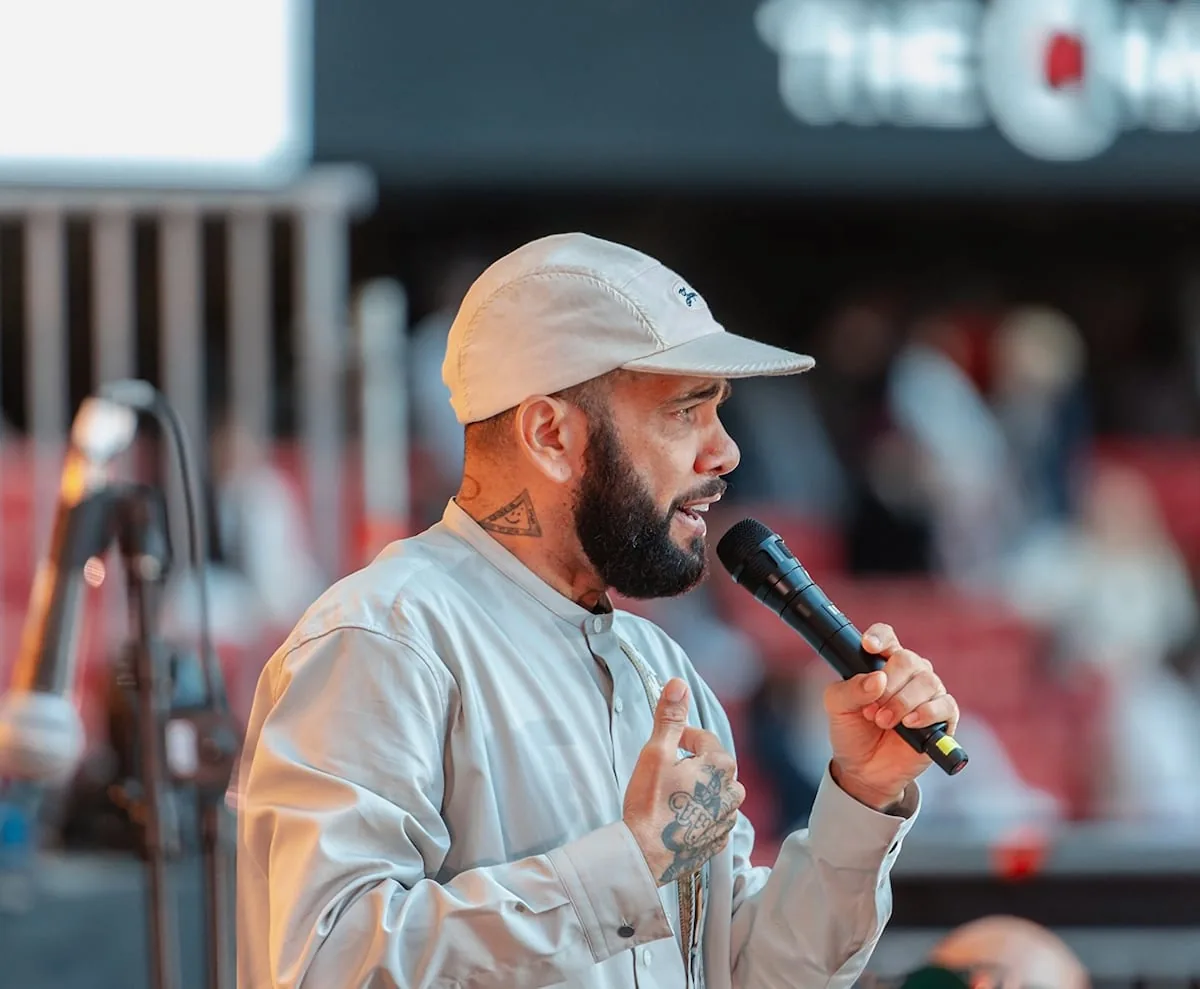
The phenomenon already moves stadium-sized numbers. This Saturday, about 35,000 people attended the Christian event The Change Madrid 2026, held at the Riyadh Air Metropolitano stadium. The organization presented it as one of the largest contemporary Christian gatherings in Europe. Admission was free, although prior registration online was required. Among lights, music, and testimonies, one of the most viral moments was the appearance of former footballer Dani Alves, accused of sexual assault on a woman in a nightclub. Alves was acquitted by the Superior Court of Justice of Catalonia in March 2025.
The former player took the stage to talk about his religious conversion after his time in prison. “I am here to say that today Christ will break these prisons, tear down these walls, and break these chains,” he said before thousands of attendees. “I was in jail for 14 months, but in jail Christ made me free.” During his speech, he insisted on the idea of personal rebirth through faith: “I have lost everything, but by losing everything I found Jesus.”
View this post on Instagram
The event’s aesthetic — giant screens, live music, emotional speeches, and audiovisual production — resembled more a concert than a traditional service. And that is precisely one of the keys to the expansion of these churches: their ability to adapt religious language to massive and contemporary formats. “Rental costs are included in private agreements signed between our Operations team and each promoter. More than 250 events are held in our stadium every year, and we do not share that information about any of them,” a stadium spokesperson assured.
In Spain, political connections are also beginning to become visible. In 2023, the Popular Party intensified its contacts with evangelical leaders seeking the Latin American vote. One of the most visible figures is Colombian pastor Yadira Maestre, known for her massive services in Fuenlabrada. At various public events, she has given recognitions to regional president Isabel Díaz Ayuso and mayor José Luis Martínez-Almeida, as well as lending her temple for political campaigns and signature collections.
Kenny Clewett, co-director of a global migration initiative and former evangelical pastor, knows the phenomenon from within. He maintains that the growth of these churches responds both to the need for community and to dynamics of social exclusion: “Many migrants arrive alone, without family networks, without contacts, and with precarious jobs. The church gives them immediate belonging,” he explains by phone. However, he warns of the risks: “There are congregations where power is very concentrated and where vulnerable people end up depending emotionally and economically on the religious leader.”
He adds that some structures use promises of healing, prosperity, or miracles as a recruitment mechanism. “Not everyone comes looking for religion. Many come looking for company, help, or someone to listen to them.”
Luis Santamaría del Río, researcher at the Ibero-American Network for the Study of Sects and author of the book On the Outskirts of the Cross, points out that the growth of evangelical churches in Madrid is mainly due to the increase in the immigrant population (mainly Latin American, but also African and Asian), in which neo-Pentecostalism has great attraction power. “This is due to its ability to connect with the especially vulnerable population at risk of social exclusion, thanks to its highly emotional services (music and great gesturality), its insistence on the supernatural action of God (miracles, healings, and exorcisms), which breaks the monotony of a gray ordinary life and, in some cases, its ‘prosperity theology,’ which is the belief that God blesses (also with wealth and success in this life) those who follow his commandments and, above all, are generous financially with their churches and pastors.”
Another element explaining its rise, according to Santamaría, is the overwhelming charismatic leadership of many of its leaders, who present themselves as “super pastors” who draw the masses with skillful preaching that combines the Bible and marketing to touch the hearts of their listeners, leaving aside rationality and falling into fanatic attitudes.
The growth of evangelism in Madrid has been discreet, but it is increasingly difficult to ignore. Last year, about 10,000 people filled the Vistalegre bullring to hear Brazilian preacher Edir Macedo, founder of the Universal Church of the Kingdom of God, in an event marked by testimonies, promises of healings, and live music. Now temples no longer only occupy commercial premises in peripheral neighborhoods. They also fill stadiums.
Read more Feijóo attacks Montero: “The minister of scams must be sent to Madrid”