









The first thing Loui Ridi did this Monday, after arriving from Toledo (Ohio, USA) at his family’s besieged home in the West Bank village of Qusra, was to hang a large US flag in plain sight, to remind that — although he is Palestinian and Muslim — he is also as much a US citizen as anyone else. And to pressure his country, Israel’s main ally, to put an end to an almost surreal situation: ten inhabitants of Qusra have been locked inside their own homes for ten days, unable to leave. First, they were surrounded by radical Israeli settlers, who cut off their water and electricity, and then — only when Washington intervened — Israel deployed soldiers in the area, supposedly to protect the local population. The result today is that the most powerful army in the Middle East has still not prevented a handful of radical settlers from roaming the area (as happened this Tuesday, when one confronted Ridi), while the inhabitants of the besieged houses cannot even go out to shop and last received food from a UN team, which was granted special permission to do so. “I am in a prison in my own home. That is how I feel now,” says Ridi.
Read more Isla Cristina, between fear and dismay after the triple homicide: “This is not our town”
The army has declared the hill on which the three besieged houses stand a “closed military zone.” They are on the outskirts of the town, with 8,000 inhabitants and located in northern West Bank, one of the areas where radical settlers have focused their efforts (even more unleashed in recent months ahead of the elections) to seize land, expel Palestinians, and impose their law.

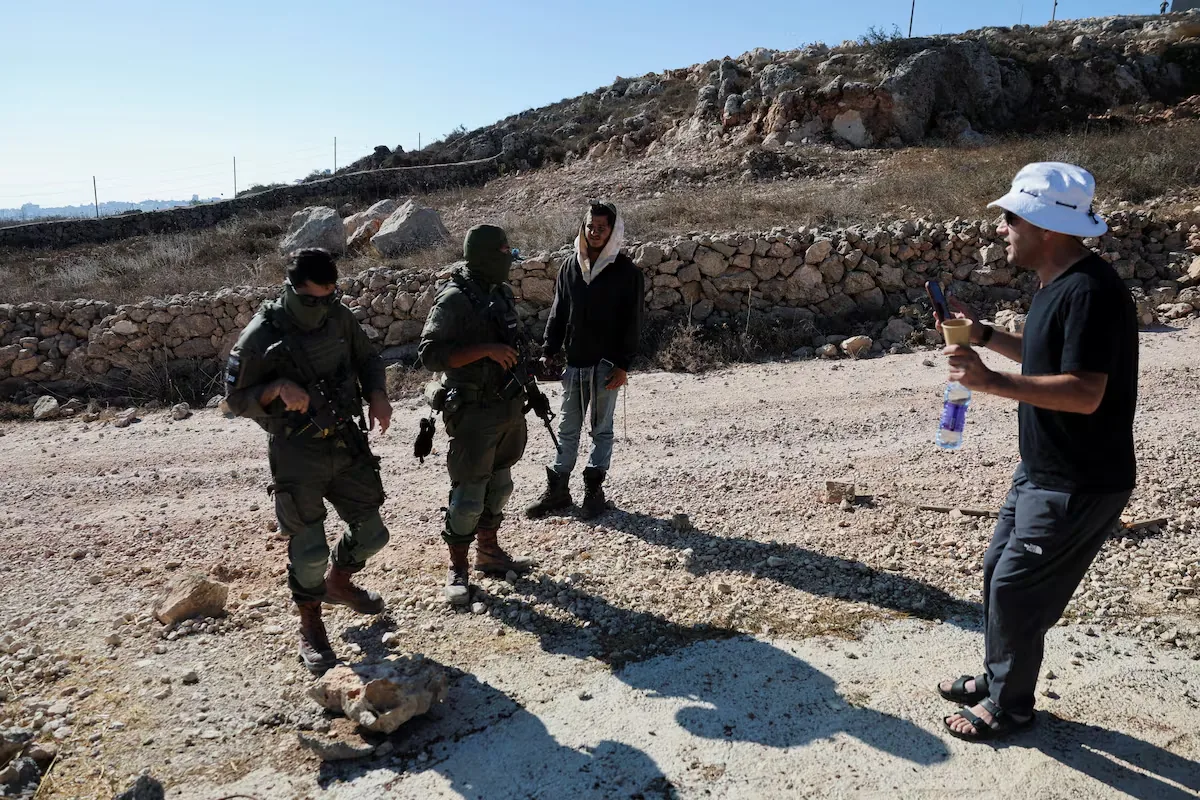
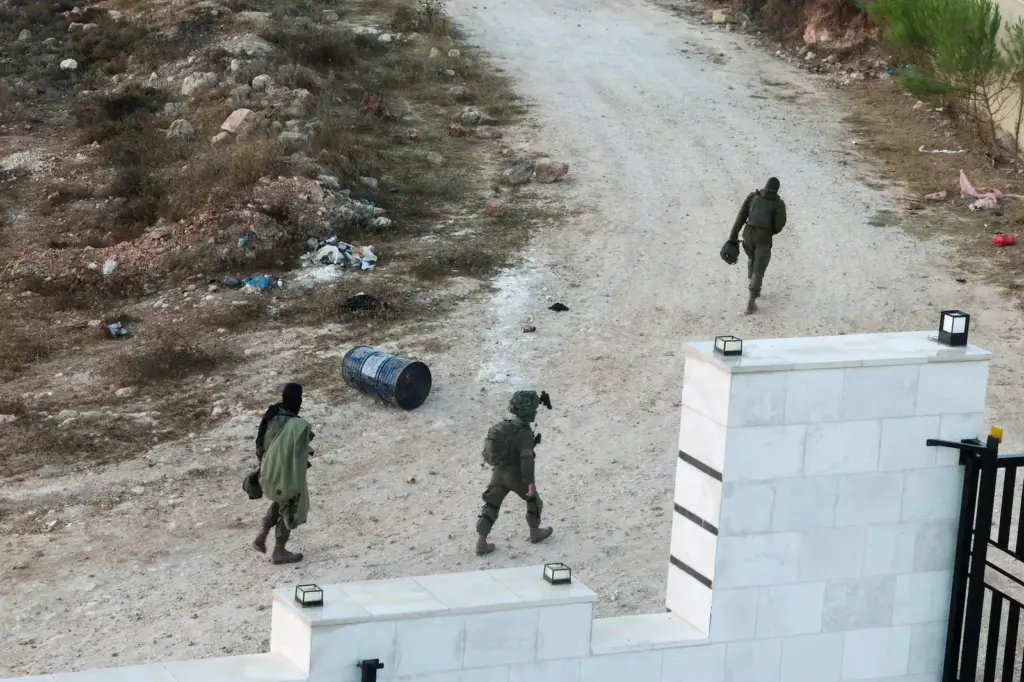
The declaration of “closed military zone” means civilians are prohibited from entering, but the settlers (with unprecedented influence in Benjamin Netanyahu’s coalition) have remained there for ten days, six since the army took positions in several of the houses. The troops have limited themselves to removing structures erected by the settlers, such as the one where they camped in front of the houses, initiating the siege of the families.
The order is, however, serving to prevent access to activists and journalists, who are forced to follow the situation from the other side of the valley. That is why the conversation with Ridi takes place exactly like this, despite being just a few minutes away by car: by video call and seeing from afar both his house and the soldiers standing guard just meters away.
The Palestinian-American, 46 years old, arrived in Qusra Monday night after flying from Detroit. In theory, no one can enter or leave the besieged area, but Ridi mobilized his Embassy and US congressmen, and obtained the green light from the Israeli Armed Forces to return to the family home. If he has momentarily exchanged his comfortable life in the US for a forced lockdown in the house where he grew up in Palestine, it is out of fear that the settlers will take over his property. “I was terrified to see live [from the US] what was happening, through the security cameras, while my brother was under siege. And it is even more terrifying to now leave my wife and two daughters there fearing for my life,” he says.
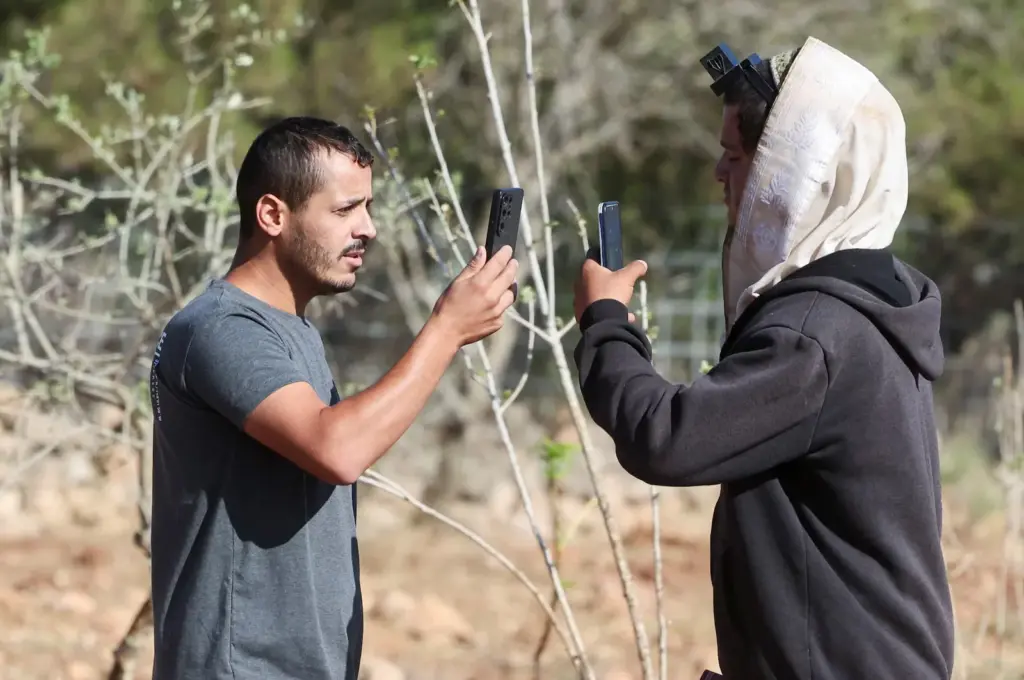
On Tuesday morning, he says, he decided for the first time to leave his house and take a walk among his cherry and fig trees. A settler passed by from the hill and they got into a verbal dispute. In the video of the moment, captured by Reuters, they can be seen facing each other and recording. Ridi says to him: “You are a terrorist settler” and the other replies in Hebrew: “This one came to cause trouble.”
Ridi speaks from accumulated anger thousands of kilometers away; the settler, from the calm of someone who has the authorities on his side. “You are trash, do you know what that means? You stink. Move, don’t touch me, terrorist,” the Palestinian insults him. Then the settler is seen talking to the soldiers and asking them to expel him: “Get him out of the house.” Ridi then insists to the military that he only moved on his own land, not a meter beyond. They urge him to lock himself back inside the house: “They [the settlers] will leave; you, stay inside.”
“We argued for about 10 or 20 minutes,” he recalls to this newspaper. “I told [the soldiers] that this is my land, my property and that I was not leaving, that their job here is to get him [the settler] out. Why can they still walk freely? That is something I still have no answer for.”
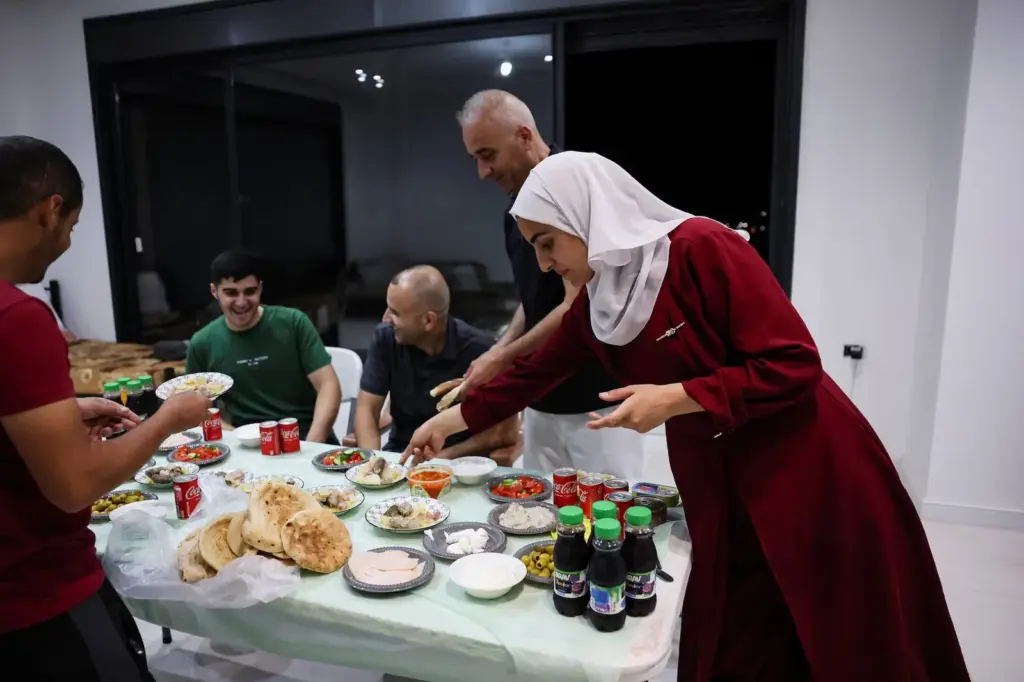
Currently, seven people live in his house, after taking in his neighbor, Yusef Hasan, his wife, and their two daughters aged two and four, whose house was first surrounded by settlers and then taken over by the military. That is why he feels the situation has worsened with the military operation. “Now, the Israeli army is in front of my house and behind my house, and yet it is not able to move the settlers, who walk around without them doing anything. So it is not something that is helping.”
Forbidden windows
Right now, only two of the besieged houses are inhabited: Ridi’s and the one where Aisha Hamdan, 35, is locked in with her mother and brother. By phone and with a tone between anger and exhaustion, she recounts that her house practically touches the adjacent one taken by the soldiers and that they have been forbidden to approach the windows facing them. “Once we tried to open the door to go out and clean and they sent us back inside. After that, we have not tried again,” she laments.
Read more Minors who did not want to be moved to the Peninsula: “I already had half my life made in Tenerife”
Hamdan gives meaning to her presence despite the pressure: “If I leave this house, I lose it. And where would I go? They will keep the house, but they will not stop there. They will go to the one below and do the same, then to the one behind and the next. They will not be satisfied with ours. They will advance little by little and take control of as many as they can. The number does not matter to them. What matters is taking control.”
Qusra is in the so-called Area B of the occupied West Bank, according to the division established in the Oslo Accords (1993) that Israel has been blurring with its de facto annexation policy. In Area B, security is in Israel’s hands and administrative responsibility lies with the Palestinian Authority, and it is where violent settlers have set their sights, after forcing the displacement of thousands of Palestinians in Area C, where dozens of settlements stand and Israel controls everything.
“As a municipality, our role must be humanitarian and oriented to providing services. Electricity, water, that children can go to school and families to supermarkets, safely and freely. But in the last ten days we have felt deeply powerless. As if we have failed them, because this is a siege and, as mayor, I cannot break it alone […] We need diplomatic intervention,” says the head of Qusra’s municipal council, Abdul Azim Wadi.
Delegations
The siege has gained as much international attention as it has shown a lack of will or power to lift it. During the day, three delegations arrive. The first is from the Ministry of Social Security of the Palestinian National Authority. The second is led by Michel Rentenaar, the diplomatic representative of the Netherlands to the PNA. The third, from the NGO Physicians for Human Rights – Israel. All three resign themselves to seeing the situation from afar, from a height where it is hard to distinguish figures without a telephoto lens.
Abdul Karim Hassan, 63, also looks from inside his car, but with a different feeling. He has a wife and three children divided between the two besieged houses, which he cannot reach. “It is very difficult because I used to be there before dawn to work my land. I was there every day and now I can only look there. It is not just that I cannot do anything, it is that the whole world does not know what to do with Israeli terrorism,” he protests.
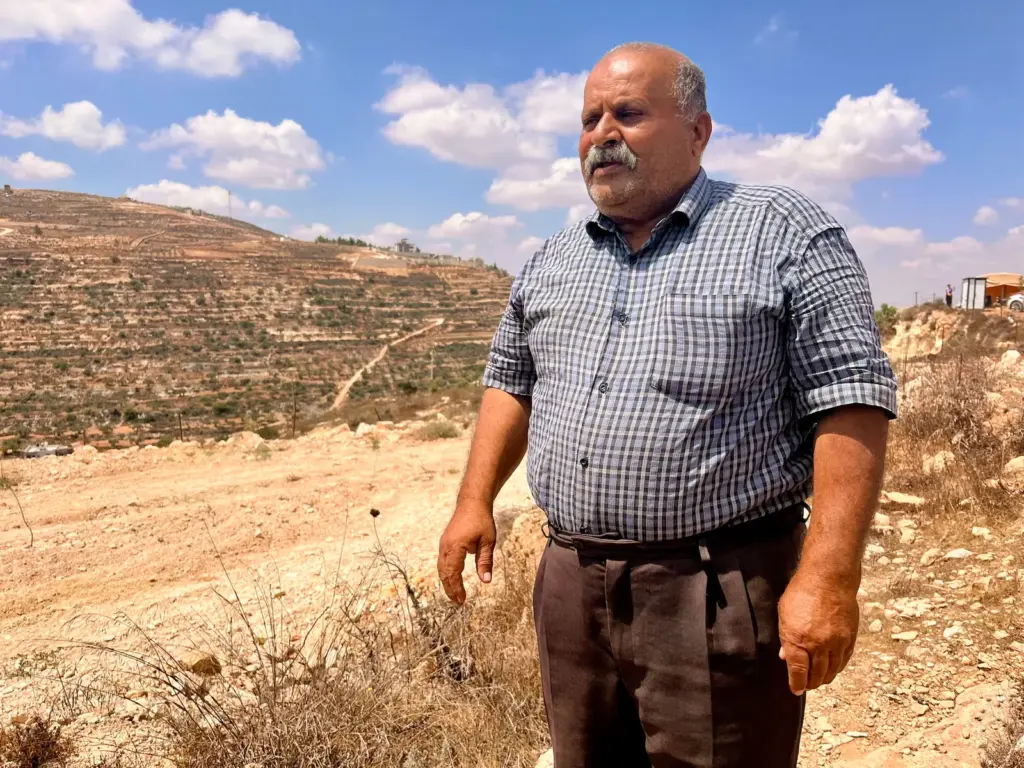
Hassan says he tried to enter on foot during the first two days of the siege, but settlers prevented him, blocking the roads. “It is a closed military zone… Closed to Palestinians, of course. Two minutes ago, a settler passed by here with a tractor, made a round with the army and the army did nothing,” he sums up. “Sometimes we called the army, but the soldiers came and drank coffee with them, or joined them. They are the same.”
Hassan’s feeling is deepened by a video from the day the radical Jews erected their proto-settlement (of the type that not only international law but also Israel considers illegal) in front of the Palestinian houses. Instead of remedying it, the dispatched soldiers joined them to pray and take photos. Since October 2023, the figure of settlers mobilized as reservists has imploded. They are residents in the settlements who receive a long weapon, military authority, and a uniform, which they sometimes wear even when off duty.
The interconnection between settlers and the government of Israel’s history in which they have the greatest influence is today so undisguised that no minister has condemned the siege, including Netanyahu, despite a citizen of his great supporter, the US, being involved.
More and more Israeli flags and Stars of David populate the roads of the West Bank. These days, a sign from Finance Minister Bezalel Smotrich announces the entry into force of tax exemptions for “residents of Judea and Samaria,” that is, Jewish settlers in the West Bank. A graffiti in Arabic is directed instead at Palestinians: “There is no future.”