

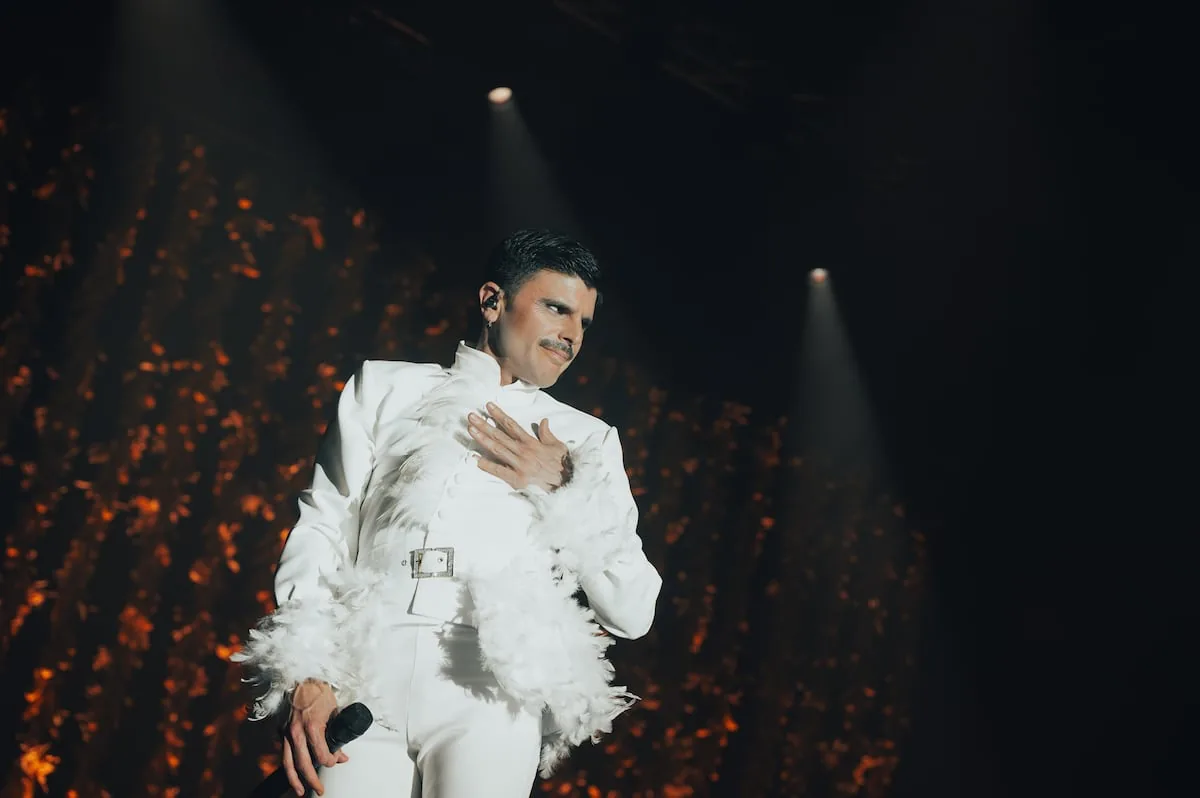
There he was, standing tall, mustache at the ready, dressed in a stylish snowy white outfit. He said he was amazed to be in such a large place, and the adjective, spurred by his gesture and tone of voice, implied without ambiguity other big things that he loves. Knowing laughter in a Sant Jordi Club with 3,600 people, a number that shows the growing popularity of Rodrigo Cuevas, a sharp Asturian. On the screens, he had been introduced by Rossy de Palma, but he no longer needs an introduction; he has rightfully become one of the renovators of popular music as well as a devoted and happy homosexual, self-proclaimed as a queer, defender of LGTBIQ+ rights, and a source of irony, humor, and boldness. In two hours, he demonstrated his ability to spread happiness and, leading his cabaret, defined by the stage aesthetics, made laughter, double meanings, and music an unbeatable script.
Read more Iran sends its response to the US peace proposal while renewing its threats in the Strait of Hormuz
He said right away with that sensual tone that characterizes him, libidinous and ironic, that although the sociopolitical situation worried him, he wanted to leave aside the claim of “things we already overcame in first grade of EGB, we are already in sixth.” In other words, he himself is the claim, without the need for obviousness, without resorting to slogans, his existence endorses it. Also, the lyrics are enough, as he sang in the first song Un mundo feliz, where “the bouncers of the clubs treat you very politely, the rich don’t go to space, and everyone is queer.” He brandished his fan, large, feathered, tight pants and clogs, opening live the evocation of Manual de belleza, his latest work, with the first song of the album. And everyone was already convinced they would have a good time. And so it was.
The concert was divided into four blocks. In the first, he sang coquettishly in front of a vanity where he put on makeup while singing BLZA, or in other words, he sang to beauty. His own and everyone’s, normative or not, “the one that makes the bulge in your pants grow,” as he sings for emphasis. Already in La hermana cautiva he walked along the tongue of the stage that extended into the stalls, began to make that typical gesture of biting the air with sensual passion, like a kitten, and popular melodies hybridized with urban music beats. Beauty is also impure and in Asturcón violin strings sounded. In the second block, he sang popular folklore duly adapted in the form of electrified muñeira, which preceded the intake of cider properly poured on stage and a pasodoble, Sácame a bailar, concluding with a tribute to Rambal in acoustic format, the Gijón transformist, LGTBIQ+ symbol during Francoism and a mirror of Rodrigo himself.
Rambal was murdered by intolerance and brutality in a still unsolved crime. It has been 50 years, Rodrigo recalled evoking him in Rambalín. Before, in Xardineru, an indisputable botanical truth: “To end the aphid plague / The best thing is to always have the house full of ladybugs.”
With costume changes each more dashing than the last, the concert entered its most festive part in the third act, called Romería. If in the previous ones elegance was finished off with clogs, here it was with stiletto shoes that would have tripped any mortal, but on which Rodrigo knew how to dance with agility and style. The audience raised their arms and it really looked like a romería, a wild popular party with songs such as Veleno, Xiringüelo, Como ye or the final Más animal, where his dancers stripped him, thus marching to the dressing rooms, as he was born but with a mustache, to change before the farewell. To avoid fainting, he walked backwards alone. Laughter, celebration, and perhaps some fleeting bulge on the dance floor.
Earlier he had gotten bawdy, announcing that he was a poet, not so much a Garcilaso de la Vega as a Garcilaso de la Verga. What in others might seem crude, in Rodrigo, who complements words with gestures, smiles, and looks, comes off as charming, cheeky, and mischievous. It’s as if he was born in a cabaret, where language is not only verbal and truths are told without hurting.
After asking the audience to attend their major festivals and not to make a fool of themselves at Coachella, he launched into El día que nací yo, Una muerte real in a very pop key and left with La fiesta leaving a smile and joy stamped on the faces of those present. Rodrigo is a celebration of life born in the villages of his land, a claim poured out with humorous boldness, with the naturalness of someone who feels happy to be who they are and to share it with others. Identities never separate, it is the looks directed at them that do.
Read more Complaint against Emilio Aragón and Movistar Plus+ for plagiarism of a musical interview show