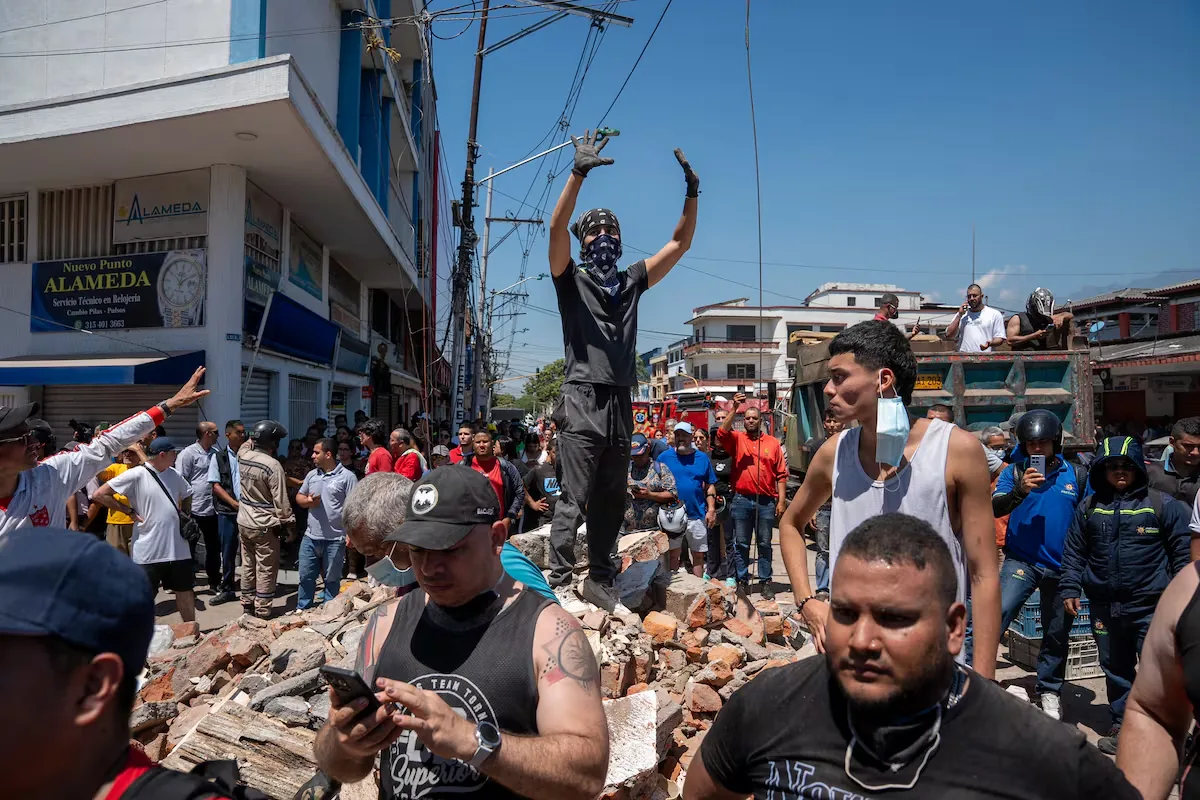
Rodrigo Alejandro León, professor in the Geosciences department at the University of Los Andes, explains the characteristics of the magnitude 7.4 earthquake that shook Colombia on Monday morning and has already left more than a hundred dead. “It occurred between 90 and 110 km deep. If it had been closer to the surface, it would have caused much more damage,” he assures. A seismologist and geologist expert in earthquakes, focused on seismic hazard assessment, he explains that a long sequence of aftershocks will come in the next months. “The public needs to prepare.”
Read more Colombia relives the trauma of the earthquake that devastated the Coffee Axis 27 years ago
Q. What is the initial assessment of the earthquake that occurred this Monday in Colombia?
A. It is one of the most severe earthquakes in the last 50 years in the country. Authorities report at least 111 dead in the first hours. And the number will keep rising.
Q. How was the earthquake?
A. It was a seismic event generated inside the Nazca plate, which is beneath the South American plate. It was not a collision between two plates, it was a detachment. This is what differentiates it from the earthquake in Venezuela last month and causes the earthquake to be very deep, with the ability to be felt on the surface over a fairly large area, but at the same time so deep that the energy was attenuated and diminished upon reaching the surface.
Q. What does this mean?
A. It means that, within the context, although there is already a lot of material damage and many human losses, it is the best scenario we could have. If we had had an earthquake of similar magnitudes on shallow faults, closer to the surface, the damage would have been much more severe.
Q. At what depth was this earthquake?
A. It occurred between 90 and 110 km deep, which is quite deep inside the earth. Other earthquakes like the one in Japan or Chile, much more lethal, occurred between 20 and 60 kilometers deep.
Q. Will there be aftershocks?
A. After an earthquake of this magnitude, we can expect a fairly long sequence of aftershocks over time, even during the next six months. Although it is not set in stone, by analyzing seismic catalogs we can say that, after a 7.4 earthquake, the strongest aftershocks can be around magnitude 6 or 5.5.
Q. What should citizens do?
A. The population should follow the recommendations of official channels, both from the Colombian Geological Service and the National Unit for Disaster Risk Management. Also, remain calm during the sequence of aftershocks.
Q. Do the aftershocks repeat the epicenter of the first earthquake?
A. Each earthquake occurs in a rupture area of several tens or hundreds of kilometers. The aftershock sequences occur over that initial rupture plane and at its edges. So they are spatially related earthquakes to the main one.
Q. How can citizens prepare for the aftershocks?
A. This phenomenon can occur at any time, so they should establish meeting places with family members. Also, have a basic kit with documents, non-perishable food, water, flashlight, anything that can help in a possible building collapse.
Q. How can people protect themselves during the earthquake? Is the so-called triangle of life useful?
A. Rescuers have already realized that the famous triangle does not work much. What you have to do is try to protect your head and, above all, try to avoid something falling on you. Hold on to any heavy furniture and wait for the earthquake to pass.
Q. Should evacuation be after the earthquake has ended?
A. Yes, once it has passed, we can start evacuating houses and buildings in an orderly manner. It is recommended to evacuate using the stairs and not the elevator. Once outside, wait a reasonable time until damage to the building is ruled out. If you live on the 20th floor, I would recommend waiting there.
Q. Is Colombia prepared for events like this in terms of infrastructure and public policy?
A. The last update to the building codes was in 2000, right after the Coffee Axis earthquake. So, buildings constructed since then in Cali, Pereira, or Armenia, the structures should be able to withstand this type of event. But the seismic phenomenon always reminds us that there are some parts we are not considering in the hazard models. Surely after this event we will be able to discuss what things need to be improved.