

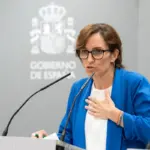







The Minister of Youth and Childhood, Sira Rego (52 years old, Valencia), apologized this Tuesday at the press conference after the Council of Ministers to all the boys and girls who have not been heard. “For years, their word has somehow been doubted and protective mothers have been singled out and criminalized,” she said. She had just presented the updates in the draft bill that modifies the law on the protection of children and adolescents against violence (Lopivi), which will continue to be worked on before it can go to Congress for parliamentary processing.
Read more United States and Iran each claim dominance over Hormuz
Among the changes it promotes is the strengthening of the obligation to hear minors in all procedures that concern them regardless of their age and the express prohibition of the so-called parental alienation syndrome (PAS), by which it is assumed that one parent, usually the mother, manipulates the children against the other. Rego meets with EL PAÍS at the ministry headquarters. “There is a huge debt to childhood,” admits the minister, who sees in this law an opportunity to safeguard the rights of children and adolescents and promote a “culture of good treatment.” In a country where three out of ten young people have suffered sexual violence during childhood; four out of ten, physical violence and almost half, psychological, she considers it essential “to bring into the public debate” something that “historically remained in the private sphere.”
Question. What is the core of this reform?
Answer. The right to be heard is very important, because we are going to be one of the first countries to end this age limit [now the law says that the minor will be heard when they have sufficient maturity and, in any case, when they are over 12, something that is removed with the reform]. With guarantees, with a series of procedures and obligations to investigate in case there is testimony of alleged violence. And correctly defining what the best interest of the minor implies is very important, because to the extent that we require that any action that guarantees the well-being of boys and girls be previously accredited by the best interest of the child, many aspects that were problematic until now are unlocked.
Q. For example?
A. We break the automatic nature of joint custody or visitation rights. In the end, what we propose is that there must be the right to be heard and the best interest of the minor must be accredited, which no longer remains as an arbitrary formula of subjective consideration by whoever is evaluating the situation, but it is specifically defined what it is. There we provide many guarantees. In addition, we make a radical change in training for all professionals who work with boys and girls at all levels, with a master plan that will be worked on in coordination with the autonomous communities.
Q. The use of parental alienation syndrome is also prohibited.
A. We are going to be the first country in the world to specifically eliminate by law the use of PAS, the false parental alienation syndrome, or any pseudotheory. There are fundamental issues that are very dramatic in custody cases, especially in situations of vicarious violence. First, that boys and girls are not heard because there is a limit to doing so. Second, the consideration of the best interest of the child, which is an almost more subjective than objective matter. Now we objectify it. And third, the application of parental alienation syndrome. These three elements together are causing so many rulings that are so burdensome for boys and girls. And what we do is, through the law, reformulate all that to avoid situations of institutional violence.
Q. They establish that if a child does not want visits with their father or mother, the causes must be investigated and it must be ensured that they take place safely.
A. First, the child must be heard with a series of procedural guarantees. Second, it must be investigated. And third, visits must be given safely. And then another thing: we propose a pioneering modification as well. For the first time, the boy or girl is recognized as a victim of gender violence, automatically [their accreditation is done together with that of their mother]. When a woman is recognized as a victim of violence, there does not have to be a sentence, it can be beforehand. The same status, the same coverage, applies to her children. Therefore, this makes it difficult to grant custody to an alleged gender violence aggressor.
Q. Are minors adequately protected in cases of family breakup?
A. There is still a huge debt and we have to make an effort as a society to adapt all our administrative and judicial structures to the childhood perspective. We are encountering many rulings and very painful cases. Many cases come to mind, some very well known, in which very painful situations have been seen, precisely because listening to the minor was not mandatory or because the best interest of the child was considered, although we did not know exactly based on what criteria it was done. Or even custody of children has been given to abusive men with a final ruling. And this cannot be. Abuse, the abuser, is dissociated from the right they have or the alleged right they have to have contact with their son or daughter. And the law has a very clear orientation, which is that an abuser cannot be a good father, and from there we also establish a series of criteria in the law itself.

Q. However, everything related to visits and parental authority, in cases where there are indications or open proceedings for gender violence, is not included in this law.
A. It will be included and worked on in the vicarious violence law, which is being processed at the same time.
Q. There was quite a notable clash between your ministry and Justice and Equality just a few months ago. Is there consensus to ban visits without exceptions, as you wanted?
A. We are working on the final drafting, closing the details. But it is true that through Lopivi, we set a series of requirements: if the boy or girl has the same protection and consideration as the mother as a victim of violence, if the judicial procedure must take their testimony into account and must investigate possible violence, if PAS is eradicated… This places us on a different screen when proposing custody or visitation rights with alleged aggressors. The best interest of the child is above pre-established bonds. That is, protecting the child is a priority and this is the order of precedence we place in the law. Therefore, everything makes the process and the procedure itself very guarantee-based and, obviously, separates a child from their alleged aggressor. Also in visitation and custody arrangements.
Q. But is it already agreed with the Ministry of Justice that it will be stated as such, without any exceptions in the law?
A. We are working to have it stated without exceptions.
Q. Another point you said was important to include was a definition of institutional violence. It is not included in the current draft.
A. We talk about due diligence and what we do is develop the entire framework that guarantees that institutional violence is avoided, which is ruled out. PAS is eradicated, children must be heard, and due diligence is established, which is a way to develop what we mean by good practice and legal guarantees for minors. Therefore, everything is fully included, although the word is not used semantically.
Q. And another point you have insisted on is the prohibition of attendance and participation in events with violence against animals. Is there consensus with the PSOE?
A. This law has gone through the first round [to the Council of Ministers], which is the starting point, and there are some aspects still being negotiated. There is a disparity of criteria within the Government here. I am in favor of including exposure to violence against animals within the law as a specific form of violence, as also pointed out by the United Nations Committee on the Rights of the Child. Given the times we are in, it was important that [the reform] went to the Council of Ministers as soon as possible, to enter in time and form within the legislature and be able to resolve it. But we will continue working between the first and second rounds.
Q. In the first draft of Lopivi, the creation of specialized courts for violence against children was mandated. Right now there are only four sections in the whole country. How can progress in gender violence be so slow?
A. We have several challenges in this country. The justice efficiency law already contemplates the creation of childhood sections in all courts. I think we have to keep pushing for it to become a reality. This depends on each territory, but we do believe that the requirements set by this law, some aspects of adapting the justice perspective on childhood that remained to be finalized, push for the sections to become an increasingly greater reality in our country.