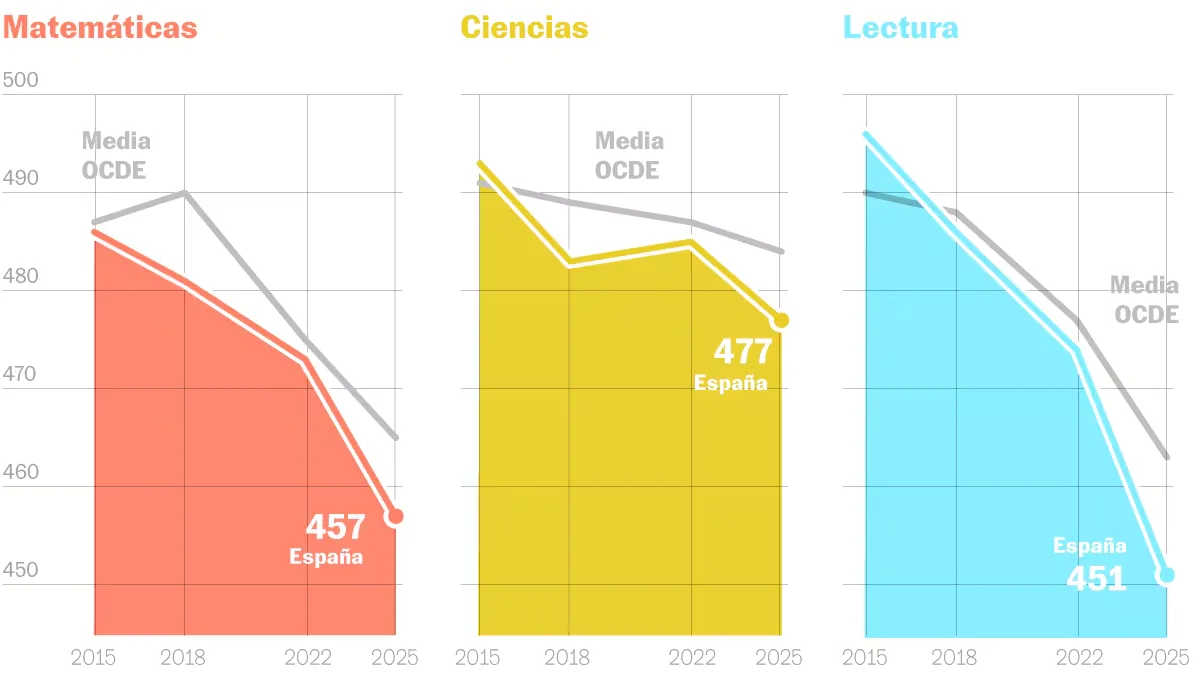
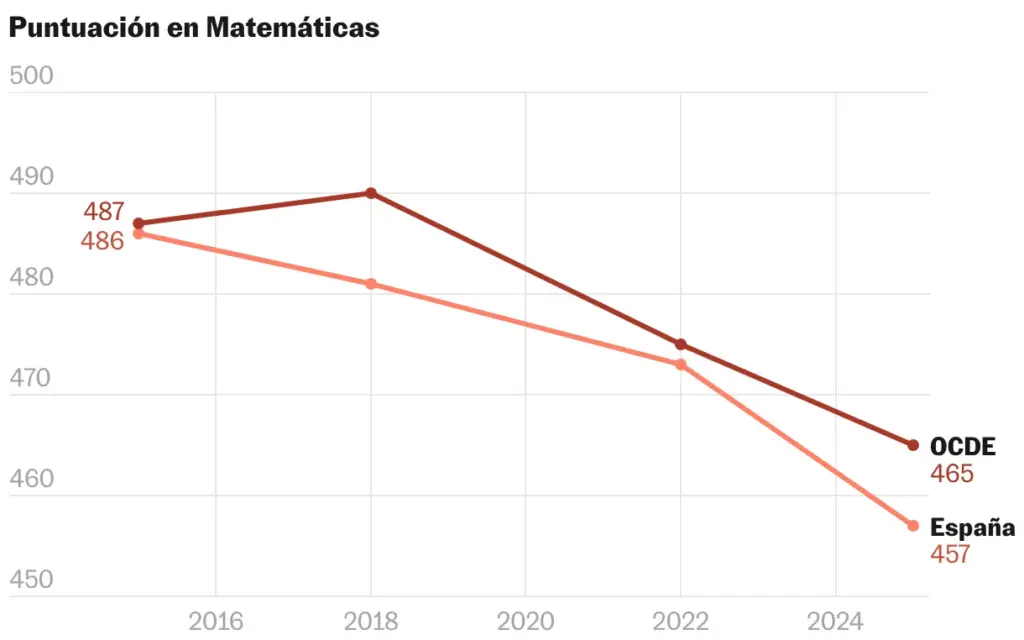
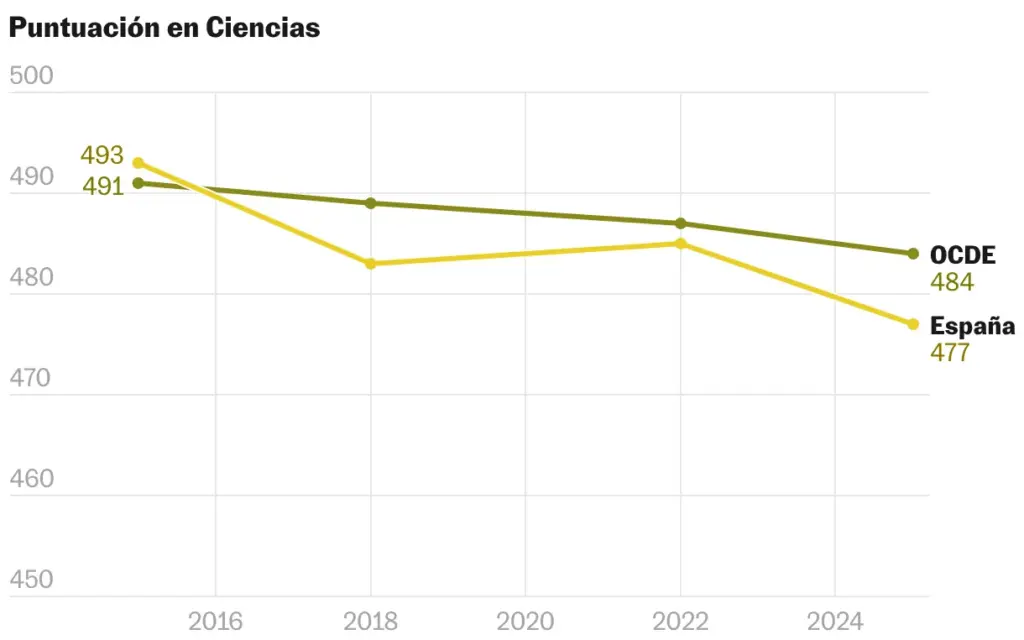
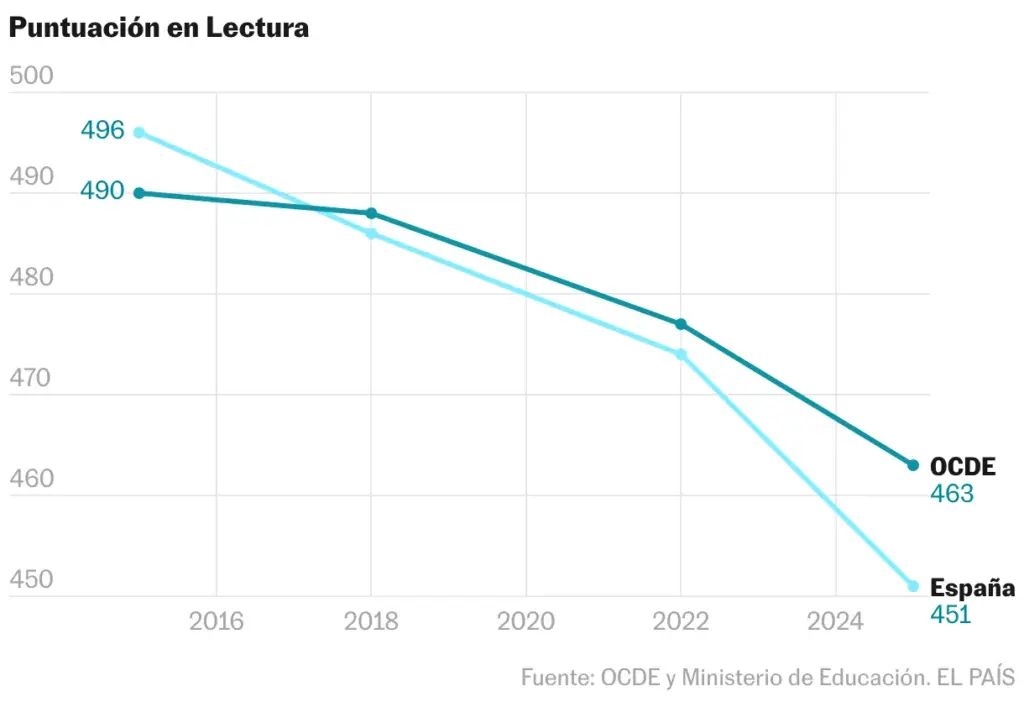
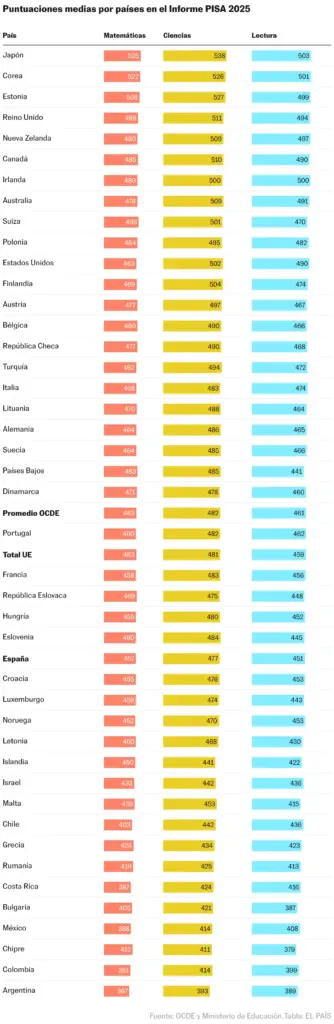
Spain’s educational results plummet in the PISA Report, the major international assessment involving 760,000 students aged 15 and 16 from 90 countries (30,000 of them Spanish), which was published this Tuesday. The OECD, the institution made up of wealthy countries that organizes the test, estimates that 20 points on the exam roughly equate to one school year. And Spain loses compared to the previous edition, from 2022, 23 points in reading comprehension, 16 in mathematics, and 8 in science, the three core PISA subjects. The country’s results are at their lowest level since the test began to be published in 2000. Spanish students’ scores stand at 451 in reading, 457 in mathematics, and 477 in science, moving away from the average of developed countries, which is 461, 463, and 482 respectively.
Read more ‘Star Trek’ aims to restore optimism to its future after 60 years of traveling through space
After the publication of the previous edition’s results, also very poor, in December 2023, the Government announced an ambitious plan to strengthen reading and mathematics that it has been unable to implement due to its inability to approve the General State Budgets. Teacher protests against the autonomous communities, which hold most educational powers, for not allocating more resources to the education system to compensate for the increase in diversity, have also continued in recent years and are one of the driving forces behind the strikes called at the start of the school year in Catalonia, Madrid, and Andalusia.
Almost half of the principals (49%) of the schools where Spanish students took the PISA exam state that they have a teacher deficit, 10 points higher than the OECD average. Regarding support staff, the proportion of Spanish principals who consider them insufficient rises to 72%, compared to the 39% average in developed countries. Among these professionals are those that teachers consider necessary to address the increase in diversity in schools, such as special educators, social workers, psychologists, and healthcare workers.
The educational collapse is not, however, only Spain’s problem, although it is one of the countries most affected, but has a global reach—including Asian countries like Singapore, Japan, and Korea, which continue to top the test—leading the OECD to sound the alarm over a “continuous decline” in results over the past decade. In a time of rapid development of artificial intelligence, adolescents’ classic academic skills seem to be in full retreat. The PISA authors point to several reasons based on the exams and contextual information collected by the test. Among them: a drop in reading for pleasure rates and a loss in the ability to sustain concentration, worsening discipline in classrooms, increased diversity in schools without adequate resources to handle it, and the time kids born in 2009 spend on screens, having grown up surrounded by smartphones. The OECD does not mention, however, that the students examined in this PISA edition are also children of the great financial crisis, which in countries like Spain caused a dramatic rise in poverty and deep cuts in education.
A third of Spanish students do not reach PISA level 2 in either mathematics or reading. This means they do not possess the minimum competencies to “interpret and recognize, without direct instructions, how a simple situation can be mathematically represented; for example, comparing the total distance of two alternative routes or converting prices to another currency.” Nor are they able to identify “the main idea of a moderately long text, locate information based on explicit, though sometimes complex, criteria, and reflect on the purpose of texts when explicitly instructed to do so.” The proportion of kids who do not reach this threshold has worsened significantly since the edition published three years ago. In mathematics, they represented 27% and now are 33%. And in reading, they were 24% and now are 32%. Across the OECD, the percentage of students not reaching this level has also increased and is similar to Spain’s: 35% in mathematics and 31% in reading.
At the other end, the proportion of excellent Spanish students—levels 5 and 6—is also very low: only 2% in reading and 4% in mathematics, compared to 6% and 8% respectively in the OECD.
“We self-criticize”
Abelardo de la Rosa, Secretary of State for Education, admitted at the report presentation that the results are poor. “We self-criticize. The data show that we have work to do, and they must drive us to improve public policies.” De la Rosa dismissed, in response to press questions, that the educational reform launched in 2020 with the current education law, the Lomloe, is responsible for the collapse. The senior analyst of the PISA Report, Danish Tue Hangreen, who accompanied De la Rosa at the presentation at the Ministry of Education headquarters, supported this view. “We see a similar trend in most countries. Attributing the cause to a specific regulation will not help find the solutions needed.” The Secretary of State assured that the Government will propose actions to reverse the trend and will address them with the autonomous communities at the Sectoral Education Conference.
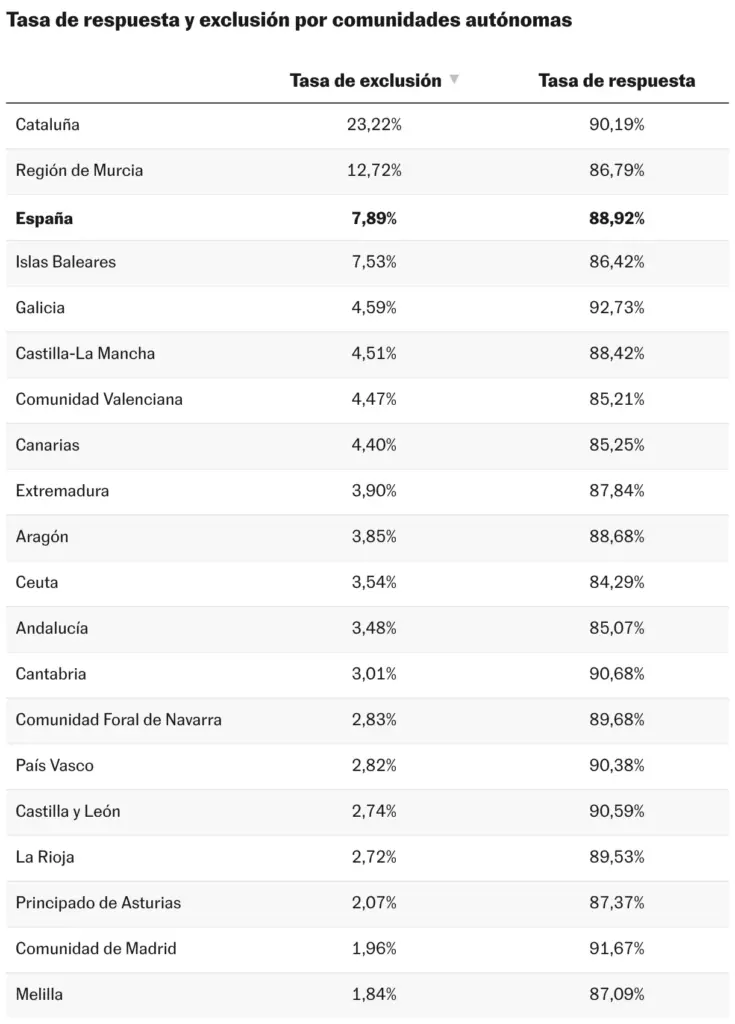
The 17 Spanish autonomous communities fall in all three competencies, except Castilla-La Mancha in science. And the declines are especially severe in the Basque Country and, above all, the Valencian Community. Catalonia’s data are not comparable because the Generalitat excluded a huge number of students who likely would have had low performance when conducting the exams. Even after excluding almost one in four initially selected students, Catalonia’s results are modest. The OECD did not even include them in the international report, as they lack value. The Spanish version of the study, published by the Ministry of Education, did include them merely for informational purposes, but separated from the other autonomous communities and warning that they are not representative.
Read more Hits and misses of Mercadona’s prepared food
The drop in results is practically universal. And it is not only focused on the West, as had happened in the two previous editions. Japan and Korea, great PISA champions, also suffer, although they remain on the podium of countries that are part of the OECD or the European Union, along with Estonia and Ireland, depending on the subject. The city-state of Singapore, which is not part of the OECD, remains first but also loses points.
Spain’s collapse ranks among the worst in the developed world and is significantly more pronounced than the OECD average, which falls 15 points in reading, 9 in mathematics, and 3 in science (standing at 461, 463, and 482 respectively), and the EU’s, 16, 11, and 3 (459, 463, and 481). This moves the country away from the convergence with both averages it achieved for the first time in the previous PISA edition, when Spain, despite the setback, withstood the educational impact of the pandemic better than its surroundings.
The magnitude of the debacle has, however, global contours. The drop recorded in reading comprehension in the OECD average is, for example, the largest in history. Japan and Germany lose 11 points in mathematics, France 16, and Sweden 18. Ireland drops 16 points in reading, the Netherlands 18, and Denmark 29. Latvia loses 26 points in science. The Nordic countries, which already had very poor results in the previous edition, are again among those losing the most points. Norway, one of the countries with the highest per capita income on the planet, and which in 2015 was at the top of the PISA ranking, is now behind Spain in mathematics and science, and only two points better in reading.
The PISA authors have been forced to dedicate a section of the report to the causes of the sustained and general decline in results over the last decade. In that period, scores have dropped 27 points in mathematics and reading in the OECD average; in Spain, they have fallen 29 and 45 points respectively. And remember: according to the report, a 20-point difference roughly equals what is learned in one school year. The damage analysis made by the authors focuses on reading competence, as it is, they say, “a fundamental learning area in itself and a basis for learning in all subjects.” Their conclusion is that the decline is the result of several simultaneous changes. “In many countries,” the report points out, students show “increasing difficulties with tasks requiring sustained concentration, a greater tendency to give hasty answers, less willingness to exert effort in school exams, and a decrease in curiosity and perseverance.” The environment and behavior in classrooms also seem to have become “more difficult, reducing the possible time for learning.”
The chapter of winners in the 2025 edition is scant. Only three countries, out of the 43 OECD or EU participants, improve their results in reading and four do so in mathematics. And only one of them does so strongly, Turkey, which rises 9 points in mathematics, 16 in reading comprehension, and 18 in science, allowing it, among other things, to surpass Spain in all competencies. The United Kingdom remains more or less stable in reading and mathematics and rises 11 points in science, consolidating its position among the top ranks.
From the group of the top 10 countries in science, compared to the 2022 results, the United Kingdom and the United States enter. In mathematics, Poland enters and Denmark leaves. And in reading, Poland also enters and Finland leaves.
Read more Influence peddling, cornerstone of the investigation against Zapatero