







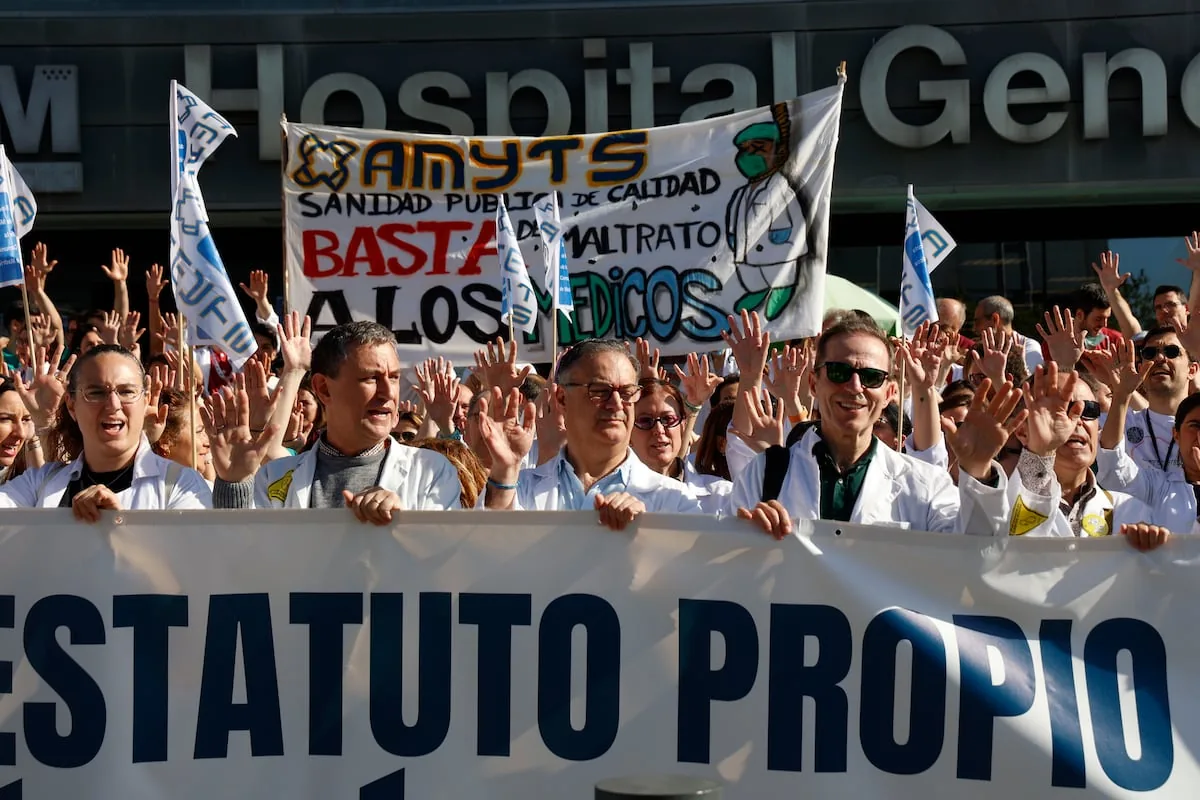
The third week of the doctors’ strike began this Monday with the lowest turnout in the monthly stoppages that started in February in protest against the Framework Statute proposed by the Ministry of Health. Andalusia, until now the community with the most support, has dropped below 20% for the first time, according to official data, which placed it at almost 25% in the first strike.
Read more Iran proposes a three-stage peace plan that leaves the nuclear issue for last
The drop is widespread in the autonomous communities that are providing their statistics. In Catalonia, turnout remains at 5.2% (one point less than in February); 7.3% in Valencia (three points less); 16.4% in Galicia (down one point); 13% in the Canary Islands (a drop of almost three points).
The convening unions, however, put the turnout between 50% and 70%. They argue that minimum services cause official figures to be lower, despite the fact that the regional ministries assure that these are already discounted from their statistics.
The conflict shows no signs of being resolved. The strike committee, formed by the Spanish Confederation of Medical Unions (CESM), the Andalusian Medical Union (SMA), Metges de Catalunya (MC), the Association of Doctors and Senior Graduates of Madrid (AMYTS), the Medical Union of Euskadi (SME), and the Independent Medical Union of Galicia (O’MEGA), has sent a letter to the President of the Government, Pedro Sánchez, asking him to “assume responsibility for the negotiation.”
After 16 days of stoppages and more than a dozen meetings, the strike committee believes that the conflict has reached a decisive point: “There will be no end without real negotiation or an effective solution. There is no turning back as long as the intention is to sustain public healthcare on permanent overexertion, structural precariousness, and the progressive deterioration of the working conditions of doctors and medical professionals.”
Their main demands include a specific statute differentiated from other healthcare professionals that recognizes them as a superior category to all others, 35-hour workweeks, reduction in on-call shifts, better remuneration for overtime hours, and that these count towards retirement.
The Ministry of Health replies that it has already granted all requests within its competence, including a reduction in on-call shifts from 24 hours to 17. But it argues that their payment is in the hands of the autonomous communities and that, by law, they cannot count towards calculating the retirement age, which for all Spanish workers is calculated based on days worked, not hours.
The Minister of Health, Mónica García, has accused the committee of crossing red lines: “A strike committee that asks me to do illegal things, or to invade other competencies, or to transgress other laws, well, I simply cannot say yes. And when someone comes to a negotiation table and sets illegal things as red lines, then they don’t want to negotiate, they want to keep the conflict alive.”
“There are some interests here that I am unaware of,” the minister denounced, considering that the strike is no longer motivated “by the demands of the professionals,” but rather that “the problem is that there are medical unions, some of them, who have decided to agree with one hand and break the agreement with the other because they prefer conflict.”
Despite the fact that the turnout is not a majority, hundreds of thousands of patients have been affected since it began. The Community of Madrid has quantified 150,000 cancelled consultations, 15,000 diagnostic tests, and about 7,000, which represents an economic impact of 11 million euros.
Read more The essential books to get to know Gonzalo Celorio, the Mexican winner of the Cervantes Prize