




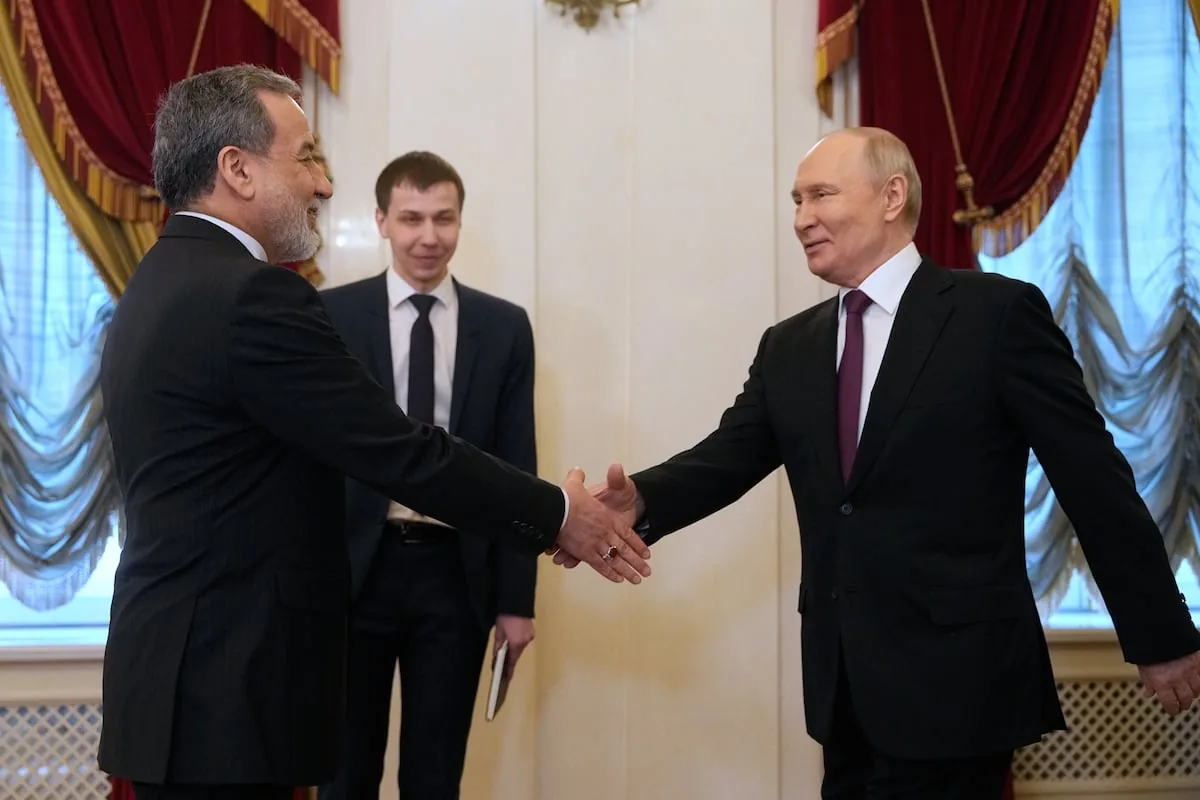
“Minab, 168”. The name of that locality in southern Iran where that number of 168 minors —almost all of them girls— perished in a US bombing of a school on the first day of the war, appeared this Monday inscribed on the plane that carried the Iranian Foreign Minister, Abbas Araghchi, to the Russian city of St. Petersburg. The symbolism and message of that inscription are what Iran has been defending since February 28: Iran is the country attacked by the United States and Israel in this war and will not give in. “The Iranian people fight with courage and heroism for their sovereignty,” Russian President Vladimir Putin told Araghchi during a meeting held this Monday. Iran proposes a three-phase plan to end the war, leaving the nuclear program issue for the end of that negotiation.
The Iranian diplomat hinted at his objectives as soon as he landed in St. Petersburg. “We want to continue the close consultations we maintain between Tehran and Moscow on regional and international issues,” Araghchi said.
The minister arrived in Moscow after an intense journey this weekend, which took him on Sunday to Islamabad, the Pakistani capital, after a brief visit to Oman on Saturday. He had traveled there after first leaving Pakistan without waiting for the arrival of envoys from the Donald Trump Administration, Steve Witkoff and Jared Kushner, who hoped to resume negotiations for a definitive cessation of hostilities with the Iranian delegation. That dialogue has been in a “no war, no peace” limbo since last Tuesday, when the US president extended the fragile ceasefire, still in force, indefinitely until Iran presents what the Republican called “a unified peace proposal.”
According to Iranian semi-official media, citing Lebanese television Al Mayadeen, also close to the Iranian regime and its network of regional allies, the Islamic Republic has already transmitted this proposal to Washington through “intermediaries,” likely alluding to Pakistan. It is a three-stage plan, the acceptance of which by Washington Iran conditions on Araghchi and Tehran’s negotiating team sitting down again to negotiate with Trump’s envoys, according to what was published by the Lebanese channel.
The American outlet Axios confirmed this Monday that Iran has presented this new proposal. Also, that nuclear negotiations are left for a final stage, according to a US official and “two knowledgeable sources” on the matter cited by this portal, which publishes a proposal whose details differ from what was disclosed by Iranian media.
According to the version of semi-official agencies of the Asian country such as Tasnim and Fars, the first phase of the three-stage plan focuses on negotiating the end of the war with guarantees to prevent attacks from resuming in the future, not only against Iran, but also against Lebanon. “In that first phase, Iran will not discuss any other matter” than that definitive cessation of hostilities, assures Tasnim, linked to the Islamic Revolutionary Guard Corps, the powerful Iranian parallel army.
“If an agreement is reached” in that first stage, “the parties will move on to the second phase,” which will be “dedicated to examining how to manage the Strait of Hormuz,” the crucial maritime route now blocked by both Iran and the United States. Nor on this issue does Iran show signs of having softened its stance. According to information cited by Iranian semi-official media, “in the phase related to the negotiation on the Strait of Hormuz, full coordination will be carried out with the Omani side to develop a new legal system for this maritime route.”
That allusion to Oman, the other riparian country of that strait, is eloquent, given that Iran plans to divide with the small sultanate the transit rights it intends to charge ships for transiting through Hormuz. These tolls are the subject of a law that the Iranian Parliament is already processing.
The discussion “of the nuclear file” will be left for the third and final phase of the negotiation, provided that Washington accepts these conditions, something that seems complicated, especially since Trump assured days ago that this issue “is the only one that matters.” The stated objective of preventing Iran from acquiring atomic weapons —a purpose that Iran denies— was one of the arguments put forward to unleash the war against the Islamic Republic on February 28. According to the Al Mayadeen channel, “Iran refuses to negotiate this matter before reaching an agreement in the first two phases.”
Read more The essential books to get to know Gonzalo Celorio, the Mexican winner of the Cervantes Prize
The nuclear negotiation has as its main stumbling blocks the US demand that Iran hand over the 440 kilos of highly enriched uranium at 60% purity that it possesses and a commitment to completely stop enrichment for a prolonged period of time. Iran is willing to a moratorium of about five years, while Washington demands that this period be extended between 10 and 20 years, according to media reports, without the parties having confirmed it.
A “revealing” itinerary
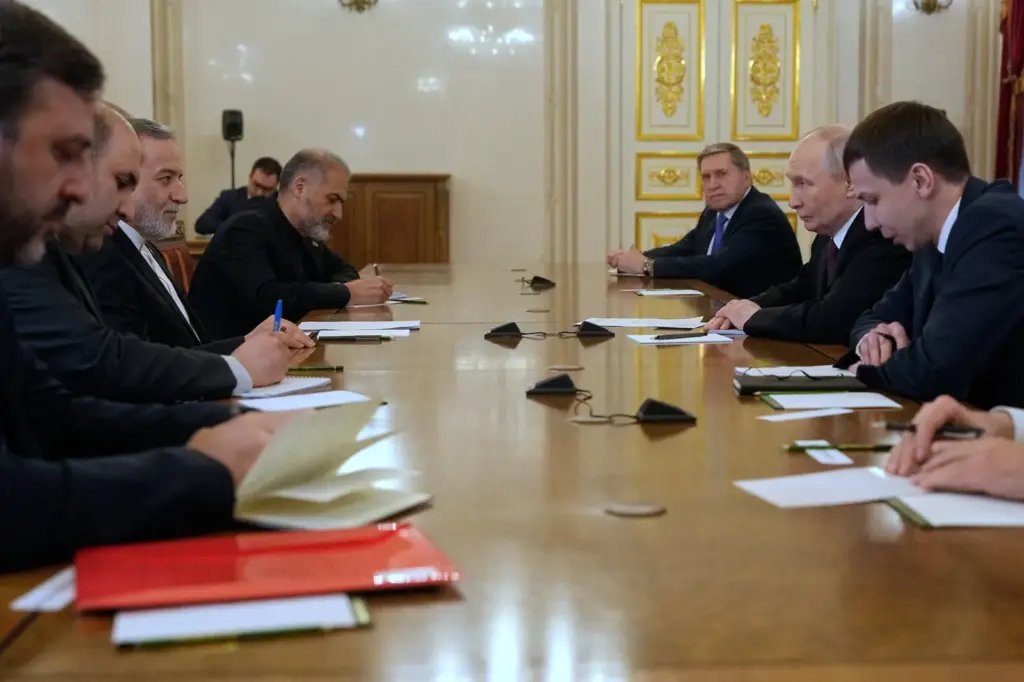
Putin received Araghchi accompanied by the head of Russian diplomacy, Sergey Lavrov, the Kremlin’s foreign policy advisor, Yuri Ushakov, and the head of military intelligence (GRU), Igor Kostiukov. The Kremlin expected to hear more details from the senior Iranian official about the peace proposal, which the head of Iranian diplomacy presented on Saturday in Islamabad to senior Pakistani officials mediating between Iran and the United States.
After his brief stay on Saturday in Oman, the Iranian Foreign Minister held a telephone call with his Saudi counterpart, Faisal bin Farhan. That conversation, notes analyst Hamidreza Azizi in his blog Irananalytica, may “be due to an attempt to involve regional actors in a peace agreement” — which is conceived from the outset as regional due to the inclusion of Lebanon — and also “within a framework for managing transit through the Strait of Hormuz,” the route through which Gulf countries export the bulk of their hydrocarbon production. This expert points out how the Foreign Minister’s itinerary of visits has “significant meaning in itself” in that regard.
“Pakistan remains the main channel for mediation, but subsequent stops point to the issues that now define the negotiations. Oman is fundamental in discussions about the future of the Strait of Hormuz and maritime access conditions, while Russia is one of the few actors with the capacity to address the nuclear issue,” he adds in the analysis published on his blog.
Russia has not only been a partner for Iran in the development of its civilian nuclear program —it was the country that completed and managed the only operational Iranian nuclear power plant, Bushehr—. Moscow is considered one of Iran’s main diplomatic supporters in the conflict.
US security services have accused Russia of supplying intelligence to Tehran in its attacks against American bases in the Middle East, a claim the Kremlin denies. In turn, Iran has provided the Russian army with vast quantities of Shahed drones in the invasion of Ukraine. On April 7, both Russia and China vetoed the adoption of a UN Security Council resolution to force Iran to reopen the Strait of Hormuz.
Moscow has a high command of nuclear technology and could collaborate with Iran if an agreement is reached to dilute the highly enriched uranium that Tehran possesses. By reducing its purity level, now 60%, that mineral would move away from the threshold necessary to manufacture nuclear weapons, which is 90%. Another possibility cited by some analysts is that Iran agrees to hand over those highly enriched uranium reserves to Russia —an ally—, instead of its enemy (the United States). Tehran has ruled out, at least publicly, that possibility, as well as renouncing uranium enrichment, something it considers a “sovereign right.”
In his meeting with the Iranian minister, the Russian president emphasized this Monday that Russia and other Middle Eastern countries “will do everything possible in Iran’s interest and for peace to be restored as soon as possible.” Araghchi handed Putin a gift from the new supreme leader, Mojtaba Khamenei, who was injured and whose whereabouts are unknown after a bombing by the United States and Israel. The Russian president sent the religious leader “his best wishes” and “all the best.”
Read more Dissidents use schools as a trench and propaganda tool