







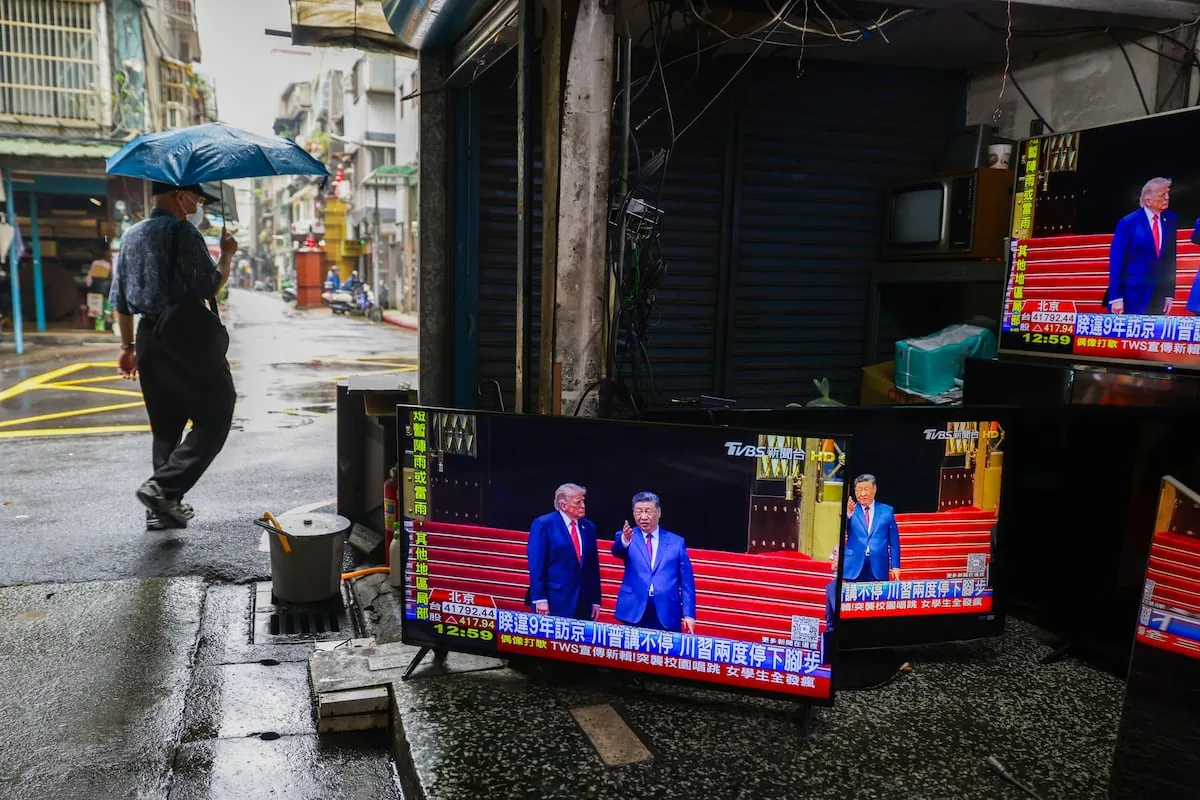
The summit held this week in Beijing between Chinese President Xi Jinping and his U.S. counterpart, Donald Trump, unfolded under a choreography designed to project good harmony. The most repeated message during the first state visit of a U.S. leader to China in nearly a decade (the previous one was made by Trump himself in 2017, during his first term) is that ties between the two largest economies on the planet must stabilize.
But beneath that veneer of cordiality, Xi laid on the table a warning that condenses the main risk of confrontation between the two superpowers: Taiwan is “the most important issue” in the relationship between Beijing and Washington, said the Chinese leader, according to the official statement released by the Xinhua agency. If mismanaged, he stressed, it could push the bilateral relationship toward an “extremely dangerous” situation and lead both countries to “clashes and even conflicts.” The U.S. reading of the meeting, however, does not mention the self-governed island.
In statements collected by CNBC, U.S. Treasury Secretary Scott Bessent said that Trump “is aware of the sensitivity” of the issue and that he will talk about Taiwan “in the coming days.” The omission during the visit illustrates how much the White House prefers to handle quietly the most explosive issue in its relationship with the Asian giant.
The “Taiwan issue” is not limited to a territorial dispute inherited from the Chinese civil war and, largely, the Cold War. Taiwan is today a democracy of about 23 million inhabitants, an indispensable node of the global technology economy, and the point where the ambition of the Chinese Communist Party intersects with the strategic interests of the United States in the Asia-Pacific.
Taiwan is an island located off the southeastern coast of China that functions as a de facto state. It has held elections since 1996, has its own political system, judiciary, currency, passport, and Armed Forces, and in 2019 became the first place in Asia to legalize same-sex marriage. Since 2016, it has been governed by the Democratic Progressive Party, which has strengthened the firmer stance against China, focused on defending sovereignty and increasing deterrence capacity.
But it only maintains formal diplomatic relations with 12 allies: Guatemala, Paraguay, Haiti, Belize, Saint Kitts and Nevis, Saint Lucia, Saint Vincent and the Grenadines, Eswatini, the Marshall Islands, Palau, Tuvalu, and the Vatican. Its international isolation is due to pressure from Beijing, which considers it an inalienable part of its territory and prevents its participation in many international organizations.
Taiwan’s diplomatic fragility contrasts with its enormous economic weight. According to data from the International Monetary Fund, it is the 22nd largest economy in the world by nominal GDP and the eighth in Asia, although its true importance lies in the critical position it occupies in the global semiconductor supply chain, a key industry for artificial intelligence, defense, automotive, and advanced electronics. Its companies concentrate more than 60% of global chip foundry revenues and more than 90% of the manufacturing of cutting-edge semiconductors, a dependence that turns any crisis in the Strait into an immediate risk for strategic sectors of the 21st century.
For the United States, this technological dependence adds to another older calculation: Taiwan occupies a key position in the so-called first island chain, the arc that goes from Japan to the Philippines and limits China’s military projection toward the Pacific. If Beijing controls the island, it would gain naval and air depth against Washington’s allies in Asia. But, at the same time, if the White House abandoned Taipei to its fate (it is its main arms supplier), its credibility would also be damaged before partners such as Japan, South Korea, the Philippines, or Australia. That is the balance Washington tries to preserve: to deter a Chinese invasion without unequivocally promising to support Taiwan militarily in case of war.
History helps to understand the juggling act. The former Formosa was for centuries a maritime contact space between indigenous communities and navigators before becoming an object of colonial dispute. The Qing dynasty incorporated it into the Chinese empire in 1683 but ceded it to Japan in 1895 after being defeated in the first Sino-Japanese war.
Read more The Amaia Montero case or why they are allowed to sing out of tune and they are not
After the Japanese surrender and the consequent end of World War II in 1945, Taiwan came to be administered by the Republic of China, then governed by the Kuomintang, the nationalist party that had led the Chinese territory since the fall of the emperor in 1912.
But when in 1949 the communist troops won the Chinese civil war, Taiwan became the refuge of the defeated. While Mao Zedong proclaimed the founding of the People’s Republic of China in Beijing, the nationalist leader Chiang Kai-shek established the government of the Republic of China in Taipei. That remains, in fact, the official name of Taiwan.
That fracture became a matter of greater scope during the Cold War, when the United States incorporated Taiwan into its strategy of containing communism in Asia. Taipei retained for years China’s seat at the United Nations and the recognition of much of the Western bloc. But the situation took a turn in 1971, when the People’s Republic took that seat at the UN. From that moment on, there was a transfer of diplomatic ties toward Beijing, which requires countries with which it establishes relations to accept the “one China” principle.
That diplomatic shift coincided with Washington’s strategic turn in the early seventies. Then U.S. President Richard Nixon and his National Security Advisor Henry Kissinger sought to approach Mao Zedong and Premier Zhou Enlai to take advantage of the split between China and the Soviet Union. In the 1972 Shanghai Communiqué, Washington “took note” of Beijing’s position that “there is only one China and Taiwan is part of it,” although it did not explicitly recognize its sovereignty over the island.
In 1979, the United States formally established bilateral relations with the People’s Republic but also approved the Taiwan Relations Act, which allows it to maintain unofficial ties with Taipei and supply it with arms. From there comes the “strategic ambiguity” that sustains the statu quo.
For China, that formulation has ceased to be sufficient. Although the Communist Party has never exercised effective authority over Taiwan, Beijing maintains that “reunification” is a “historic” mission and, although it advocates a peaceful path, it does not renounce the use of force to achieve that goal. Xi links this endeavor to the “great rejuvenation of the nation,” whose symbolic horizon is set for 2049, when the centenary of the People’s Republic will be celebrated.
Since Nancy Pelosi’s visit to Taiwan in 2022, then Speaker of the U.S. House of Representatives, China has turned military shows of force around the island into a new normal. The latest live-fire maneuvers took place in December, shortly after the Trump Administration approved the sale of a historic arms package to Taipei, which has not yet been delivered. Beijing justifies the military exercises by citing Taiwanese “separatism” and U.S. military support.