




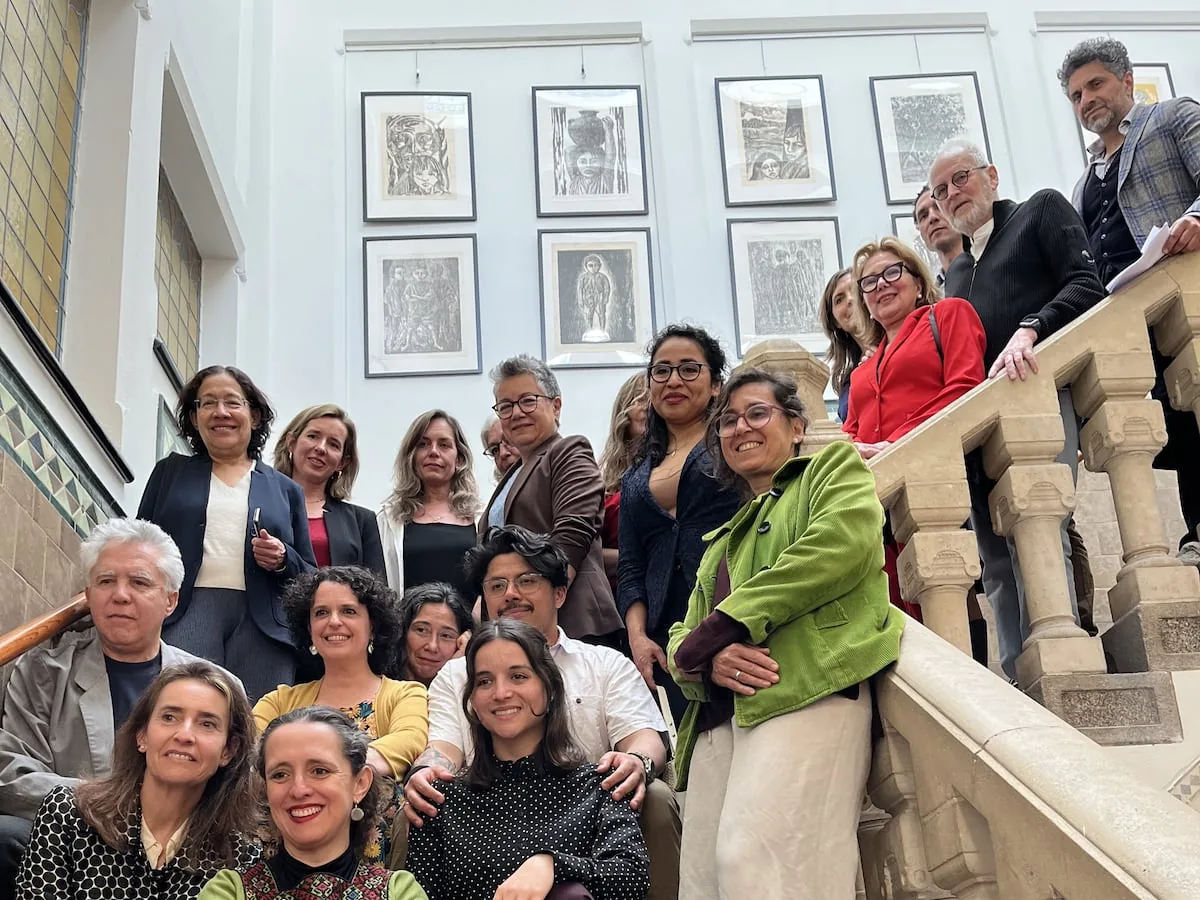
The Association of Hispanic Writers in the Netherlands, a pioneer of its kind in the Benelux, was officially presented this Wednesday at the Cervantes Institute headquarters in Utrecht. There are 26 authors of nine nationalities permanently residing in Dutch cities, who hope to give visibility to Spanish literary production. Not all of them knew each other before joining, but all are professionally dedicated to literature and have published with professional publishers. One of their tasks will be to ensure that Dutch translations of works published in Spanish are done directly. This does not always happen, as some publishers do not use the original text as a source but rather a version in another language, usually English.
Read more The other Cannes festival: the mecca of auteur cinema embraces AI
“The core of the Association is literature in Spanish, from a pan-Hispanic perspective, vocationally diverse, and trying to avoid national perspectives or viewpoints,” explains Alberto Gascón, director of the Cervantes Institute headquarters in Utrecht. The group of writers came together from the desire to have a space at the city’s International Literature Festival, for which they had to constitute themselves as their own entity. “The Spanish language unites us, and we aim to be a meeting point for those of us who are writing professionals, as well as serving as a link with Dutch culture to reach translators,” says Peruvian author Karina Miñano, president of the association. When not translated from the original text, “there can be conceptual errors, and we have seen them, and by having translators as partners, the final result would be more reliable.”
Alberto Gascón agrees that “we must unite to gain visibility, a single voice.” He points out that the new group “has the full support of the Spanish-speaking diplomatic corps.” On the other hand, he reminds us that the Dutch literary market “is clearly oriented towards the Anglo-Saxon world when it comes to international books.” Hence, in many cases, they only pay attention to works in Spanish after they have been translated into English. “And there is evidence that the trend will intensify with advances in artificial intelligence.”
In practice, English is the second language of the Dutch. And French and German continue to dominate the educational system as optional subjects, given the weight of the two neighboring countries. “The linguistic map leaves little room for a fifth language, but Spanish has been making steady progress in recent years,” according to Gascón. It does so supported by culture, geographical and demographic power, “and its growing economic power and influence as a market,” he adds.
The associated authors are originally from Uruguay, Argentina, Venezuela, Colombia, Mexico, Peru, Chile, Bolivia, as well as Spain, and have two godparents who represent the bridge between Spanish and Dutch literature. These are the writer Herman Koch, one of the most translated into Spanish, and author, among others, of The Dinner (Salamandra), translated into 33 languages. And the Spanish Amalia de Tena, who debuted in 2023 with I Give You a White Horse, a novel first published in its Dutch translation.
Next year, the association will organize its first Book Fair at the Cervantes Institute headquarters in Utrecht, and Karina Miñano says they would like to bring “the writer Rosa Montero, who has been one of the first” to support them. Their colleagues Luis García Montero —director of the Cervantes Institute— Héctor Abad Faciolince, Renato Cisneros, and Gioconda Belli have also done so, among others.
Read more Secretary Markwayne Mullin warns that funds to pay DHS employees will run out in May