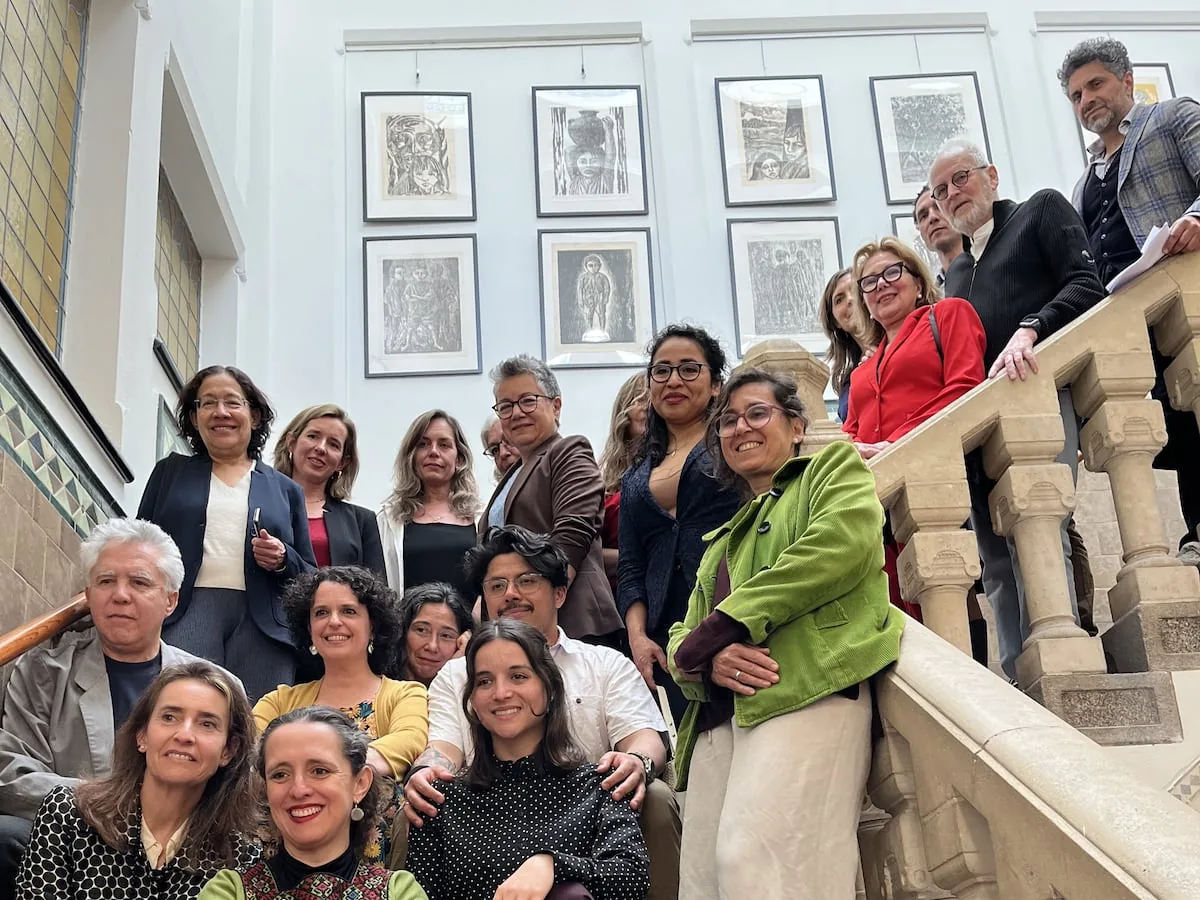









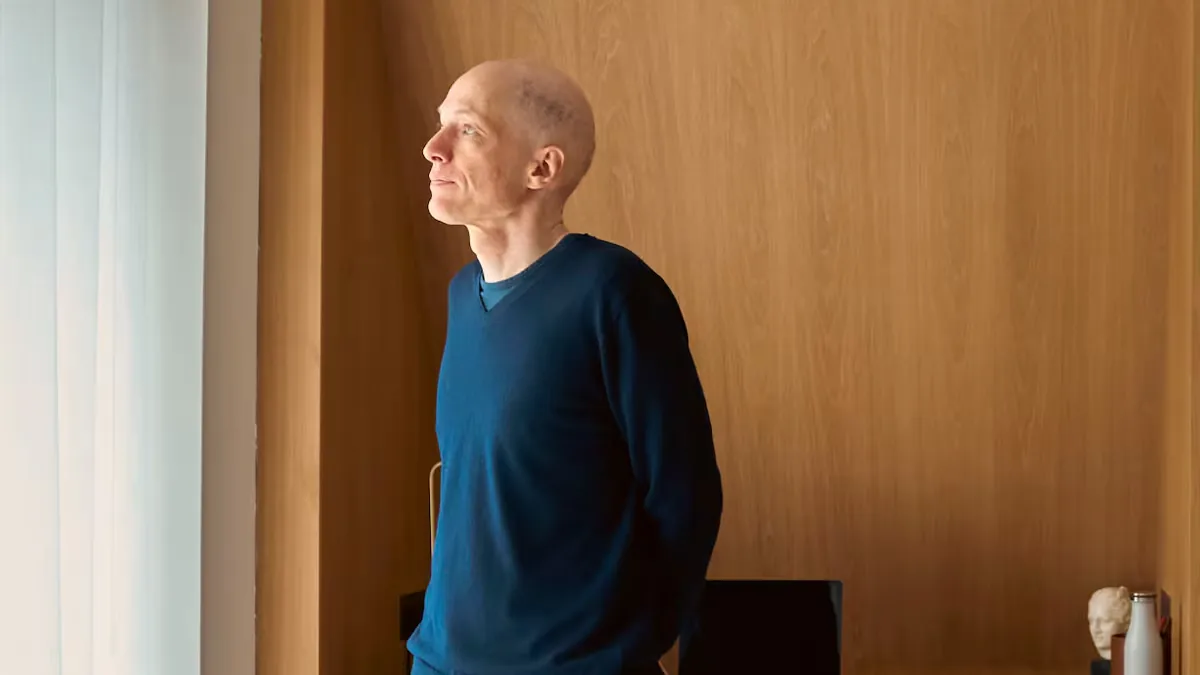
Alain de Botton (Zurich, 56 years old) is quoted by El País Semanal in a house under construction. He gives meticulous instructions to the workers with a smile. He explains that his ex-wife lives four buildings up. Both homes stand out among the Victorian houses in the London neighborhood of Camden. He says he is finishing another house in Mallorca. He fell in love with the island 15 years ago. “It will be strange to live there. I have never spent time next to a tree. But I am ready for the journey.” In the hallway there are vases with flowers. And, carved in stone, a quote from Seneca: “Why cry over things of life if life itself demands tears.” He sees me reading it and interprets it: “If your expectations are accurate you will not need to cry.”
Read more Gonzalo Boye, Puigdemont’s lawyer: “Time is against the image of justice, not against us”
Are you prepared for the worst?
No one is. But if you reach 56 years you know the ups and downs of life. That is why at this age we like flowers.
Flowers?
They speak of a moment of fullness. Young people are not satisfied with just that moment.
At 23 you sold two million copies of The Pleasure of Love. What did you know?
A 23-year-old person knows something that 56-year-olds have probably forgotten. Technical knowledge accumulates, but not emotional. Love was new, extraordinary, and intense.
Twenty-one years later you wrote The Fatigue of Love.
I learned about the perversion of love. We get into relationships that go against us. It’s the story of Adam and Eve: they are in paradise and they sour their lives.
Why?
Maybe it can only be understood through psychoanalysis. The way we love always refers to the way we were loved as children. Just as we don’t remember how we learned to speak, we learn the language of love unconsciously and that has an echo. Imagine your parents scolded you all the time. What do you do if you break a glass? You stay silent. Imagine you don’t feel like having sex and you stay silent so no one gets angry…
The protagonist of that book stays silent until he explodes.
I identify. I understand those who stay silent and those who get angry.
Were you a quiet child?
Yes. I didn’t like rough games or the company of boys. I preferred to sit with girls and play with dolls. From eight years old until adolescence I lived in boarding schools. It’s a difficult experience. I had a military education, a remnant of the British Empire that taught children to be little soldiers. Not to cry or express feelings.
What did you learn?
Patience. I expected a rescue. Also to take care of the place where I live. And to protect my freedom: I don’t want anyone to tell me what to do.
What rescued you?
I survived. Curiosity kept me alive.
What interested you?
I saw that my parents were unhappy. Each on their own and also together. And I didn’t understand why. My father was born in Alexandria. He came from a Sephardic family, fleeing Spain. When he had to leave Egypt he went to Switzerland. And he met my mother. I grew up there. They worked in finance. They had professional success, but at home they lived tormented, anxious. Maybe that’s why I got used to staying silent. Also to self-analyze. It was a survival technique. I needed to understand what made me sad to try to avoid it.
As a writer you dare with philosophy, art, architecture…
Everything serves to know oneself better. That’s why we founded The School of Life, my business. We are 50 people teaching how to look. It occurred to me after reading Pierre Hadot, who studied philosophical schools and realized that Plato’s Academy, Aristotle’s Lyceum, and Epicurus’ Garden were businesses. That appealed to the entrepreneur inside me. It was a desire to make what interests me a community, since the writer is a solitary person. We set up the school in Bloomsbury, between a kebab stand and a hairdresser’s.
Is the street a university?
Of course. I grew up in a snobbish world where knowledge was confined to great universities. And… I don’t think that’s healthy. The University is not the owner of knowledge. At Cambridge, I supposedly received one of the best educations the UK can offer. It was terrible. I was an idiot at the beginning and an idiot at the end. I didn’t learn anything useful to question the world. I had to do it alone. The Academy has a poison: not daring to think anything without having read 1,000 books about what others think.
Is philosophy self-knowledge?
It is many things. The Greek translation, love of wisdom, is interpretable. If you ask a taxi driver, his answer will be close to that. But if you ask at Oxford University, the answer will overwhelm you and be completely abstract. I receive letters from young people excited to study Philosophy. They believe they will learn to live, think, and love. I warn them they won’t learn that.
Do you criticize “intellectualism”?
Wisdom doesn’t need a specific vocabulary. My parents didn’t raise me alone. They hired a nanny who was key in my life. She lacked formal education but was intelligent and kind. She was the most important adult in my childhood. A friend told me: you write books that your father and your nanny can understand. She was the queen of why. In the UK, T. S. Eliot decreed that culture should be preserved by the elite. Maybe because I grew up in Switzerland I don’t believe that. Switzerland is a rich but dignified society.
It has its edges: it doesn’t get involved and guards money without asking questions…
Outwardly they are boring. But they bet on security until they cut the rope. One doesn’t live surrounded by high mountains without consequences.
Why do you live in London?
For English. At 12 I was torn from French. French culture is narrow. They are at odds with the modern world.
You have become a psychotherapist.
I trained for four years at the University of London, after psychoanalyzing myself for a decade, five times a week.
What did psychoanalysis change for you?
You open doors and closets. It prepared the ground to become a psychotherapist. If you don’t know yourself you can’t know, nor help to know, anyone. Now I have clients.
Do you call them clients?
Psychoanalysis has patients. Psychotherapy, clients.
Who can afford psychoanalysis five times a week for 10 years?
It’s a luxury, but not in NW3 (the postal district of his London neighborhood). Freud lived here. In one out of every two houses lives a psychoanalyst. I know because the three I have gone to lived just a few meters apart.
How did you decide which worked for you?
Therapy is an art, not a science. With one I understood my inner landscape. I focused. And it gave me confidence to try myself as a therapist. As a child I had a very sparse emotional education.
Have you been better with your children?
Probably, but I couldn’t bear my children suffering. I think I didn’t prepare them for the world. We have gone from living a childhood of demands to overprotecting our children.
You relate beauty and a good life.
In German-speaking Switzerland, design is key. Think of the company Vitra or Peter Zumthor. That simple architecture defends an idea of beauty for everyone. Everything is beautiful: schools, the station, the hospital. And everything is well made.
Was your house beautiful?
Yes. We lived in a raw concrete apartment. Raw, simple, but I felt it as solid. The building had a nuclear shelter where my sister and I played. I think I developed a taste for materials there. In England, later everything seemed flimsy to me. Maybe that’s why I have dedicated myself to building simple houses: to bring something from my childhood to this country.
Read more Kimi K3, the Chinese AI that has put Silicon Valley on alert
Do you make a living as a developer?
To a large extent. I have built modern homes and learned to appreciate tradition, updating it. I’m not interested in perpetuating it.
You advocate starting relationships by explaining where each person’s madness lies. Where is yours?
I am like the sea: deep down I am calm, but on the surface, very agitated. I wonder why everything affects me. I experience everything as a ten. And I should experience it as a six. Intensity is a form of madness. I am extreme even in love. Madness arises because I am attracted to the difficult, suffering, and complicated people who don’t give me exactly what I think I need: calm…
Are you sure you seek peace?
Maybe not. But peace is where I want to live.
Your house is very tidy.
We decorate our homes not as we are, but as we would like to be. Think of the painter Agnes Martin. She was a schizophrenic and tormented woman. However, her canvases are pure order. The power emerges not from being calm paintings. They are paintings that try to calm. That is moving.
You make exclusive reasoning: either polyamory or boredom. Either safe sex or excitement.
The mind has the natural temptation to break. Naomi Klein has written that babies imagine two mothers: a good one and a bad one. When one is frustrated, they would kill the bad mother. When happy, they embrace the good one. Until they realize the mother is one: sometimes good and sometimes not. Maturity is associated with some depression, that of reality. But it is in the middle ground. I am still extreme, but I seek the intermediate position with humor.
Can humor be used to not feel?
Without a doubt. To cover something painful.
You have written that marriage is a prank played on the one you are supposed to love.
Bringing anyone deeply into your world is tormenting them. To hurt is to hurt oneself. It is easier to be a good friend. If they disappoint you… you let them go. In love we should do what good friends do: not take anything for granted. “How wonderful, my partner hasn’t made me cry today.” Getting married is choosing someone to suffer with.
Why do we do it?
Fear of being alone? The worst part of being single is that you don’t stop thinking about love. It’s the same as when you have no money: you don’t think about anything else.
You are separated.
That’s why. Love steals a lot of time. You have dates and… I don’t know how it works in Spain, but in a city like London you can only meet people through apps and that makes contact difficult due to excess possibilities. A young woman gets more than 200 relationship requests in an hour. The amount of work she must do to discard those offers requires time. In the past, when you met someone you were interested in, you made an effort. Knowing, understanding, and loving is an effort. Not a blessing.
Is there a skill to love?
Of course: listening, apologizing. You don’t have to agree. But you do have to listen. That should be taught in primary school.
Do you listen?
In love much of the dialogue is defensive: “I didn’t say that. I don’t agree.” That is poison for a relationship. We live in sophisticated societies, but we don’t learn to use the basic tools of love.
You wrote that alcohol and Christianity were the great European narcotics.
I am interested in the big hole left by religion. Religions did many good things: build communities, seek beauty. The seriousness of art and architecture we owe to religion. Today art is confusing, why? Because religion has disappeared. We no longer know what it is to be part of a group. I wonder what can inspire us spiritually. The figure of Jesus Christ was exemplary avoiding yes and no and offering a third way. The ancient Greeks avoided extremes.
But they had slaves…
Every era of the world, and every era in a person, has lessons to teach. Studying history should be studying the position of the spirit in the evolution of humanity. Today we know more things, but are we wiser? In Greece they read less, but thought more. We lack their clarity.
Montaigne wrote that in friendship, kindness is better than intelligence.
Intelligence is openness to experience. A good friend tells the truth. If someone says: “I had a sexual fantasy,” and you respond; “You had what?”, no one will tell you anything. Helping others explore themselves is what psychotherapy does with kindness. With some people, listening is one of life’s pleasures. With others, you feel they have no space left to listen to others’ complications. It is hard to have friends. I have three. Two men and one woman. All are interested in introspection. And all have a mix of darkness and fun.
Why are you so interested in darkness?
It’s what we are, isn’t it? It’s the press game: celebrities are fascinating. And when they die… it turns out they weren’t: they were messy, treated their family badly… The story of the fall from perfection is a very unrealistic game many people play.
“My priority was more to please than to tell the truth.”
That’s why I became a writer. There is more freedom writing than speaking. Any dialogue starts from trying to please the other.
How much love should one feel for oneself?
Maybe love is not the word. How about generosity? Tolerance? Love yourself is the American message. No. I settle for being kind. There is a moment when self-love becomes indulgence. A bit of dissatisfaction is important. Human beings are lazy animals: we don’t think until there is a problem. In artists’ lives there are periods of intense creativity. Often they relate to digesting a problem. And there are periods when nothing happens. If you think of the Beatles… between 19 and 28 they produced some of the best songs in the world. And then?
Did McCartney have fewer problems than Lennon?
The album that meant the breakup, Let It Be, tells us something about human nature: we have moments of communion with life and others… of isolation. Right? I’ve seen it with friends: when problems come, they become better friends: more humble, more able to listen. But come on, there are problems that kill people.
Rigid routine or comfortable life?
Schopenhauer and Nietzsche worshipped discomfort, but Flaubert defended living like a bourgeois to create like an artist.
Did your life change with Proust?
A lot. Proust tells you: “Art is not a dream, it is awakening.” And also: “I worked hard, you can do it too. Try again.”
Read more The court that will try Ayuso’s partner for alleged tax fraud admits it is “overloaded”