








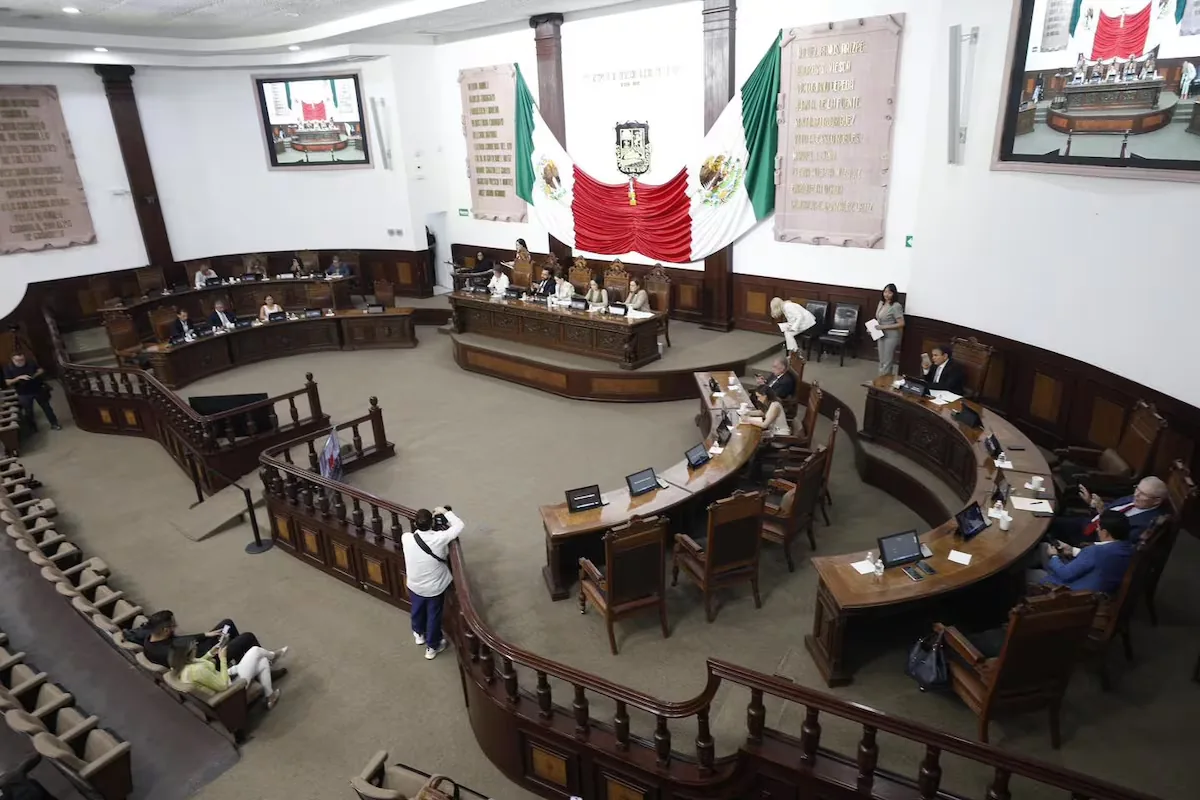
This Sunday, while the majority of the country observes from a distance a mini-election to renew the local Congress of Coahuila. In the State, one of the few political exceptions that survive Morena’s hegemony will be put to the test: the capacity of the Institutional Revolutionary Party (PRI) to continue governing a territory that has resisted the Morena tide for almost a decade. Internal polls and the parties’ own forecasts point in a single direction. The PRI, allied with the Democratic Unity of Coahuila (UDC), arrives as the favorite to maintain control of the local Legislature. Morena, on the other hand, approaches election day amidst a weakened political operation, with internal fractures and with a national leadership under Ariadna Montiel who privately assumes that the result will be adverse. With barely a month at the helm of Morena, it was not enough to salvage the election that Andy López Beltrán left adrift after his resignation as Secretary of Organization of the Morena group. The son of former president Andrés Manuel López Obrador jumped ship, say Morena heavyweights, in the face of the imminent defeat, which implied his second electoral failure in his nascent political career.
Read more Gargi Chaudhuri: “The USMCA resolution can be a positive catalyst for Mexico”
The dispute is for 25 seats in the state Congress —16 by relative majority and nine by proportional representation—, but the underlying battle is another. On this election day, the only one in 2026 in the country, the PRI will measure its strength to see if it can keep one of its last remaining strongholds in Mexico intact and, at the same time, expose Morena’s limits in the north of the country.
These elections also have a symbolic component for the ruling party. Coahuila was one of the tests entrusted to López Beltrán, who coordinated Morena’s territorial strategy in the entity for months. However, the recent reshuffle in the national leadership and his departure from the political operation, from which he jumped to seek a federal deputyship for Tabasco, ended up undermining a campaign that was already facing difficulties competing against the local PRI machinery.
Among Morena and PT operators, there is a shared vision; the Coahuila election became an “impossible mission,” which started badly from the moment the coalition with the PVEM broke. The feeling is reminiscent of the one left by the ruling party’s defeat in various municipalities of Durango and Veracruz during the 2025 local processes, also led by Andy López Beltrán and where they were also divided. In the north of the country, Morena has not managed to gain territorial roots; the party’s brand continues to clash with local political structures built over decades, federal legislators report.
Unlike other entities where the PRI was swept away by Morena in the last seven years, in Coahuila, the historic party that governed Mexico without interruption for 70 years, retains a network of power that has survived the national debacle of the PRI. A good part of that machinery was built during the governments of the Moreira brothers. Although the surname carries a handful of controversial chapters in the recent history of the State. During Humberto Moreira’s administration (2005-2011), the growth of the Los Zetas Cartel, the massacres of Allende and Piedras Negras, where hundreds of people died and disappeared at the hands of organized crime, as well as the unprecedented indebtedness of the State, were recorded. His successor, Rubén Moreira (2011-2017), bore the liability inherited from his brother and faced questions of opacity on the issue. Although he has been credited with the drastic reduction in homicide rates and the presence of organized crime in the State.
Nevertheless, the surname remains in the public spotlight. Álvaro Moreira Valdés, brother of the former governors, will seek a new legislative re-election this Sunday, while his brother Humberto, expelled from the PRI years ago, continues to appear on the margins of local politics as a reference figure for PRI sectors. Meanwhile, Rubén remains as the coordinator of the PRI’s parliamentary group in the Chamber of Deputies.
Continuity is not limited to the Moreiras. The list of PRI candidates is made up of legislators seeking re-election, party leaders who have been characterized by jumping from one position to another, and members of a political elite closely linked to the acting governor, Manolo Jiménez Salinas.
Read more Journey to the heart of ‘fracking’
In Coahuila, the election is shaping up as the ratification of a power structure that has managed to navigate national changes without losing local control. While Morena insisted on the need for alternation, the ruling party candidates opted to defend stability and economic growth, but above all, security in the entity. In a region marked by a past of extreme violence, the argument remains an attractive electoral banner.
Morena’s main paradox in Coahuila is that, despite being the second electoral force in the State, it has never managed to build a solid local identity. Many of its most visible figures carry a political history with the PRI and the PAN. A case that attracts attention is that of Luis Fernando Salazar, a former PAN militant who joined Morena after the PAN group blocked his path to the gubernatorial candidacy. The same scene is repeated among other local leaders. The result is a party that, despite its national strength, still fails to build roots in an entity where the local vote has not followed the national trend.
The Retreat of Andy López Beltrán
The campaign for the ruling party became further complicated when the operation led by Andy López Beltrán began to crack and eventually crumbled. López Obrador’s second son replicated the same failed strategy he implemented in Durango and Veracruz months ago. Since April, he ordered the deployment of dozens of federal deputies from Morena and the PT to support their candidates and strengthen the election. The objective was to turn the Coahuila election into a demonstration of his talent in territorial organization, according to PT deputies. It did not happen. Party sources consulted by EL PAÍS describe a structure exhausted by financial outlay, citizen resistance, and the latent perception that the outcome is already defined.
López Beltrán’s departure from party leadership exacerbated the problem. Many of the operators sent to Coahuila supported the campaign because they considered it a gesture, more for the former president and founder of Morena than for Andy, so they decided to step back. Montiel’s renewed leadership tried to reactivate mobilization during the last days of the campaign despite the diagnosis, acknowledged behind closed doors by the party. That is why this Sunday’s election day is set to become the second major political defeat associated with López Beltrán since he began his nascent career as a political operator.
The Electoral Laboratory for 2027
Beyond the dispute for the local Congress. Coahuila emerges as a warning for all parties ahead of the 2027 midterm elections. For the PRI, a broad victory would confirm that it still possesses cadres capable of resisting Morena’s national dominance. Along with some northern and Bajío entities, Coahuila represents one of the last regions where the opposition can demonstrate governing capacity and territorial control. For Morena, on the other hand, the result will force it to rethink its strategy and profiles. While the PRI seems to arrive at the election as a perfectly oiled machine, Morena appears trapped between recycled candidates, internal disputes, and an old strategy that failed again.
This Sunday, when the polls close at 6 PM, not only will the number of seats obtained by each party be counted. It will also be recorded whether the last great PRI stronghold continues to resist the advance of the self-proclaimed Fourth Transformation or if it begins to show the first cracks.
Read more ‘We’, by Compañía Mal Pelo: dance that overwhelms and reveals