






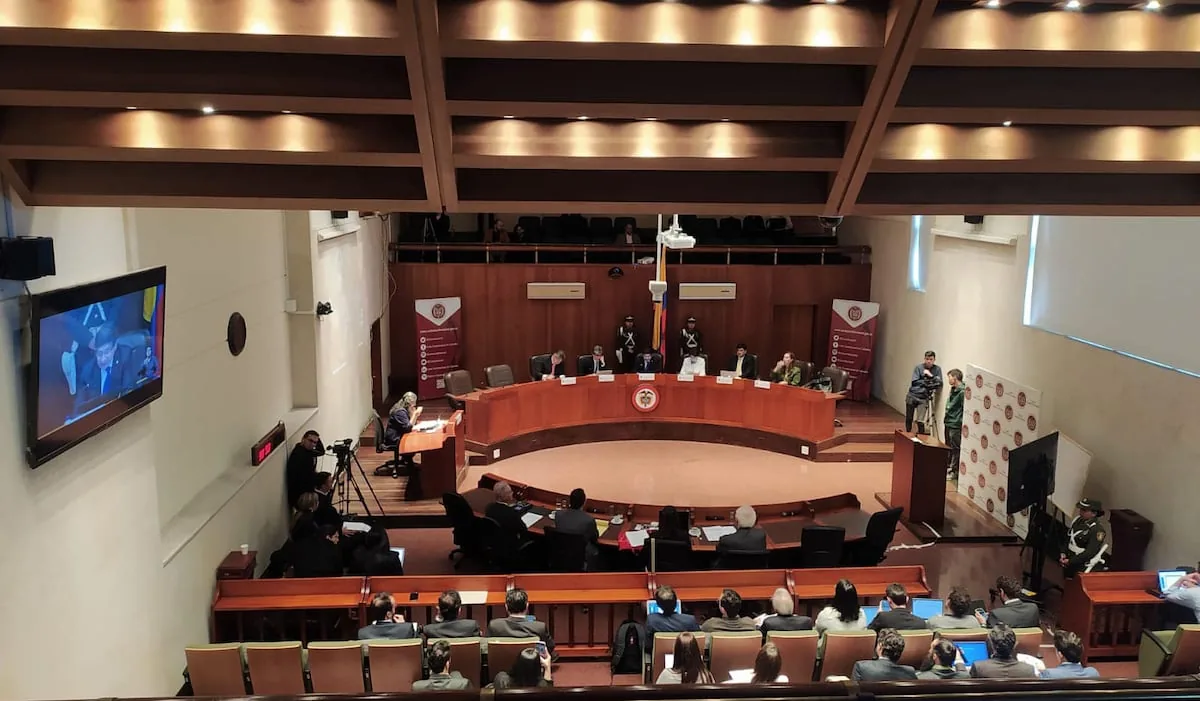
The Constitutional Court dealt the final blow to the economic emergency decreed by the government of Gustavo Petro. If last Thursday it found the decree that declared it unconstitutional, the Full Chamber decided this Wednesday, unanimously, to overturn one of the decrees that developed it. Under number 1474 of 2025, it imposed tax measures such as the increase of VAT on liquors and the increase of the income tax rate for the financial sector. The ruling grants retroactive effects to the unenforceability, which obliges the DIAN to return to taxpayers the nearly 600 billion pesos, more than 160 million dollars, that it managed to collect.
Read more The magazine ‘Time’ includes Claudia Sheinbaum among the 100 most influential people
These effects represent the worst scenario for the national government. President Gustavo Petro justified the economic emergency on the shortfall of 16.3 trillion pesos in the 2026 budget. According to the president, this seriously threatened the economic and social order of the country. This happened after Congress denied him a law that sought to increase taxes to avoid the fiscal gap. While the emergency was in effect, the DIAN added additional revenues close to 814 billion pesos. Part of those resources are what must be returned to taxpayers, including those collected before the provisional suspension decreed in January. The exception is the money paid by delinquent taxpayers thanks to a partial tax amnesty.
The ruling, with the opinion of magistrate Juan Carlos Cortés, distinguished three scenarios for the return of the resources. In the first, direct taxes — those that fall directly on the payer — will not be subject to declaration, settlement, or collection, and the amounts already paid must be returned to taxpayers. This is the case, for example, of the wealth tax.
“There is an aspect that must be clarified,” explains Andrés Quitián Calderón, constitutionalist expert in tax law. Some of the affected taxes operate as period taxes, “so that the collection is not materialized immediately, but with the declaration submitted the following year.” As an example, he mentions the modification to the non-deductibility of royalties, which affects the income tax declaration. In these cases, since payment has not yet been made, the taxes simply will not be incurred.
The second scenario corresponds to indirect taxes — such as VAT or consumption tax — which must be returned to those who prove they made the payment, for example, through an electronic invoice. This is the most complex scenario, warns Quitián. “The ruling provides for the return of indirect taxes to the person who materially made the payment, which poses significant practical difficulties.” That is, the DIAN must pay not the merchant who sold a bottle of liquor, but the buyer who paid the tax when making the purchase.
For this reason, Quitián adds, it is not always easy to trace the payments. In this context, the Court delegated to the DIAN the definition of the mechanisms to make the return effective, “which in practice shifts the discussion to the evidentiary and operational level.”
The third scenario — in which the Court adopted a more flexible position — corresponds to the tax benefits that the government granted to taxpayers in arrears with the DIAN. “The consolidated legal situations regarding taxpayers who met the conditions required to access the tax benefits remain intact,” the ruling states.
For this concept, the DIAN collected 237.246 billion pesos from those who got up to date. Since these are not taxes created under the emergency, but the payment of previous debts, the Court does not oblige the DIAN to return them. In total, the taxpayers’ portfolio with the entity amounts to 36.7 trillion pesos.
“This includes, for example, payment facilities or other situations that had already been structured according to the required conditions. In these cases, it was not possible to alter them, precisely for reasons of legal certainty,” explains Quitián.
The national government suffered another setback. Unlike the ruling that declared the unconstitutionality of the declaratory decree, magistrates Vladimir Fernández and Héctor Carvajal — nominated by President Petro — did not save their vote, but joined the majority. Fernández, before joining the Court, served as legal secretary of the Presidency of the Republic, while Carvajal had been the lawyer of the head of state, as well as other political leaders. Both also voted against the majority decision to provisionally suspend that economic emergency.
The Court also has in its hands the future of the second economic emergency, decreed by the Petro government after the floods at the beginning of the year on the Caribbean coast, and the decree that creates taxes under its protection.
Read more Vice Admiral Farías Laguna sends a letter to Sheinbaum to intervene in his case for fuel theft