Of all the victims of the Civil War, none is more symbolic than Federico García Lorca, who was shot in August 1936 alongside a teacher and two anarchist banderilleros in a place in Granada. His remains have never been found.
Read more ‘Tadeo Jones and the Wonderful Lamp’: good cultural adventures with a comic imbalance
Luis Muñoz, a poet from Granada, argues that any scenario following a hypothetical exhumation of the poet would diminish the permanent denunciation of the crime scene. The historian and university professor Pilar Mera urges to keep searching for his body because the will of a democratic society must be to try to know the whole truth.
A wound that cannot be closed
Luis Muñoz
Tragically, the murder of a poet confronts us with an extreme form of existential horror, in which the capacity for creation not only finds its limit in death but becomes the object of a deliberate will of destruction. Lorca spoke of “the immense conscious joy of creating,” and his murder seems to condense a tension that is hardly repairable: that a being devoted to expanding life, to endowing it with abundance and new thicknesses and meanings, is deliberately torn from it. Perhaps it is that unbearable disproportion between what creation adds to the world and what brutal destruction takes away that prevents me from seeing his murder as a true possibility of peace or closure.
The condemnation of Lorca’s murder, when the news began to spread, still in the form of doubt, on August 30, 1936 — more than 10 days after his death — initially had to face the efforts of the rebel side to misinform and distort the facts. Nevertheless, that condemnation would end up overflowing the realm of denunciation to become a powerful form of recognition and dignification, first in Spain and progressively in Latin America and Europe.
Two culminating moments of this initial condemnation almost coincided in time: the display dedicated to Lorca in the Spain Pavilion at the 1937 Paris Exhibition, along with various tribute activities, and the recognition acts of the International Writers’ Congress, such as the reading in Paris by Louis Aragon of an Oath, written by Langston Hughes and Stratís Tsircas, in which the poets committed that his name would never be forgotten.
In response to the international resonance of the condemnation of the murder, Franco himself tried at that time to counteract the impact by making a statement to an Argentine newspaper where he said that the Reds had used “this name” as a propaganda lure — precisely avoiding his name and calling him “a writer from Granada” — and distorting the account of the facts with calculated ambiguity by stating that he died “mixed with the rebels.”
Lorca’s death was officially recorded in the administrative and police documentation of the regime. A death certificate from 1940 attributes it to “wounds caused by an act of war,” while a 1965 police report records his arrest, that he was “executed by firing squad,” and his burial in Fuente Grande, along with accusations of being a socialist linked to Fernando de los Ríos, a mason, and having been “labeled as practicing homosexuality.”
The investigation to clarify the historical truth of the murder, whose first works began to be published in the early seventies, with invaluable contributions from Ian Gibson and Marcelle Auclair, has allowed the reconstruction with remarkable precision of the sequence of scenes, movements, and words that converged in it.
Read more “We must denounce that young people have to flee their country,” says a reader
Regarding the family matter, I cannot understand that they are pressured and their wish is not respected, just as the wish of those who fight for their relatives to be exhumed and dignified as victims must be respected. A family that, mind you, has not prevented the site from being disturbed, although it has expressed that it would prefer it not to be done.
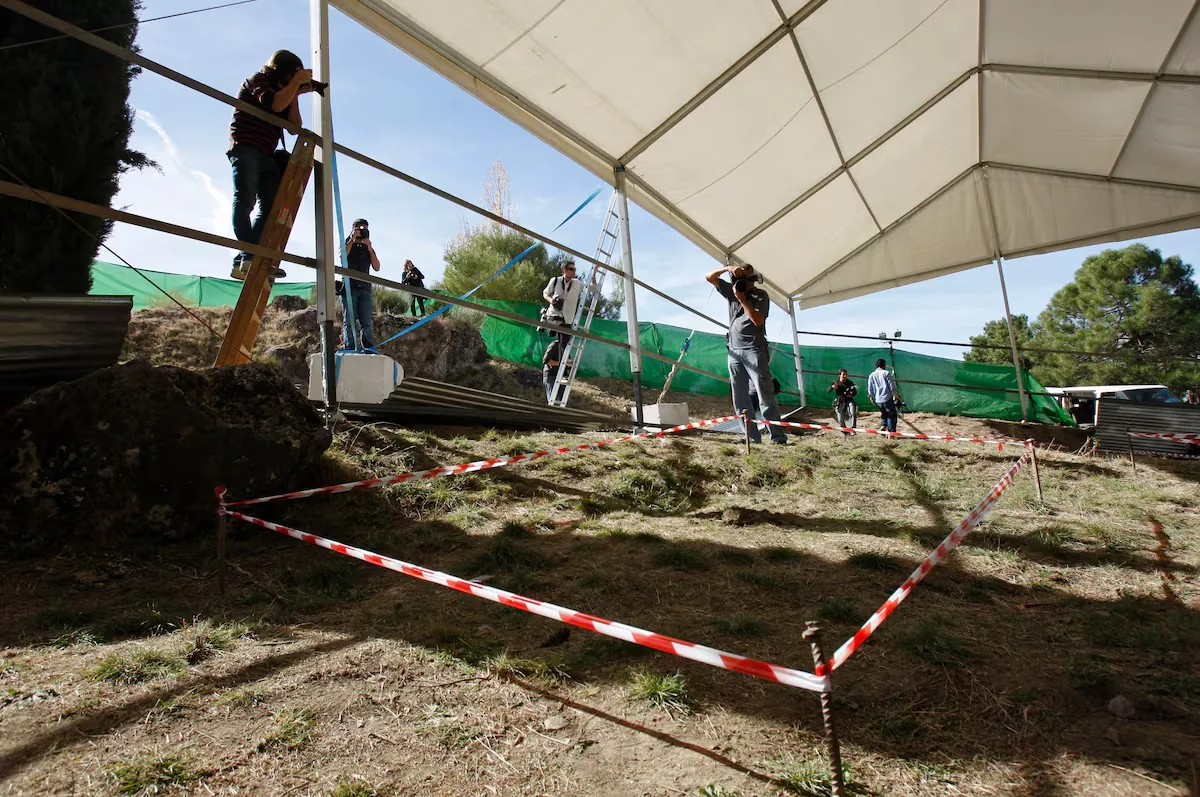
So what would be the point of exhuming Lorca’s remains and what are the pros and cons. The memorial topography of the surroundings of Fuente Grande and Víznar, where he apparently lies, has turned Lorca into one more victim among the many buried there. Added to and, at the same time, immersed in that landscape of memory.
Any of the possibilities after a possible exhumation seem worse to me than leaving him where he is, and I believe that, at least, they would diminish the intensity of the permanent denunciation of that space and its character as a reminder to — using Antonio Machado’s terms — call “at the doors of all hearts, of all consciences.” Because perhaps the problem lies precisely in the idea that every wound must be closed. If it is about concluding a chapter of the history of Spain and the world, that wound, I believe, is incurable.
Search for all the bodies, search for the truth
Pilar Mera
The entire Víznar ravine is Lorca, said Santos Juliá. What better monument to remember the poet? The image is powerful. A murdered genius. A mysterious story. Ninety years of rivers of ink knotting his memory. Poems, songs, academic research, anniversary articles, rumors, and legends. Vague clues, clear testimonies, an endless search, and no results. His body has not appeared, but his memory keeps flourishing. We know the route from his arrest, we have an approximate idea of where he was shot, and the certainty that he was buried between Víznar and Alfacar and not in the ravine, as was thought for years. Even so, the poet resonates in the ravine, a nest of chained graves where the University and Memory team of the University of Granada has already located the remains of 194 people. A cathedral of ash that reminds us all of the men, women, and children who, like him, died in those places. If his legacy remains so strong, why keep searching for his bones? Because that must be the endeavor of a democratic society.
“Through the branches of the laurel / go two dark doves. / One was the sun, / the other the moon. / ‘Neighbors,’ I said to them, / ‘where is my grave?’” Lorca sang (with Paco Ibáñez’s voice in my backpack) in one of the casidas of his Diván del Tamarit. The poet’s grave is not in the tail of the Sun, nor in the throat of the Moon because his death was neither figurative nor symbolic. It was not the only one either. With him were killed Dióscoro Galindo, Juan Arcollas Cabeza, and Francisco Galadí Melgar. And that same day, the previous days, and the following weeks, there were thousands more murders. They accumulated in those months, called “hot terror,” and continued during the dictatorship. There were also those killed in the Republican rear, someone always adds. It is true. But if Francoist repression was a state policy, the same did not happen with these murders, more or less organized crimes by groups that acted despite the Republican state, broken by a coup that generated the necessary conditions for the revolution the coup plotters said they wanted to avoid. That these murders are not state crimes does not deprive these dead of the status of victims, as recognized by Law 20/2022, of October 19, on Democratic Memory. But it clarifies the differences in the conduct and legitimacy of one side and the other.
The Law of Democratic Memory also reminds us that “the drive of democratic memory policies has become a moral duty,” a vision that transcends Spain and its recent history. The horrors of the 20th century turned the civic pedagogy of the past into an ethical imperative of democracies. Thus, memory, recognition, reparation, and dignification of victims are a sign of democratic quality. Amid political brawls over the past, there was a moment, before Vox, when a consensus was reached: the need to locate and identify the thousands of dead who remained in ditches and mass graves. The right of the dead to be found, named, and remembered. This was recognized by decree 9/2018, of April 12, of Historical and Democratic Memory of Castilla y León, promoted by the PP, or law 10/2016, of June 13, for the recovery of people disappeared during the Civil War and Francoism, of the Balearic Islands, approved with the vote in favor of all parliamentary groups. Perhaps because from Antígona we understand that the duty to bury the dead responds to a natural law that transcends any supposed social utility.
That is why the will of a democratic society must be to seek the truth. To find Federico García Lorca, Dióscoro Galindo, Juan Arcollas Cabeza, and Francisco Galadí Melgar. To find all the names lost in anonymous graves and all the nameless dead and take them out of the limbo where their murderers abandoned them. The dictatorship is not our responsibility, but it has left us a legacy. What we do with it does not speak of our past, but of us, of our present, and the democratic future we want to build.
Read more ‘The Dog Star’: Ridley Scott keeps making good movies at 88 years old