









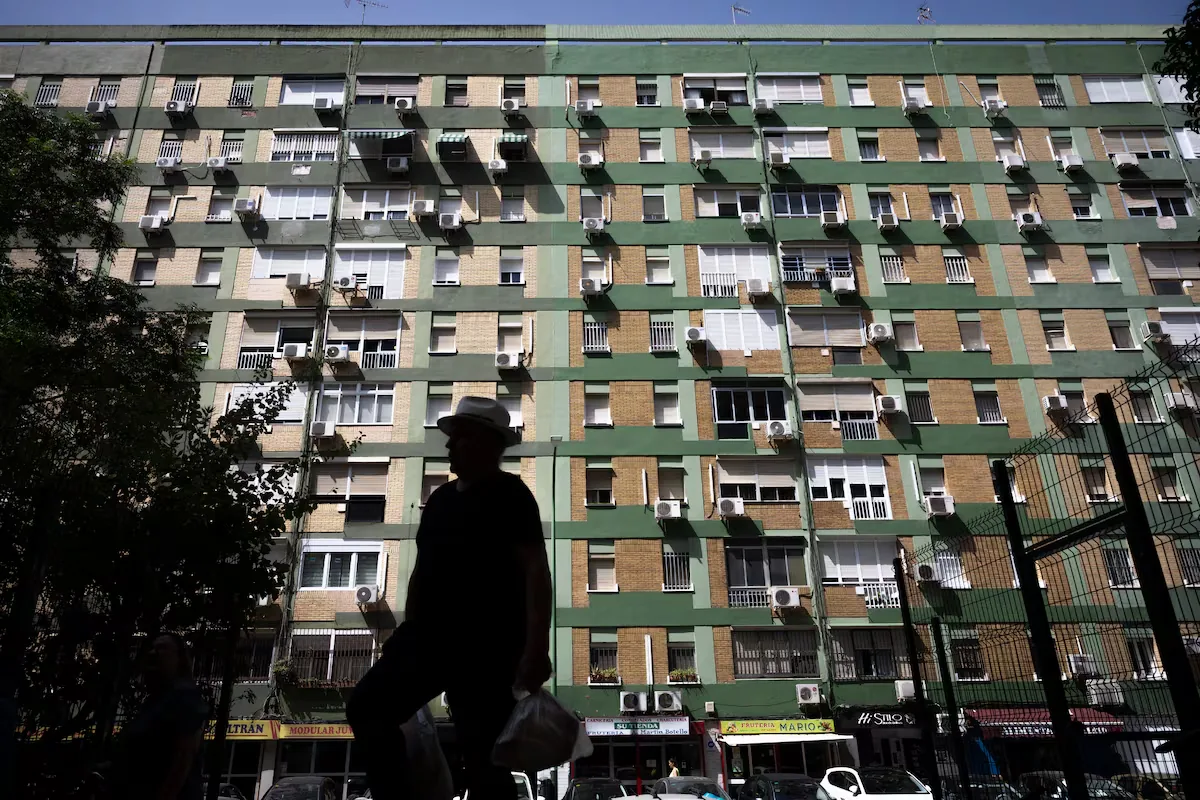
Western Europe is experiencing its hottest summer on record, as has happened many times since the beginning of this century, and is beginning to become aware of the effects that the climate crisis has on quality of life and health. Adaptation to new temperatures is necessary, but one of the most obvious solutions, air conditioning, raises certain hesitations due to its high energy consumption and its effects on health. Journalists Thiago Ferrer and María Herrán discuss the pros and cons of air conditioning in daily life.
Living with dignity requires comfortable temperatures
Thiago Ferrer Morini
Right-wing populisms almost always play the culture war in the same way. From time to time, outraged headlines appear claiming that “the left” wants to ban something: red meat, candy, kittens, you name it. Generally referring to what some enlightened person has said—often out of context—as proof. And, in many cases, with a display of the allegedly persecuted behavior: if today it’s red meat, with a two-finger-thick grilled steak; if it’s tobacco’s turn, smoking a Montecristo à la Sara Montiel, and so on.
When we talk about air conditioning, we are faced with an example of H. L. Mencken’s classic phrase: “There is a known solution to every human problem: simple, plausible, and wrong.” Populisms sell solutions that a 15-year-old would understand and are probably what a 15-year-old would try: of course you can have ice cream for dinner, of course you can stay up late, why can’t you play the drums until one in the morning. After all, we have already had several generations raised in the belief that human beings can do whatever they please and, if they can’t, it’s due to a lack of willpower. It is up to the experts to undertake the ungrateful task of waking people up from this perpetual adolescence, to remind them that nothing is so simple, that behaviors have consequences, and that living in society implies sacrifices. In this case, the most obvious solution is to put air conditioning machines “everywhere.”
The World Health Organization estimates that 548,000 people die each year from heat-related causes. This figure will only grow as climate change raises global temperatures and worsens heatwaves like those we are experiencing in Spain this very week. And, for the living, extreme heat represents a deterioration in health and quality of life. We sleep worse, we think worse, our illnesses worsen.
Living with dignity, therefore, implies spending as much time as possible at a temperature compatible with life and health. The best possible option is to reduce greenhouse gas emissions so that the warming of the atmosphere does not become more serious than it already is. But, in the meantime, we have to adapt to the conditions we have now. As Pedro Vicente Quiles, president of the Technical Committee of the Spanish Technical Association of Air Conditioning and Refrigeration (Atecyr), points out, when street temperatures exceed 30 degrees, “it is generally impossible to achieve adequate indoor conditions without the use of air conditioning systems, and even more so during heatwaves,” so “in homes, air conditioning should be considered a right and not a luxury.”
The problem, and this is where adults enter the equation, is that we all have to enjoy this right, and in a way that does not harm others. First, because energy must be used efficiently. Second, because some methods of electricity production exacerbate the emission of polluting gases. Third, because excessive use of air conditioning also has its effects on health. And fourth, because, as Homer Simpson said, “in this house we obey the laws of thermodynamics”: the heat we remove from our homes and workplaces has to go somewhere, which is, generally, the street.
For the first, as important as air conditioning is ensuring that this cold stays in the house, with thermal insulation systems and air circulation. For the second, advancing in electrification and the implementation of renewables and energy storage systems. For the third, setting the air at a reasonable level; if you have to put on a cardigan, that’s not it. And, fourth, planting trees, removing asphalt and concrete, and installing shade to avoid the effects of heat islands.
All of this has a cost. Distributing it fairly is equally important. Because not all of us are equally responsible for climate change, but we all suffer its consequences. We cannot, voluntarily, make them worse.
Thermal comfort is more than pressing a button
María Arranz
Air conditioning has become the umpteenth cultural war in the midst of a heatwave and, as is customary in these cases, it seems obligatory to declare oneself, in the most extreme way possible, for or against an invention that, given the alarming increase in temperatures on a planetary scale, is positioned as an essential ally for survival. Let me say upfront that I deeply hate summer and I know that this “phobia” would make me the perfect candidate to adore any cooling technology, but one of the reasons I can’t stand this season is precisely because of air conditioning.
I am clear that proper use of these devices avoids many of the ailments associated with them—dry mucous membranes, throat irritation, headache, to name a few—the problem is that in most shared spaces, the air conditioning is set to polar temperatures. Although it is recommended to set it between 24 and 26°C in summer, one only has to take a walk through shops, offices or supermarkets to realize that this recommendation is not given much heed.
Nor do I understand that passion for sleeping all night with a flow of cold, dry air in the room. I am aware that the feeling of covering oneself with a blanket in summer is most pleasant, but a ceiling fan can have a similar effect, with less impact on health and also lower energy consumption.
Beyond my individual preferences, energy expenditure and its consequent environmental impact are the big issues that always hover over the topic of air conditioning. That we all have an air conditioning unit at home seems like a great short-term solution, but it is well known that, while these devices cool the inside of buildings, they expel hot air outside, contributing to further heating the environment. I read that, fortunately, there are increasingly efficient devices in this regard and that this impact could be minimized, but right now air conditioning does not seem to be the most sustainable option either for the planet or for our pockets. If the heat continues to increase—as it seems it will—so will energy expenditure and the electricity bill.
Having an air conditioning unit and maintaining it is expensive, so cooling is becoming a new factor of inequality. And as long as it remains so, we must also advance in other solutions that guarantee thermal comfort for everyone. Of course, I believe there are cases where air conditioning should not be a debate. Places like hospitals, nursing homes, schools, public transport and other spaces where many people gather, or homes where there are particularly vulnerable people, need cooling when the heat is intense and, in the absence of other solutions, air conditioning emerges as the most effective option.
My hesitations come more from that single-card bet made by some sectors, while climate change is denied and cities continue to be filled with asphalt and concrete. Relying solely on air conditioning is a way of individualizing a problem that we should address collectively. If the market takes on the challenge of dealing with the generalized increase in temperatures, we run the risk of focusing only on mitigating them, instead of also opting for structural and long-term air conditioning solutions that help alleviate the environmental crisis. Homes with better thermal insulation, allowing passive cooling and ventilation, the installation of awnings, or having cities with more shaded areas, trees, and vegetation seem like a more sustainable future bet, in every sense, than pressing a button to air condition our little piece of the world. We may still need air conditioning indoors, but this should not make us forget to build a more habitable exterior.
Read more Three femicides and six orphans due to gender violence in 24 hours