










The labor market usually gains workers and loses unemployed people in May. This year has been no exception thanks to the seasonal boost from tourism, but these two variables offer different readings in this fifth month: Social Security affiliation data are better than unemployment figures. With 232,000 more affiliations compared to April, this record is the second best in the historical series for May and comes with a very special prominence of foreigners — they contribute almost half of the jobs created, 111,000 jobs, the highest figure recorded in a May month —. However, registered unemployment contracts by 36,300 people, a drop much lower than usual for this time of year. Excluding the anomalous pandemic year, it is the worst data in this series since 2012, in the midst of the Great Recession.
Read more The leader of Podemos in Andalusia resigns after disagreements with the national leadership
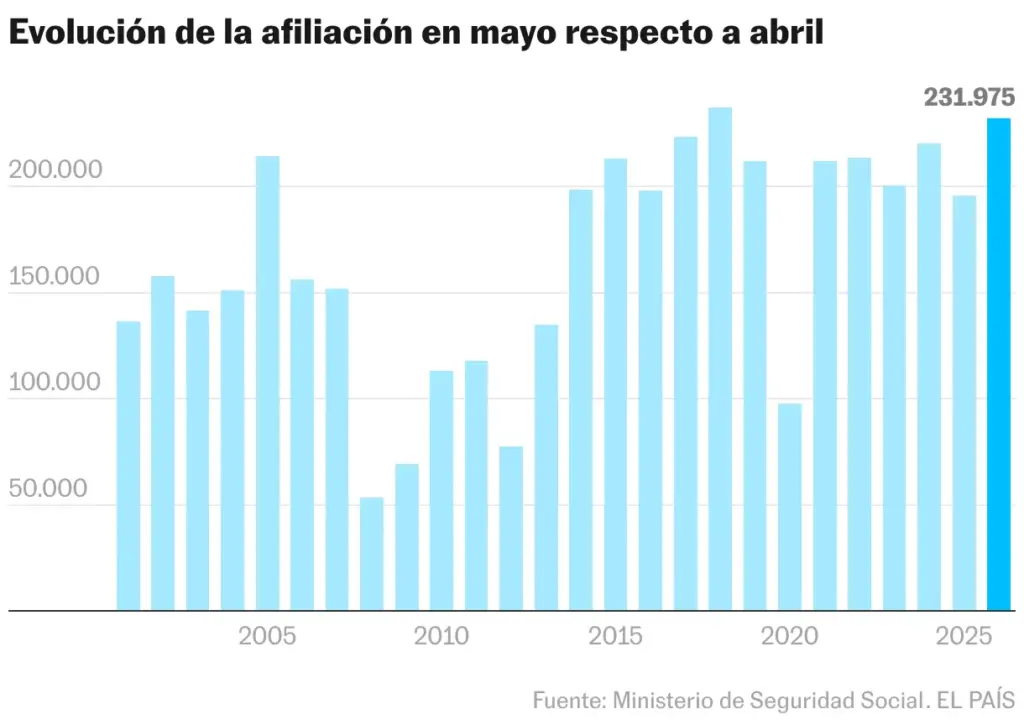
The 232,000 affiliations gained by Social Security are much more than last year (+195,700), than 2024 (+220,300), than 2023 (+200,411)… And so on until reaching 2018, when Spain added 237,200 jobs, the highest figure in a May month, which leaves this year’s record in second place. These monthly data place the total number of affiliates at 22.33 million, a new employment record that, if the trend of recent years continues, will be surpassed again in June.
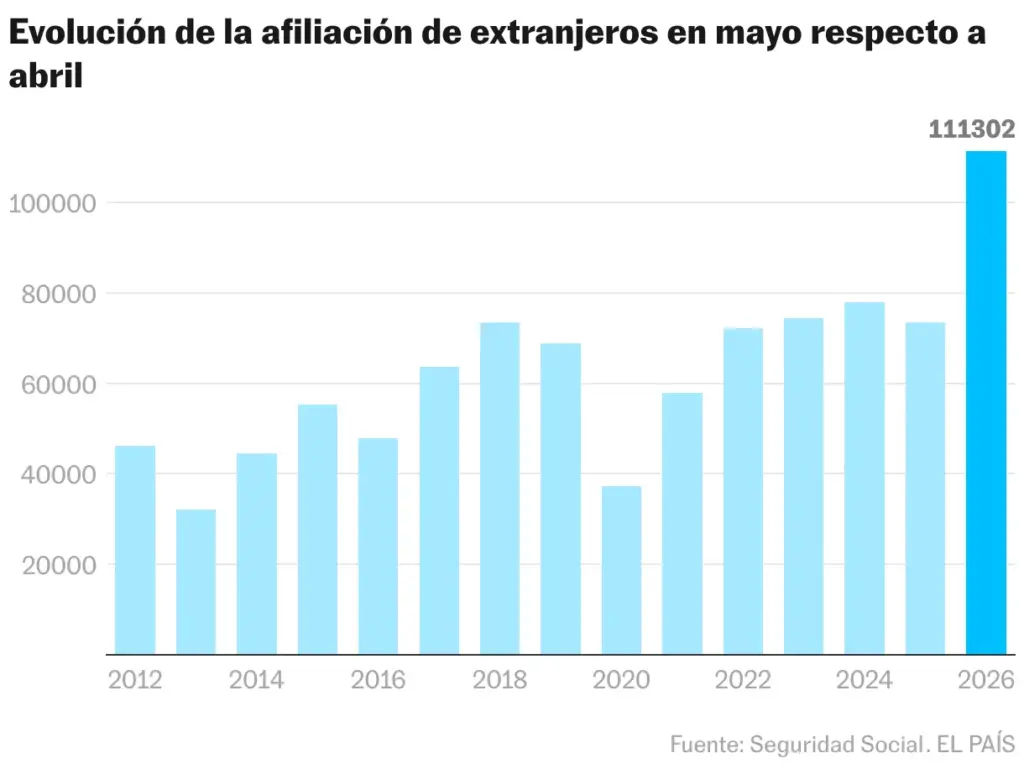
The breakdown by nationality shows an unprecedented prominence of foreigners in the monthly data. Spain gains 111,300 affiliations of foreign origin (an advance of 3.4% in a single month), almost 40,000 more than the previous year (when it increased by 2.5%). It is, by far, the largest boost of foreign employees in a fifth month since records began — starting in 2012 —, a figure that occurs in the second month of the foreigners’ regularization being in effect. In its analysis of the figures, Social Security does not mention regularization as a possible explanation for this strong increase, which was already beginning to be sensed in April.
Then the number of foreign employees also grew more than ever in the fourth month, with 96,700 more affiliations (20,000 more than in the same month of the previous year). The Secretaries of State for Social Security and Labor will attend the media during the morning and then explain if they see a relationship between this phenomenon and the extraordinary process that started in mid-April.
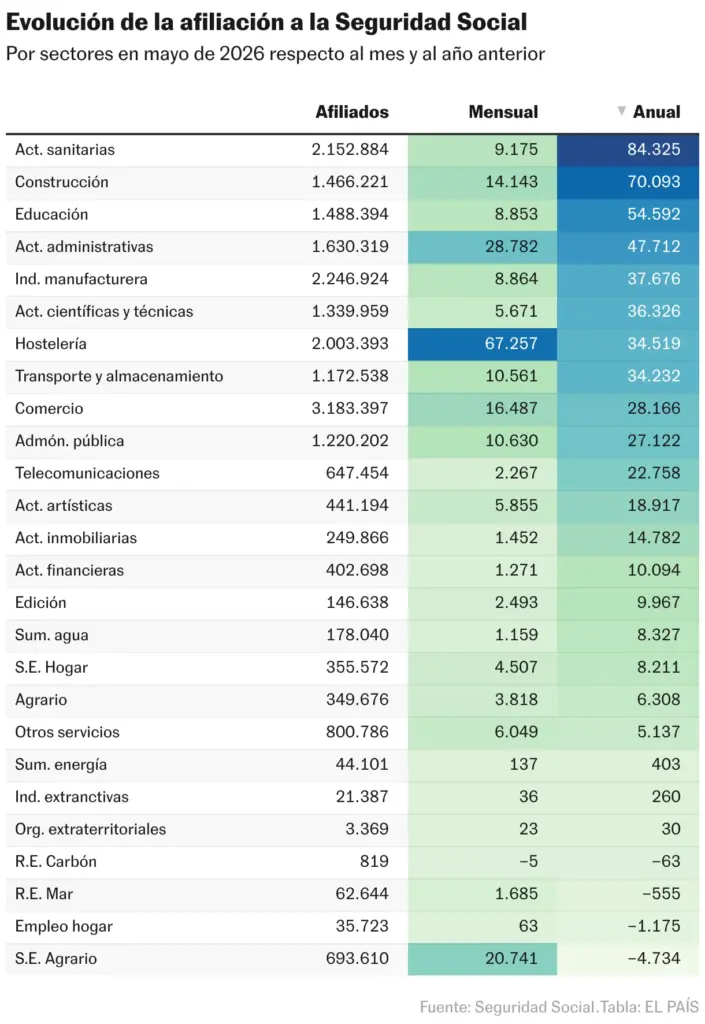
An annual look at Social Security data shows that Spain has gained 553,400 jobs in the last 12 months, almost 100,000 more than the previous year, which was already very positive for the labor market. This advance maintains job creation at 2.5% year-on-year, three tenths more than in the previous year. The sectors that contribute the most new jobs to this annual advance are health and social services (+84,300), construction (+70,100), education (54,600), administrative activities (+47,700), and manufacturing industry (37,700).
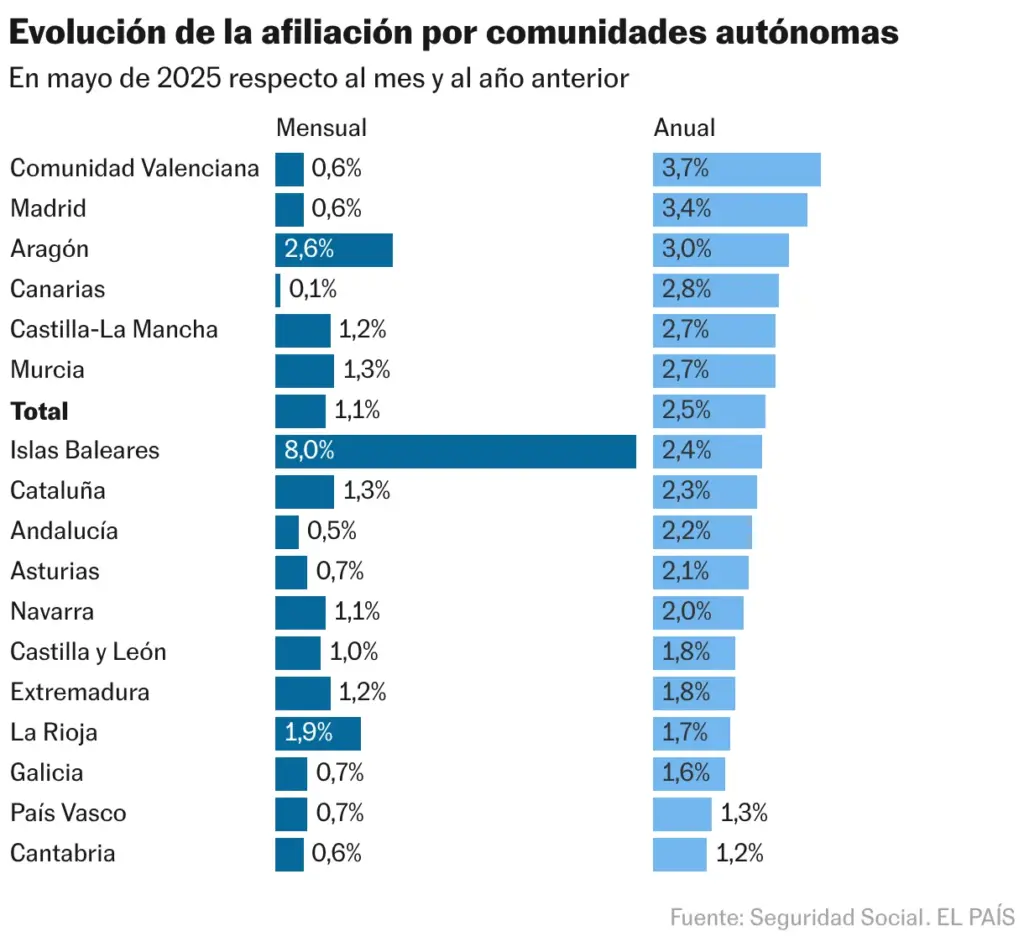
Hospitality is not among the sectors that contribute the most jobs in the last year, but it does dominate the data encapsulated in May. The sector gains 67,300 jobs, more than double the second on the list, administrative activities with 28,800 more jobs, and more than triple the third, the special agricultural system with 20,700. This dynamic is clearly seen in the Social Security affiliation map, with the largest inter-monthly increase in the Balearic Islands. The archipelago, so dependent on tourism, sees its number of jobs grow by 8% in a single month. The reverse is the other island territory, the Canary Islands, with a meager advance of 0.1%.
Beyond these seasonal dynamics, the autonomous community that creates the most jobs in the last year is the Valencian Community, with an advance of 3.7%, followed by the Community of Madrid, with 3.4%, and Aragón (+3%). The worst year-on-year data are those of Galicia (1.6%), Basque Country (1.3%), and Cantabria (1.2%)
Read more Junts: “If Feijóo has something serious to explain, we’ll see each other in Waterloo”
On the other hand, the Ministry of Social Security claims that “there have never been so many self-employed workers in Spain,” with 3.46 million after adding 15,500 in the last month and 45,900 in the last year. The ministry also boasts that employees under 30 years old have experienced an increase of 900,000 affiliates since 2018 (when Pedro Sánchez’s government began) and that female employment is “at its highest level” with an average of 10.6 million female affiliates in May
Unemployment falls, but little
Registered unemployment contracts with less vigor than usual in the fifth month of the year. Spain records a contraction of unemployment of 36,300 people, a decrease much lower than in 2025 (-57,800), 2024 (-58,600), or 2023 (-49,300). Excluding the atypical 2020 coronavirus crisis — when unemployment grew by 26,600 people —, one has to go back to 2012 to find a reduction in unemployment lower than that of this last month. Then, in one of the hardest years for the Spanish labor market in this century, unemployment fell by 30,113 people.
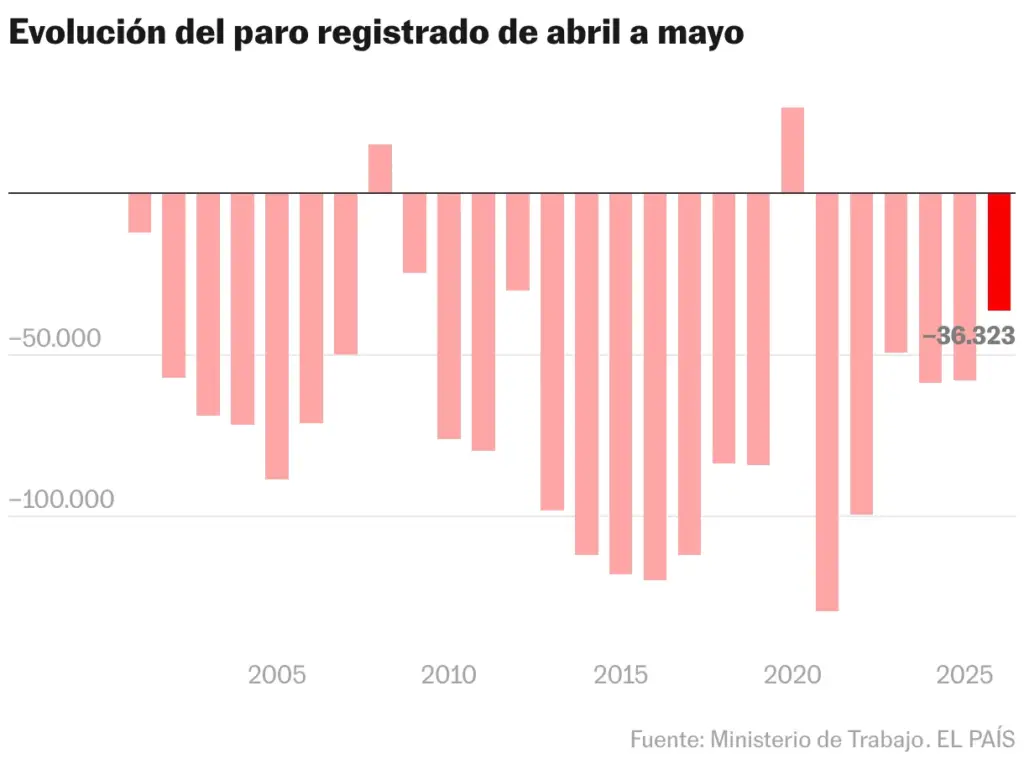
In April there was already a contraction of unemployment (-62,700) slightly lower than last year (-67,400), while March of this year (-22,900) was better than 2025 (-13,300), so it is still too early to draw deep conclusions regarding this figure.
The regularization of foreigners does not seem to play a predominant role in this May unemployment figure, since the number stands at 337,900 foreigners registered as unemployed, about 4,000 less than in April. The previous year saw a deeper contraction (from 352,700 to 342,800), but the 6,000 people difference between one year and another is far from explaining such a different unemployment behavior in each year.
Despite the bitter data with a month-to-month analysis, it is worth noting that unemployment reaches a new minimum in the last 18 years. One has to go back to March 2008, with 2.3 million unemployed, to find a figure lower than that reported in May: 2.32 million. This trend maintains the annual contraction of unemployment at about 134,000 people, less than last year (-153,000) but more than the previous one (-131,300).
In its analysis of the data, the Ministry of Labor emphasizes that for the first time in a May month unemployment among young people under 25 is below 165,000 and that permanent hiring “is consolidated at nearly one in every two new contracts compared to one in every ten prior to the labor reform.”