It is no longer about hybrid threats. These are very real actions. The thwarted attack, with drones loaded with explosives, against the German airport of Leipzig, after which Berlin directly pointed to Moscow, is marking a before and after in a European Union where other incidents with drones and sabotage, also suspected to be the work of Russia, have multiplied in recent weeks and months. The bloc, more aware than ever that the Kremlin is not currently considering seeking a way out of the war deadlock it has plunged the entire continent into with its offensive against Ukraine more than four years ago, has once again closed ranks with Kiev.
Read more The “pro-life bloc” aims to limit rights with the Government’s push
“Russia has to understand that these threats, hybrid or not, will not change the position of the European Union. We will continue to stand by Ukraine regardless of the threats Russia may make against us,” summarized this week the sentiment of the Twenty-Seven by the President of the European Council, António Costa. And this, besides continuing to support Ukraine militarily and economically, implies seeking new ways to make the war increasingly costly for Moscow, the capitals agree.
But after more than four intense years approving restrictive measures that have already put nearly 3,000 individuals and entities on European blacklists, Brussels also acknowledges the growing difficulty of agreeing on ambitious sanction packages, even though they constitute the most forceful instrument of pressure on the Russian aggressor. Not only because the scope of action, after 21 packages, is beginning to narrow, but also because it is increasingly difficult to prevent any country from blocking measures due to conflicts with national interests, as happened in July. This is forcing the Twenty-Seven to seek a change in method that allows them to remain faithful in substance, the “unwavering” support for Ukraine that everyone knows is what irritates the Kremlin the most.
Brussels closed the shutters for the summer break with a somewhat bittersweet taste. The 21st sanction package was ambitious and tough, but it should have been much more so: in the end, several of the measures planned in that and other previous packages were revised downward after several countries opposed some measures that harmed their national interests: among others, Greece, which even threatened a veto, obtained concessions for its naval sector regarding the transport of liquefied natural gas (LNG) outside the EU, while Austria also secured an exemption for Raiffeisen bank, which continues operating in Russia. Germany and Portugal, in turn, blocked attempts to limit the entry of fish from Russia, and France and Italy watered down the idea of limiting visas for Russian fighters that the Baltic countries had strongly promoted, who continue to demand greater restrictions on tourist visas for Russian citizens.
Thus, while Ukraine experienced one of its deadliest summers and Germany narrowly avoided an attack in which, according to German media, at least one of the alleged perpetrators had managed to enter European territory with an Italian tourist visa, tens of thousands of Russian citizens were again vacationing on European beaches and other destinations. The numbers have dropped substantially since the start of the war, from four million visas issued annually until 2022 to 618,000 in 2025, according to the latest data from the European Commission. But for many capitals, there are still too many Russians who can travel through Europe with relative ease.
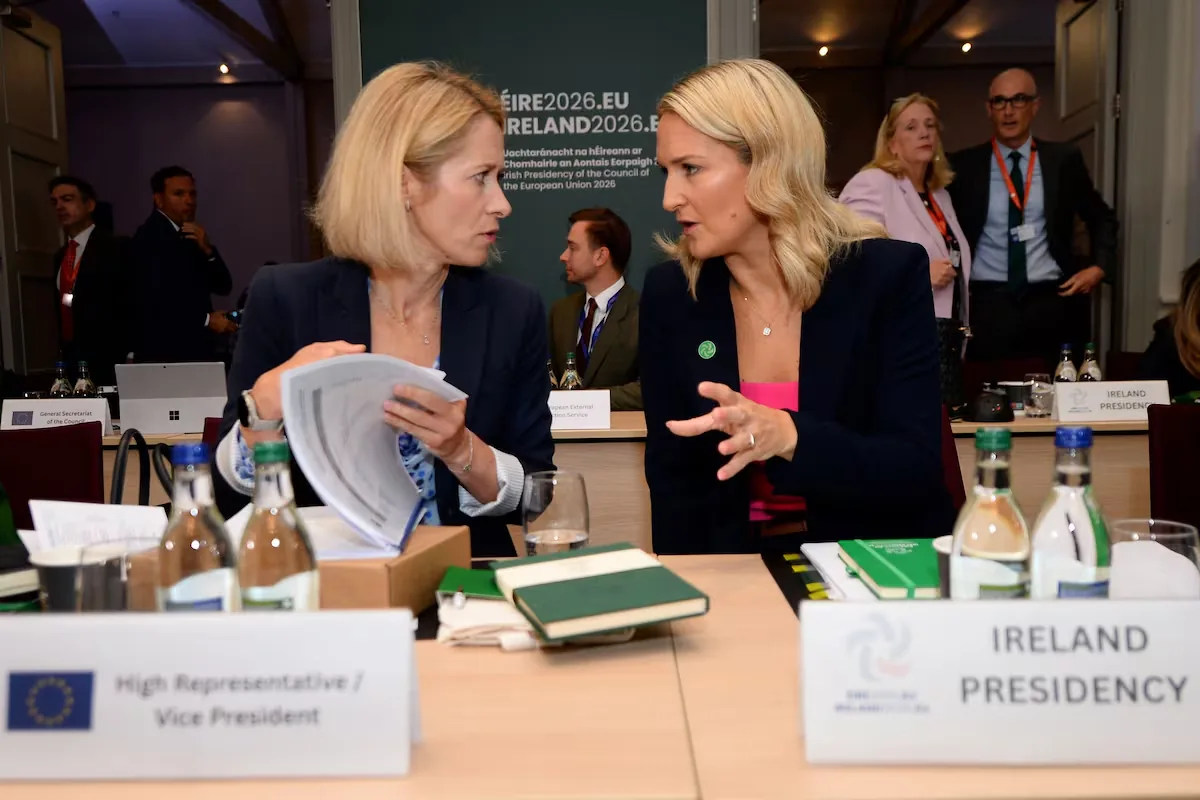
“It is not right that the country bombs Ukraine, killing more civilians than ever in this war during July and August, and meanwhile Russians enter [the EU] and enjoy the hospitality of European countries,” denounced the High Representative for Foreign Policy, Kaja Kallas, during the informal meeting of Foreign Ministers in Ireland that opened the European political cycle this week. But although the Estonian assured that there is now “broad support” to revisit the visa issue, there are still no guarantees that this will happen since, as some countries recall, some of the legal issues raised to downgrade the initiative in July have not yet been resolved.
“The fact that political solidarity is expressed does not always translate into support for concrete measures,” warns a European diplomatic source.
Read more They have sold Venezuela with the Venezuelans inside
In fact, other calls, such as that of Polish Foreign Minister Radoslaw Sikorski to close all Russian consulates in Europe, have also had little echo, despite half a dozen governments summoning Russian ambassadors after the Leipzig incident to present explanations and hear the European condemnation of an attack whose authorship Moscow continues to deny.
Rosja rozumie jedynie język siły pic.twitter.com/TFvXoW3G8a
— Radosław Sikorski 🇵🇱🇪🇺 (@sikorskiradek) September 2, 2026
Hopes are also low that the recent attempt by Spain, Sweden, the Netherlands, and Poland to reopen the debate on frozen Russian assets to finance aid to Ukraine will break, at least soon, the outright no with which Belgium already blocked that proposal last December.
In this context, another debate that has been open in Brussels for a few months gains strength about the need to change the “approach” to sanctions, sources familiar with the closed-door deliberations indicate. Instead of trying to approve very broad packages in quick succession, which require unanimity that is increasingly difficult to obtain, the idea would be to focus on very specific objectives or sectors.
This does not necessarily mean ending sanction packages, the sources clarify, but working in parallel on more concrete and themed lists to include in the EU blacklists. Like the 1,600 names of individuals and entities that Brussels is already finalizing for the next ministers’ meeting in October, which constitutes the “largest” list worked on to date. Also, as European Commission President Ursula von der Leyen emphasized in recent days, work must be done to close the “gaps” in previous sanction packages that still allow restrictions to be circumvented. Such as those that allow Russia to use Western and Asian components in its weapons. Ukraine says it has identified more than 5,500 of these components in neutralized Russian targets. “After four years of war, this is inexcusable. Those components should not be there,” condemned Kallas.
Because despite the difficulties, “we all agree that we have to keep pressuring Russia, that has never changed,” asserts another diplomatic source. “Europe and NATO are not only going to maintain pressure on Russia, we are going to increase it. And we will not stop,” also promised Von der Leyen in a statement with NATO Secretary General Mark Rutte, after Berlin accused Moscow on Tuesday of the thwarted attack in Leipzig in early August.
And that is important, emphasizes Ian Lesser, analyst at the Brussels office of the German Marshall Fund (GMF), because sanctions also “have a highly symbolic character.” And although they have not yet achieved their main goal, bringing Moscow to the negotiating table for a peaceful end to the war, sanctions are also a “mechanism to generate a unified international response,” he stresses in a phone conversation. “Even though it is known that the usefulness of sanctions, in a direct sense, is questionable, the political usefulness of sanctions as an instrument remains valid on the allies’ side.” Furthermore, he adds, weakening that sanction mechanism now, “what image would that give? It would send the signal that the West is not united, and that is something no one wants to do.”
Read more The king without a kingdom