“It is a disgrace, an absolute outrage.” With these words, the socialist deputy and head of Social Policies of this party in the Madrid Assembly, Silvia Monterrubio, denounces that 3,047 people are currently waiting for a place in a public residence in the community ―last year around this time it was only 2,165―, that another 2,794 are pending access to a day center, and that 16,780 more are waiting for home help services. The Ministry of Social Affairs, when asked by this newspaper, does not comment on the figures, which are published by the Government of the Community of Madrid itself.
Read more Woman arrested for starting a fire by lighting a fire to cook
Although Monterrubio admits that the waiting lists, year after year, “are bad at the national level” and that in other regions such as Murcia or Andalusia they are even worse, the problem in Madrid is that “they increase instead of decreasing” and that there is the paradox that, while the Government of Spain transfers 680 million euros to finance dependency, the regional government “cuts 32.1 from the Madrid Social Care Agency” (AMAS), an amount that has gone, according to Laura Muñoz, secretary of Social Policies of UGT, to prevent the bankruptcy of the La Paz hospital. “It cannot be that other communities with fewer resources attend better and faster to their elderly and it cannot be that the State Observatory on Dependency complains that Madrid provides the least and least accurate data,” the deputy points out.
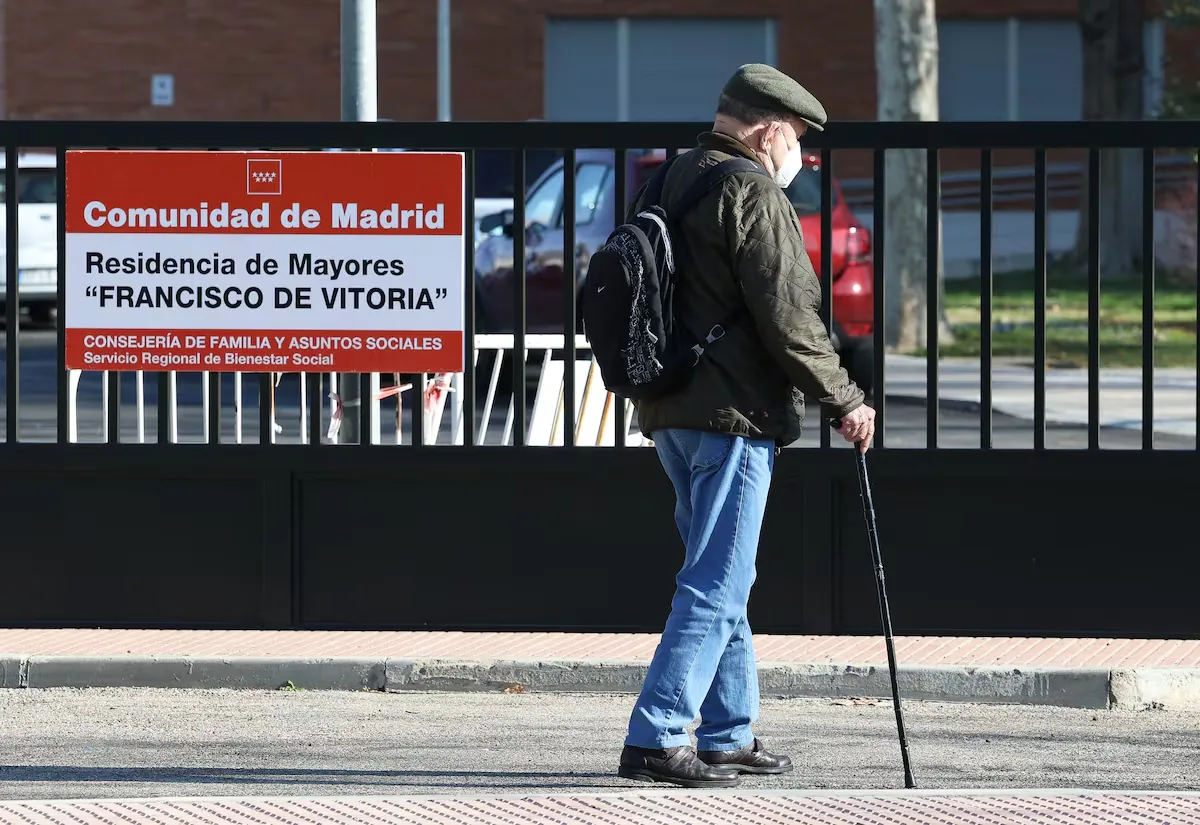
In the region, there are 1,211,324 people over 65 years old according to the latest available census data, which represents 17.28% of the population. Of these, more than 276,000 live alone in their homes and 55,300 in 500 residences, a predominantly private business since only 25 of them are 100% public. The user profile is that of an 80-year-old person, in 71% of cases a woman, and most require specialized care due to some degree of physical or mental dependency.
When asking for help, the big problem for the elderly is that they face the wall of unacceptable deadlines. How long is the average wait in Madrid from the time a dependency assessment is requested to access a day center, a residence, or home help until it is received? The ministry spokesperson also does not provide this figure and limits himself to responding that the community “has an average time 19 days less than the national average,” but it does not add up. The wait in Madrid right now is 330 days, “the same figure as in 2025,” clarifies the UGT official also according to the data published by the regional government. The national average is 314 days, according to the Ministry of Social Rights in July, so Madrid is 16 days above. In Ceuta, where the wait is shortest, it is 82 days; in Aragon, 117; and in Castilla y León, 120. The maximum set by the regulations is 180 days (six months).
However, the 330 days of waiting have “traps and tricks,” according to criticism from PSOE and UGT, because the real bottleneck is before getting on the lists. The socialist deputy assures that “thousands and thousands of families” have to wait “almost two years” for their father or mother to receive the services they already have recognized. “The average processing time actually exceeds 500 days, since 200 pass from getting an appointment to submit the application and it is assessed and granted, and another 300 until the benefit arrives,” Monterrubio says, criticizing the territorial inequality in getting an appointment: in southern districts it can take up to two months.
For her part, Muñoz emphasizes that the number of those waiting is “infinitely greater than recognized,” since “it takes a year of ordeal just to have the elderly assessed and 20 more days to prepare the report (PIA)” and there “they offer the economic benefit or social voucher to look for private residence or day center or home help.” “If accepted, even temporarily until the public resource exists, the elderly person does not enter the list,” explains the union representative.
Read more A 78-year-old man drowns while bathing at Gran de Palamós beach (Girona)
These deadlines are an eternity for an elderly person. “The Madrid Government continues to delay and delay the processes, which causes more people to die along the way each year,” denounces the deputy, who estimates 3,700 dependent elderly died in 2025 without receiving the requested care ―2,200 waiting for the benefit and another 1,500 who already had the right recognized― according to the latest report from the State Observatory on Dependency. The drama is that certain lists “do not decrease because requests have been attended to, but because applicants die” during processing. For Muñoz, the Community should invest “more economic and human resources” to hire more assessors and pay them better, “which would drastically reduce the lists.” “There is no money for this, but there is for buying a penthouse for 6.3 million. The millions are there, but they do not go where they should, it is a political issue,” she laments.
Francisca Gómez, secretary of Social Policies of CC OO Madrid, also stresses that “the dependency waiting lists in the Community of Madrid are ”a consequence of insufficient funding by the regional government, which she demands ”a substantial improvement in the working conditions of the sector and a notable increase in staff ratios.” At this point, PSOE, UGT, and CC OO accuse the Ayuso Government of transferring another 61.5 million euros from AMAS surpluses to pay the debt with the Quirón group.
But once access to a public residence is gained, the drama continues with “abandoned” and “overcrowded” centers, “overcrowded” rooms, and “unairconditioned” bedrooms, with “absolutely overwhelmed” staff and job positions that “are not filled” due to the conditions offered by the Ayuso Government, according to the socialist head of Social Affairs. According to Monterrubio, this bleak scenario leaves families “absolutely desperate” and elderly and dependent people without receiving “the dignity or rights that legally correspond to them.” “They again show how little they really care about solving real problems,” she concludes.
In response to these criticisms, the ministry boasts of its management with a series of figures. The spokesperson assures that, as of July 31, Madrid attends to more than 225,000 dependents, which means that 56,000 more have been assisted so far this legislature. “Only in the first seven months of the year, an average of 2,180 people per month have joined the system,” he highlights. Since 2023, more than 2,200 new places have been created for dependent elderly: 1,106 residential and 1,112 day care, “a figure that will continue to increase in the coming months.” In addition, more than 2,300 benefits linked to residential care services have been increased in this same period. “All this despite the 3.4 billion euro debt that Pedro Sánchez’s Government owes the region in dependency,” he states.
Immediately after, the spokesperson claims the 40 40 Plan, “which will allow the construction of 40 residences and 40 day centers with 8,000 new places, 6,000 residential and 2,000 day care” and for which, according to PSOE’s criticism, there are no deadlines. “Only one residence and day center in the San Blas district of the capital has been tendered and we are sure that none will be finished by the end of the legislature,” Monterrubio assures, adding that 60% of these places will be private. “It is a lucrative business with free public land transfer, so that companies exploit it with no other limitation on their activity than the existence of contracted places, which are a minority compared to private ones,” adds CC OO. According to PSOE’s calculation, the profit “will be 2.4 billion euros for the concessionary companies.”
Read more Four new positive cases of African swine fever in Catalonia