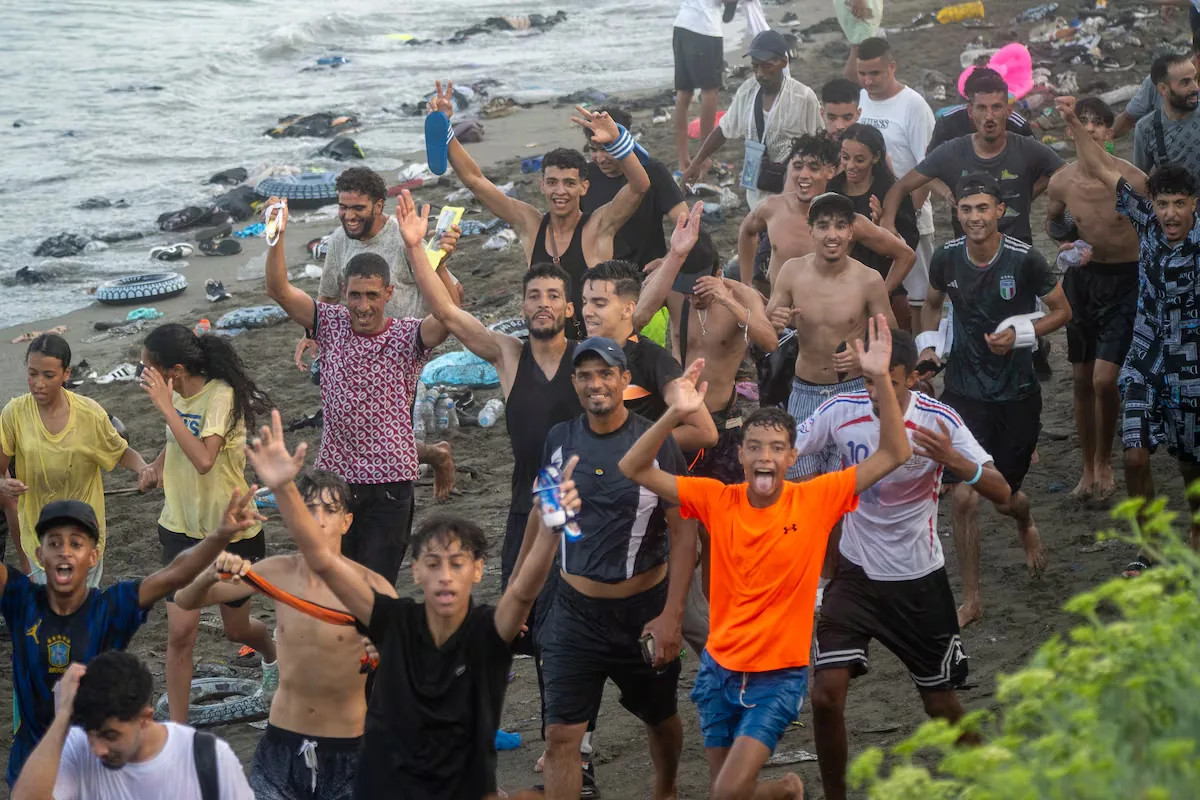
The incursion of 72,000 people into Ceuta from Morocco on July 30 and 31 was “a deliberately organized operation, constructed with a purpose and directed, not a spontaneous popular movement nor an accidental social contagion.” This is the conclusion of an investigation carried out by Golden Owl, a startup linked to the Scientific Park of the University of Alicante, after analyzing the activity of Moroccan social networks, especially intense between July 24 and 30. “It was a coordinated, pre-established, and publicized operation, executed as a distributed network through a coordination core, a public diffusion surface on Facebook with over a million declared members and dozens of pre-assembled self-assembled cells,” it emphasizes. “The desperation [of young Moroccans] is real and is the fuel that burns the operation, but the fuel is not the engine,” it underlines.
Read more Rufián calls Puigdemont «ridiculous» in the claim of his escape from Barcelona
To reach this conclusion, the report highlights that there was “selective and quota-based” recruitment ― one recruiter selected two girls and six boys for a cell and another assembled a “large group” for this purpose ― which would reveal a casting effort, not a mere flood. It also reveals how the organizers took security measures: hiding names, changing the keyword, using compartmentalized single-use accounts or cross-border phone lines. “Those who go to such lengths to hide their identity, geography, and coordination are not an accident, they are people who planned an operation and expected to be investigated.”
The study, dated August 3, is based on the analysis of 25 Facebook assets linked to the campaign. The operational core, made up of direct recruitment groups plus coordination and market groups, had about 478,000 declared members; while the entire surface reached 1,032,000 and the amplifying pages over half a million more. Being a member does not mean being a unique person, it warns, as the same accounts are repeated, “but it reveals great exposure.”
The researchers consider their “most important structural finding” to be that there was no leader, but there was “a brand and a market.” “The campaign is organized horizontally, not hierarchically. It has a name, a rotating coded vocabulary, a recognizable visual identity, and a set of shared slogans, but no central command, whose removal would cause it to collapse.” This is the reason, they argue, why it reached such a huge scale and is resilient to arrests and content removals: the brand generates demand and dozens of unconnected individuals supply the cells to cross the border.
The study identifies three layers in the operation: a closed coordination core, through private messaging, that “issued the brand call, set a meeting point and a unified time, debated crossing tactics [swimming or walking] and instructed followers; a public diffusion surface on Facebook made up of public groups and high-reach amplifying pages in Arabic that motivate candidates to migrate; and a lower layer of micro-recruiters, each of whom assembled their own cell and coordinated through private messages. To make their location harder, the WhatsApp or Telegram link was not included in their own posts but was systematically placed in the first comment of the same. Also, the keywords are not only changed but fragmented with punctuation marks, making them harder to scan.
Recruiter in Turkey
Regarding the political objective of the operation, the report states that “there is no single ideology” and “no node in the network is affiliated with any party, NGO, association, or registered institution.” The messages are crossed by three currents: “Moroccan anti-system populism, a framework of geopolitical literacy with an elitist tone, and an apolitical fatalism of exile.” Additionally, “two transversal markers ― a cultural Amazigh signature [the Berber culture of North Africa] and an environmental irredentism of occupied Ceuta ― appear everywhere.” All these currents are “partly antagonistic and the only thing they share is grievance against the Moroccan state and the belief that leaving is the answer.”
The study points to economic benefit as the ultimate reason for the operation. After highlighting that the free layer operates professionally and is monetized through audience growth that makes it suitable for advertising, it adds that there is a “paid layer,” which functions as “a genuine smuggling market. The same groups that carry out recruitment also advertise commercial sex or missing persons,” as well as ads with offers of mediation and fees to take young people from Casablanca or Fez to Ceuta. “A network that monetizes migratory intent, channels minors and women, and runs alongside a paid smuggling market.”
The core would be made up of “a small set of administrators and recruiters” who “provided the operational layer”; among them, a man from Casablanca residing in Istanbul (Turkey), who offered a Turkish WhatsApp line as a contact point and is considered “the most competent cell builder.” Also, an administrator who claims to reside in Rome and manages the largest node of the network, with the hashtag “haragaceuta” (Ceuta smugglers) and a syndicator from the Tetouan area who distributes content to three different groups of 50,000 members. Recruitment was national, not local.
Read more This is how the anonymous army of ‘patrons’ works in Spain: when (financial) unity makes strength
The researchers emphasize that the network uses a series of Algerian origin markers that individually may be circumstantial, but “taken together form a pattern too consistent to dismiss as coincidence.” In their opinion, everything points to “an operation led by Moroccans running on a set of assets of Algerian origin recycled or acquired.”
Active, but less visible
A new Facebook sweep completed by the same team last Thursday shows that the activity of this network remains operational, although it has become less visible after the massive entry at the end of July. “The [recruitment] network has been displaced, but not dismantled. Police action has degraded the observability [of groups promoting illegal migration] faster than it has degraded their capacity,” it warns. The authors of the investigation note that five of the most active groups in migrant recruitment, which together exceeded 200,000 members, have simultaneously ceased operating, probably due to pressure from the Moroccan police.
To escape authorities’ action, the network has moved to other host groups that, in theory, have no migratory purpose. The study cites a Tangier-Gueznaya job board, with 139,100 members, which it calls a “main node” and “head operator,” from which an “unequivocal mobilization call, in the first person” is made. Another group is called “youth of Castillejos Ceuta” and a third presents itself as a facilitator of “work contracts in Europe.” Their advantage is that they do not use the keywords of those specifically dedicated to migration, making them harder to detect. It is also more difficult to shut them down because they are legitimate groups dedicated to legal activities. Additionally, their audience is the target public of migrant recruiters: unemployed youth aged 18 to 25, many of whom would never join a group specifically intended for emigration.
While in their previous report the authors gave much credibility to the possibility of a new attempt to assault Ceuta on August 15, a call has circulated widely on Moroccan social networks in recent weeks, they now believe it “remains likely,” although it is unlikely to reach the scale of ten days ago. They add: “The probability that the effort lands somewhere other than the beaches of Fnideq [Castillejos] has materially increased.”
Recruitment networks operate on two levels. Outwardly, a public showcase on Facebook. Inwardly, closed WhatsApp groups accessed only by invitation. The report warns that people who declare they cannot swim are volunteering to try to enter Ceuta and that cases have also been detected of women inviting girls to accompany them from cities as far away as Agadir, 1,100 kilometers from the border. Other groups call to divert to the second Spanish city in North Africa, Melilla, theoretically less monitored, and report the arrival of groups to the neighboring Moroccan town of Nador, “with explicit instructions not to obey the orders of security forces.”
“The scale of evasion to confrontation is new and is the biggest change in the threat,” warn the authors of the study, who acknowledge, however, that they have no direct news of these instructions, only references in the Moroccan press. While previously the Nador-Melilla axis was a recipient of reroutes from Ceuta, now “it is the main designated target,” they add, so they recommend expanding monitoring to this last city and also to the departure ports from Algeria.
In short, the closure of the most active groups in the migrant recruitment campaign “eliminated the largest audiences of the campaign, but not its organizational layer, which was never on Facebook.” The most visible and easy-to-monitor spaces disappeared, it warns, and traffic was pushed towards general interest groups, not specifically dedicated to emigration, in which “it is much harder to detect” these operations. “Monitoring by group identification is no longer enough. Since the [recruitment] network will host itself in any large and lightly moderated Moroccan group, detection must focus on language and not on space,” it emphasizes.
Read more Jorge Messi dies, the man who guided Leo Messi to the top of the world