






The global economy has been subjected to multiple crises for more than half a decade. First was the collapse due to the covid-19 pandemic, which left business activity in a state of hibernation. When the world woke up, bottlenecks in global trade arrived, and almost immediately, an energy crisis that drove up commodity prices and triggered an interest rate hike. The conflict in the Middle East now threatens to unleash another wave of inflation that will once again hit citizens’ pockets. Again, flammable material that the far right can use.
The socialists put several economic recipes on the table this Friday to stop a redistribution of wealth that is happening from the bottom up: the ultra-rich already hold 17% of the world’s wealth. These include limiting the extra profits that will rain down on the big energy companies, obtaining more affordable housing, and protecting citizens to prevent the gap between billionaires and the middle- and low-income population from widening. “We must safeguard our democracy so that it does not become an oligarchy,” reminded Gabriel Zucman, economist at the Paris School of Economics.
The economic and fiscal debate marked much of the first day of the Global Progressive Movement (GPM), which is taking place in Barcelona. Oxfam data indicate that incomes at the top of the pyramid, where the richest 1% are, have grown twice as much as those at the base in recent years. And this accelerated with the inflation crisis derived from the end of the pandemic and the war in Ukraine. According to Isabella Weber, economist and professor at the University of Massachusetts Amherst, the richest 1% took 50% of the profits generated by the rise in raw materials, for example, through investment instruments. “The definition of being poor is not only not being able to pay for the most essential, but also not being able to participate in any of the generated profits,” Weber pointed out. “We must face the sharks and limit the profits,” added the economist, who stressed: “If we say we can do nothing about the basics, we are damaging democracy.”
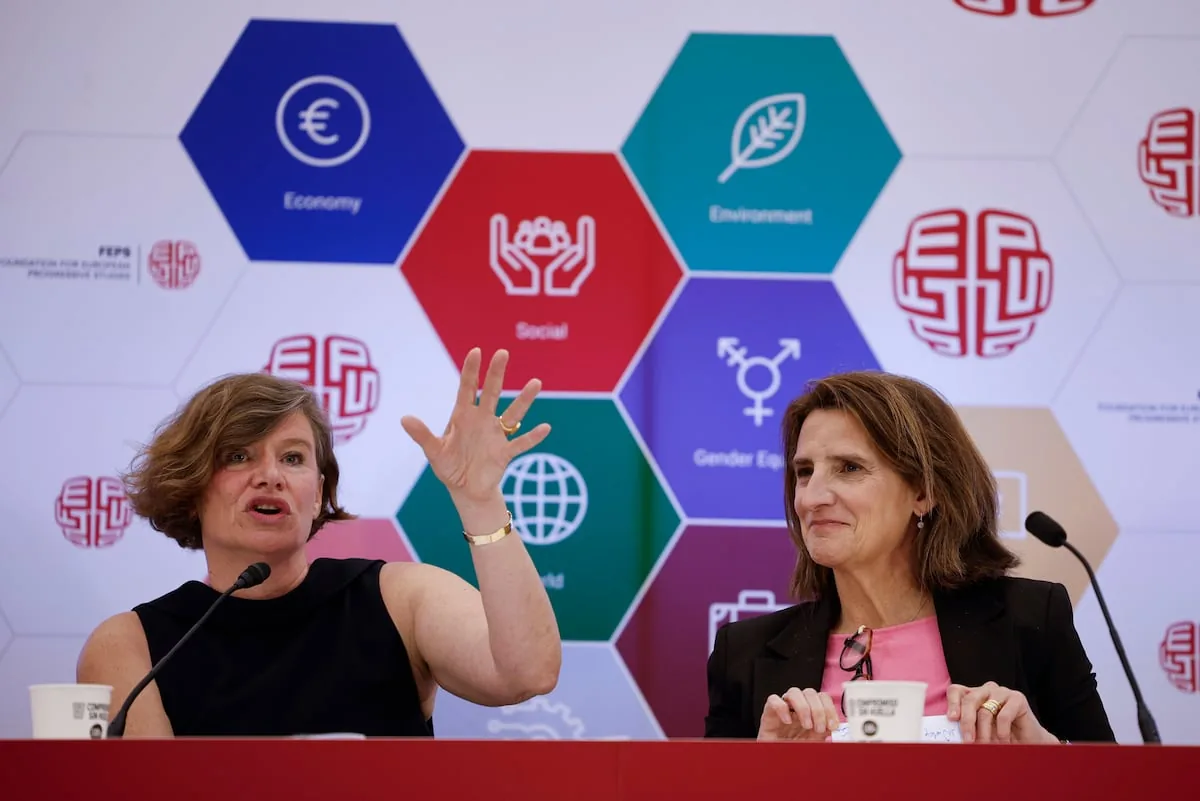
Economist Mariana Mazzucato, economist and professor at University College London, also advocated putting limits on the profits obtained from housing or public services such as energy or health, which have also ended up becoming “speculative assets” within investors’ portfolios. “We have socialized risks and privatized profits,” lamented the economist. Beside her, the First Vice-President of the European Commission, Teresa Ribera, advocated identifying society’s needs. And from there, seeking fair responses. “To concrete needs, concrete responses,” Ribera said.
It was the unions who most clearly referred to the threat that the far right will once again take advantage of the current context. “The fight for democracy is inside workplaces,” said Knut Dethlefsen, executive of the Friedrich Ebert Foundation (FFE). Both Unai Sordo, general secretary of CC OO, and Pepe Álvarez, leader of UGT, agreed with him. “We must recover the concept of community, and that is done with more fiscal and wage distribution measures and an improvement of public services,” Sordo maintained.
Read more Return to southern Lebanon: «We will raise a new generation that fights against Israel»
The fiscal lever
Taxation remains for the socialists the main lever to redistribute wealth and curb the rise of the ultra-rich. Mazzucato recalled the tax on so-called windfall profits, that is, those that energy companies and banks obtained from the 2022 inflation crisis. Zucman focused on the ultra-rich, insisting that the richest 0.0001% already own 17% of the world’s wealth after their wealth expanded at an annual rate of 7.5% between 1987 and 2026. “In France, the working and middle class are paying between 40% and 50% of their income in taxes for a good reason, which is to maintain the welfare state. But millionaires are only paying 25%,” Zucman explained, going further: “The ultra-rich now only pay 2%.”
The good news, the economist assured, is that there is already a global initiative to correct this trend that Brazil put on the table during its presidency of the G-20. It is about imposing a 2% wealth tax on the ultra-rich to raise about 250 billion dollars (211 billion euros) to combat inequality. “It is necessary to have a tax system in which those at the top pay what they should pay. And there the applicable minimum tax is important. We need fairer tax systems,” said the leader of the Australian Labor Party and former deputy prime minister of the country, Wayne Swan.
European socialists also advocated advancing that tax on great fortunes, which already exists in some countries like Spain. “The five richest people in the world have a trillion dollars. And there are 700 million people in the world without access to electricity. We have to get those great fortunes into the tax system. We cannot just say that a percentage of the richest have a certain percentage of the wealth,” reasoned the Swede Stefan Löfven, president of the Party of European Socialists. Teresa Ribera recalled the EU’s responsibility not to disappoint citizens’ expectations in the European project. “We need to defend ourselves and not remain silent when we see things we do not like. We have to be prepared to fight and not take for granted that we have things secured,” she concluded.