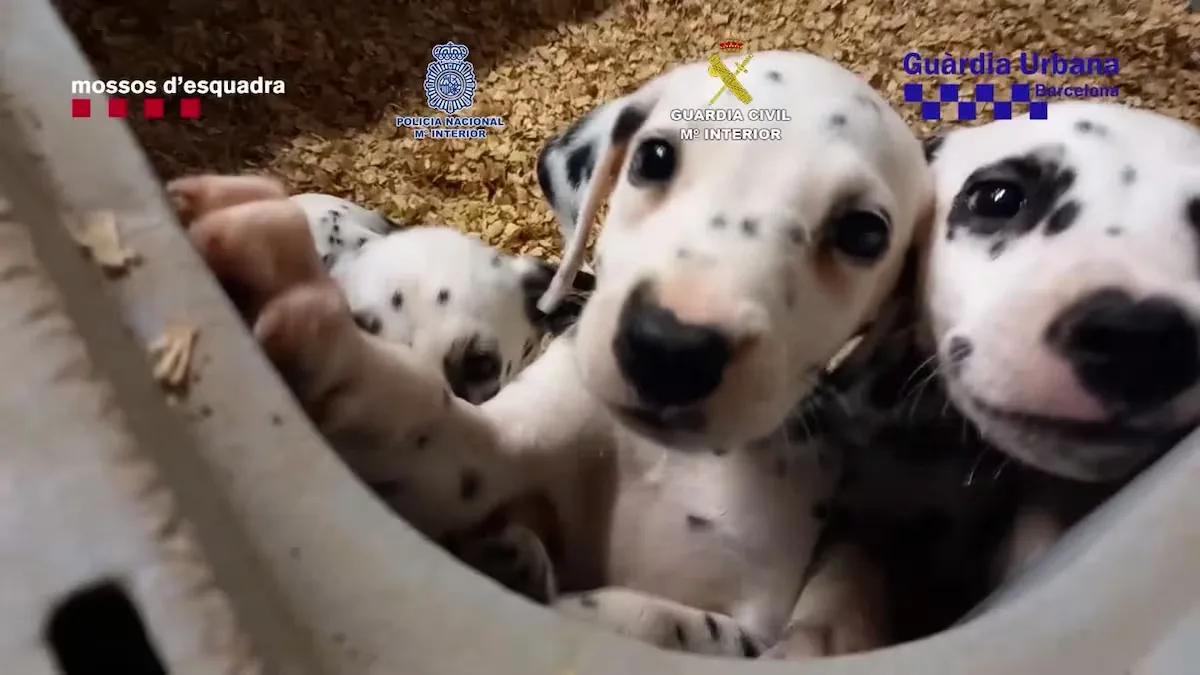
A police operation dismantled in 2023 an illegal network that trafficked animals, mainly puppies of dogs and cats, which they kept in dreadful living conditions before trying to sell them and thus achieve the maximum profit from their business. After the judicial investigation was concluded, the Prosecutor’s Office has decided to request between 5 and 17.5 years in prison for six members of the group accused of forming a criminal organization, mistreating animals, falsifying documentation, and ultimately defrauding customers, to whom they repeatedly delivered sick animals that in some cases died days later. A tangle of companies was used to channel this business, which allowed its leaders to live a luxurious lifestyle: their profits enabled them to acquire properties (one in Dubai), drive a Ferrari or a Maserati, and wear Rolex watches.
Read more Euromillions: Friday, August 7 draw
In its indictment, the Environment section of the Barcelona Prosecutor’s Office collects the testimonies of 35 people who, between 2018 and 2023, were victims of the illicit business set up by the group, which operated through different pet shops, breeders, and a veterinary center, as well as importing puppies from Eastern countries at a young age despite regulations prohibiting it. One of them recounts the purchase by a woman of a Jack Russell puppy on January 26, 2020, for which she paid 786 euros and which ended up dying three days later suffering from coronavirus and parvovirus, lacking vaccination. Another client acquired a Border Collie for 968 euros, which she had to euthanize two months later after unsuccessfully investing another 3,979 euros in the veterinary clinic of the same group, without recovering a single euro from the scam.
Two more linked accounts border on the absurd: the purchase of a cream-colored French bulldog for 1,210 euros. The shop assistant at the store called Bitxets explained to her client that the dog had three months to live, not five as the documentation stated, because the age was altered to circumvent the legislation that allows the entry of animals for commercialization in Spain. In any case, a day later the dog began to suffer vomiting and dry cough, so they advised her to take it to Vetpro, the veterinary clinic of the network, although it was ultimately the shop assistant who took care of the puppy. After 14 days, the owner returned to the establishment to pick up the animal, but the employee refused to hand it over, even when the owner returned accompanied by the police. Why? Because she could not. The same puppy had already been sold to another man, who paid 1,000 euros for it and had to take it first to a veterinary clinic on his own and then to Vetpro to treat the sublingual lump and bloody stools it was suffering from. When he returned to the center to recover that special specimen, the clinic was already closed: the Barcelona Urban Guard had shut it down as part of a joint operation with Mossos d’Esquadra, National Police, and the Civil Guard. It was later revealed that it was not a bulldog but a mixed-breed dog.
The Prosecutor’s Office concludes that the sole objective of the network in its business of importing, breeding, caring for, and selling animals was “the obtaining of economic benefit through the systematic reduction of costs at the expense of animal welfare.” And the entire structure was set up for that purpose: the successive companies used, the front people in the businesses, the supply circuits, the logistics. The two leaders of the network, A. E. A. P. (for whom they request 17.5 years in prison) and C. P. B. (14.5 years), besides managing the whole corporate mess, assumed veterinary functions such as scheduling vaccinations, administering medications, or implanting microchips, as well as making other clinical decisions. N. V. A. (9.5 years) was in charge of the Bitxets store and the sale of pets there, while R. D. L. R. (partner of A. E. A. P. and in whose home two pistols were found despite not having a license, for which he is also requested 17.5 years) had administrative organization and document control functions, including regularizing the animals’ documentation. Even a veterinarian who is also accused, M. L. F., facing 9.5 years, signed documents left blank to be later completed under the criteria her partners deemed necessary. As a professional, the Prosecutor’s Office holds her responsible for “serious non-compliance with animal care, health control, and welfare regulations,” after prescribing medications by phone without even examining the animals. E. P. D. R., cousin of the group leader, handled the more corporate and investment functions, so he is accused of alleged money laundering and risks spending 5 years in prison.
Read more The beach bar, praise and vindication of a popular institution
The facilities where the group operated had “serious hygienic-sanitary deficiencies.” The veterinarian herself had described them at some point, the prosecutor’s document states, as “a disaster,” which fostered the appearance of serious infections in the animals. They acquired puppies abroad to take advantage of their low price and transported them in “deficient” conditions, in unconditioned vehicles (one with Slovak plates carried 71 animals) on journeys exceeding 20 hours by road. After a potential client’s complaint, an Animal Protection team from the Barcelona City Council entered the establishment and, after observing the disastrous conditions, saw that all the animals were imported and were younger than the required age (15 weeks) for commercialization. Thirty-five (out of 42) animals with health problems and undiagnosed despite needing to be in a veterinary clinic were seized.
Dirty centers, without ventilation and without space
During the intervention at a center used as a breeding place, called B Huella, investigators found a floor full of urine and feces, no ventilation, and poor lighting. In another space intervened, a dog with an old tibia fracture was found and had to be amputated. A veterinarian certified that it was used as a dog and cat breeding center without authorization and that “multiple” females suffered pathologies linked to intensive breeding practices “consisting of continuous matings and pregnancies without respecting physiological rest periods.” In another, a six-month-old dog could not get up from the rear due to the overcrowding conditions in which it lived for four months, barely allowing it to move.
In addition to prison sentences and fines for professional intrusion committed by some of the accused by assuming veterinary functions, the Prosecutor’s Office demands that the clients listed in the case recover the money they paid for the animals and that the accused return more than 287,000 euros that various city councils and animal welfare entities had to cover for the maintenance and veterinary care expenses of the animals seized in the operation.
Read more Friends, vacations, and different budgets: why money can be a threat that ruins the trip