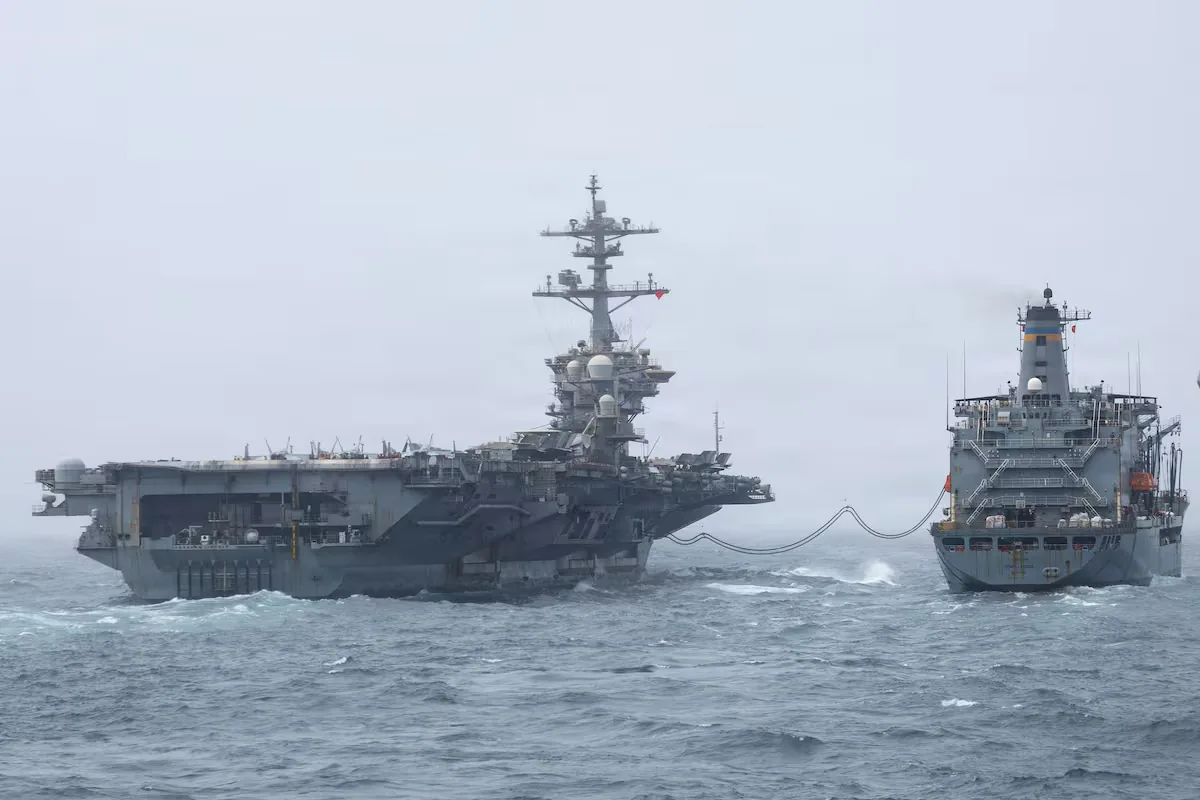
The U.S. aircraft carrier George Washington and its strike group have already arrived this Thursday in the Middle East to relieve the troubled Abraham Lincoln, which has accumulated seven months of service in the area, and whose crew members’ families denounce a serious deterioration in the sanitary, food, and mental health conditions of its sailors.
In a message on the social network X, the United States Central Command (Centcom), responsible for the country’s military operations in the Middle East, confirmed the ship’s arrival. “The George Washington strike group is operating in the Middle East on a scheduled deployment, after having arrived yesterday in the Centcom area of operations,” the military command wrote. The text is accompanied by a photograph showing U.S. sailors working on the aircraft carrier’s flight deck.
U.S. Sailors work on the flight deck of USS George Washington (CVN 73), Aug. 20, as the aircraft carrier transits the Arabian Sea. The George Washington Carrier Strike Group is operating in Middle East during a scheduled deployment after arriving in the CENTCOM theater yesterday. pic.twitter.com/DEkHHukHeI
— U.S. Central Command (@CENTCOM) August 20, 2026
Last week, the U.S. Navy announced that the Lincoln would end its deployment and return to the United States for repairs and crew rest. The journey of this nuclear-powered Nimitz-class aircraft carrier has been much longer than usual: the ship departed its base in San Diego, California, last November and was deployed in the Asia-Pacific before receiving orders to head to the Persian Gulf.
The ship arrived in the Gulf of Oman one month before the United States and Israel launched the first attacks against Iran on February 28. Its mission in that area has set a deployment time record: 272 days, without anchoring in a port except for two very brief resupply stops. One in December in Guam and another in Oman in July.
Besides the prolonged deployment duration, the damage caused by Iranian attacks on the U.S. naval base in Bahrain, which hosts the Fifth Fleet and is the logistical center for U.S. forces in the Persian Gulf, has taken its toll.
Last week, a series of complaints about the poor conditions on board were leaked. The very long deployment had triggered maintenance problems and shortages of food and hygiene products. The lack of port access and the conflict situation had prevented taking rest days.
Several Democratic opposition lawmakers expressed concern about the situation of the nearly 5,000 crew members. Senator Richard Blumenthal even wrote a letter to Defense Secretary Pete Hegseth and Navy Secretary Hung Cao to request explanations about the shortage of basic supplies, water contamination, complications with drainage systems, and the deterioration of the military personnel’s mental health.
Read more Price of gasoline and diesel rises in Chile: how much it increases according to Enap
Some accounts from family members, collected by the military publications Stars and Stripes and Navy Times, reported that several crew members had wanted to jump overboard to commit suicide, driven by despair. Three U.S. officials also told CNN that a sailor fell overboard earlier this month; he was rescued in less than an hour and, wearing a life jacket, was not injured. According to sources cited by the U.S. media, the Navy considers the incident a mental health-related episode.
In a social media message last Friday, Cao denied the problems reported by the media but acknowledged some incidents: “There were a small number of mental health cases, with no loss of life.” He also admitted that they had to “adjust” food plans “when it was not possible to restock fresh products,” but emphasized that “not a single meal was ever missed.” He added: “Calls home were limited when the operational threat was too high.”
Long journey back
After the arrival of the George Washington in the Middle East, the Lincoln will finally be able to return home. But it will not happen immediately: the return trip is about 22,000 kilometers, a distance the ship may take four to five weeks to cover.
The Lincoln is not the only aircraft carrier that has suffered problems due to its long deployment. The Gerald Ford, the largest in the world, which was also participating in naval operations near Iranian waters, had to leave the area and head to the Mediterranean for emergency repairs after a serious onboard fire destroyed several crew dormitories and damaged basic equipment.
The George Washington aircraft carrier, a Nimitz-class like the Lincoln, has its permanent base in Japan. It is the only U.S. aircraft carrier permanently assigned to the Asia-Pacific. But given the demands of rotations in the fleet of these ships— the United States has 11 nuclear-powered aircraft carriers in service— the need for repairs and crew rest on some of them, and the prolongation of the war in Iran, the Pentagon has decided to temporarily forgo that protection in Asian waters.
It is not the only military asset the Pentagon has withdrawn from its bases in the Asia-Pacific—the area that for two decades its strategists have considered a priority due to China’s military rise—to use in the war against Iran. An expeditionary unit (MEU), led by the destroyer Tripoli and with a complement of 2,500 men, received orders to move to the waters of the Gulf of Oman in March. The Department of Defense has also drawn on its Asian arsenals to replenish ammunition, interceptors, and air defense equipment in the conflict in the Persian Gulf.
Read more East of Eden