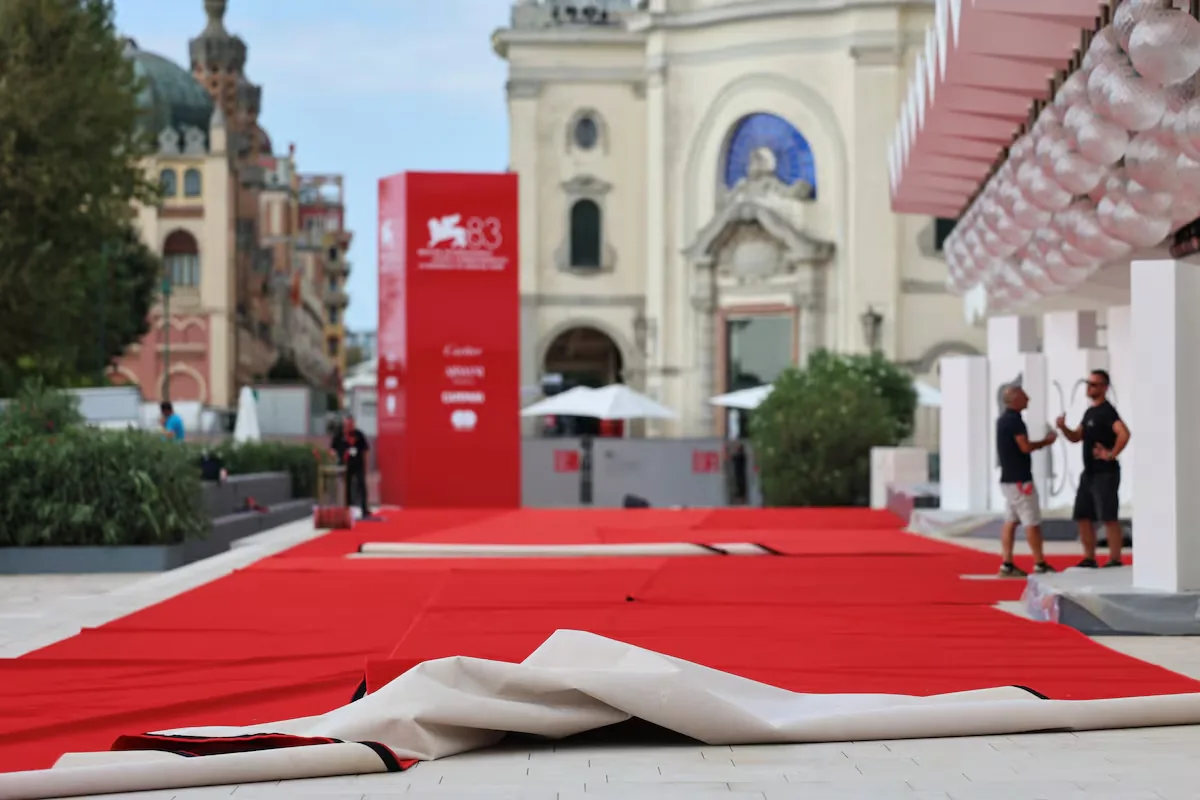
In a world increasingly saturated with irrelevant images and an inevitable scent of déjà vu, the Venice Film Festival opens the doors of its 83rd edition this Wednesday with an agenda marked by a real war horror film. As happened a year ago, the Venice4Palestine collective, which in the last edition achieved significant pro-Palestine mobilization, has returned with a new letter titled And Yet Gaza Keeps Burning, signed by writer Annie Ernaux, artist Nan Goldin, and filmmakers Matteo Garrone, Marco Bellocchio, Abel Ferrara, Céline Sciamma, Isabel Coixet, and Alice Rohrwacher, among others.
Read more Ghosts, ‘yokais’ and other monstrous inhabitants for a hot autumn
The document demands that the festival maintain a public position of solidarity with the Palestinian people and fly their flag throughout the festival, as four films about the war are participating: from Al mowaten Osama, by Ahmed Hassouna, a documentary about one of the photojournalists who stayed in the Gaza Strip during the Israeli military offensive to Hiwar ma’ albahr, by Muayad Alayan, set in Jerusalem, which narrates the trial brought by an Israeli court against an old Arab man for the debts of his deceased son, or the “musical and visual” journey, El camino a Jericó, by veteran Amos Gitai.
The fourth film will be the one that puts the definitive focus on Gaza. Titled with the acronym NAZA, it is the only one participating in the competition and its inclusion was last minute. According to the festival note, it is a documentary “filmed on the rooftops of Tel Aviv” that reveals “the systems behind the calculated mass murder of Palestinian civilians.” Directed by Israelis Yuval Abraham and Rachel Szor, two of the directors of No Other Land, a documentary that won the Oscar in 2025, it is produced by the British newspaper The Guardian and has as executive producer Jonathan Glazer, the director of The Zone of Interest, about Rudolf Höss and Auschwitz, who has been one of the first Jews in the film industry to demand an end to the dehumanization of Palestinians and the instrumentalization of Holocaust memory.
In the last edition of the festival, questions to participants about Gaza were persistent. The then jury president, American filmmaker Alexander Payne, avoided commenting in the traditional jury press conference but ultimately ended up awarding a film denouncing the brutal Israeli war campaign, The Voice of Hind. Its director, Tunisian Kaouther Ben Hania, is part of this year’s jury, chaired by American actress and director Maggie Gyllenhaal. Payne then claimed he did not feel “prepared” to respond. His evasiveness was at least smarter than that of German Wim Wenders, president of the last Berlinale jury, who, faced with the recurring question about Gaza, got involved in the mess that art must “stay out of politics.”
This year, the jury’s meeting with the press has been called, canceled, and called again in a strange dance attributed to scheduling problems of its members. It is likely that the recent controversy at the Art Biennale in the city added concern to its long-standing cousin, the film festival. The final inclusion of the Russian and Israeli pavilions caused a tsunami—daily protests, including actions by Pussy Riot and FEMEN in front of the Russian pavilion; the request of 200 artists to expel Israel or a strike—that ended with the jury’s collective resignation, which referred in its withdrawal to investigations for crimes against humanity in Ukraine and Gaza.
Read more A reader to Shakira: “Madrid does not celebrate Latin culture, it celebrates money”
The other controversy prior to the start of the Mostra has to do with the poor female representation in the competition. Among the twenty or so films selected to compete for the Golden Lion, only two are directed by women.
These are the drama Woman Unknown, by Danish-Egyptian May el-Toukhy, and the aforementioned NAZA, co-directed by Rachel Szor. This drastic reduction in the participation of female perspectives has raised alarms about a festival in which in recent years two female directors have won the Golden Lion, Audrey Diwan for The Happening (2021) and Laura Poitras for All the Beauty and the Bloodshed (2022).
Faced with the avalanche of criticism, the festival director, Alberto Barbera, explains: “Unfortunately this year, besides the number of films directed by women dropping to 24% of those we received, the quality was worse.” The new works of Nanni Moretti, Werner Herzog, Hirokazu Koreeda, Danny Boyle, or Martin McDonagh did pass the selection.
Faced with this drop of female directors in the front row, in the second most important section, Orizzonti, almost half of the selected films are directed by women.
Read more Peridis: “Shake the strawberry tree!”