




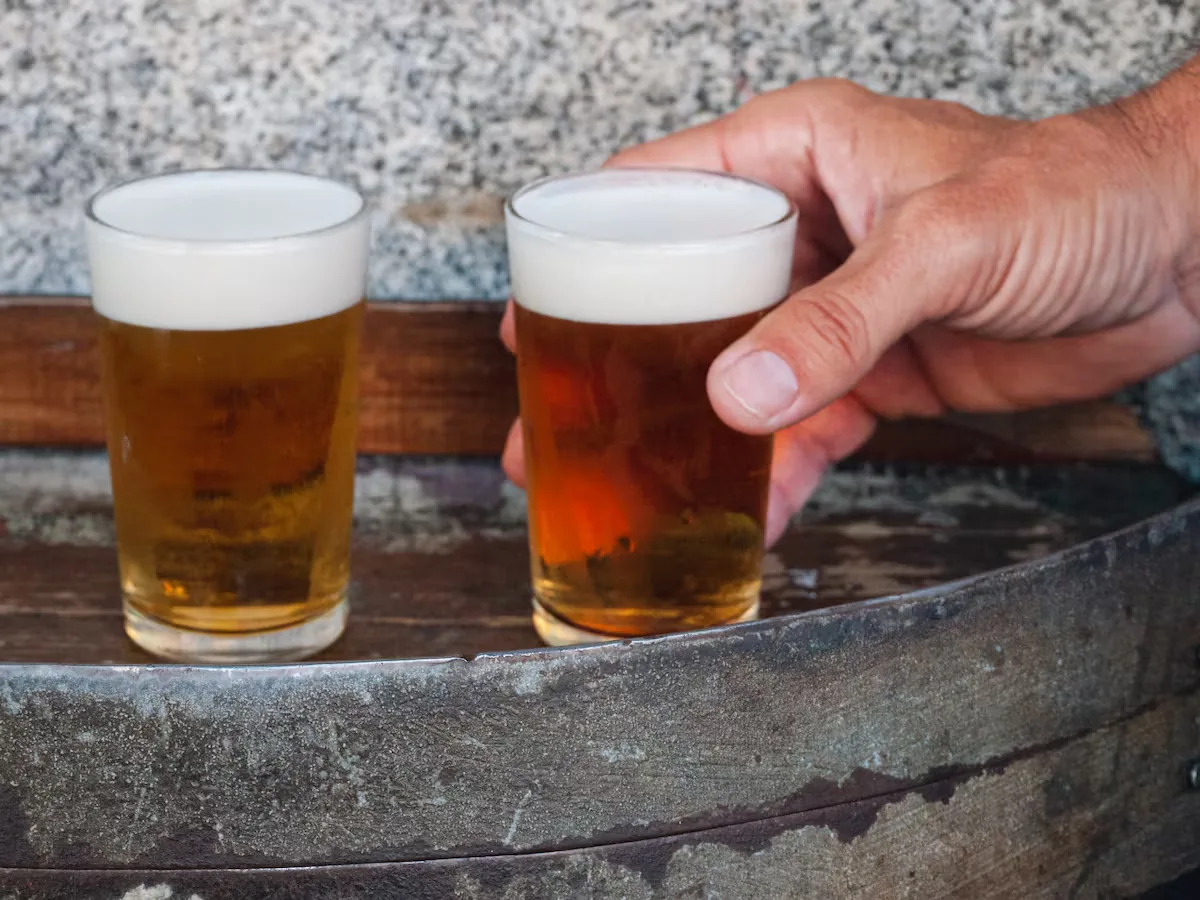
Repeat after me, a “caña” is a small-format glass —between 200 and 250 ml— where you can enjoy a draft beer. This is how it has been known in Madrid since time immemorial. Although today, many places call “cañas” doubles, glasses, or even tubes. It seems that the terminology has shifted, and with it has come its near disappearance, due to serving a little more and charging a lot more. “Cañas”, like half portions, canapés, or “free” tapas, are not liked by a large majority of Madrid’s hospitality industry. I’m sorry, but that’s how it is. Today it is difficult to find “cañas” in certain neighborhoods, and let’s not even talk about terraces, where they seem completely extinct. As in many of their bars, where it is now impossible to stop, stand, on the fly, without a reservation, without sitting down, and order one.
Read more Ansu Fati, from football to music as a way of escape
It’s absurd, but it’s happening. Isabel Díaz Ayuso, president of the Community of Madrid, visited the Mahou factory a month ago. There we saw her serving beers, not “cañas”, in glasses, and drinking from another glass, which was also not the canonical “caña” glass. It’s sad to see how a format that has always worked, due to the freshness and speed with which it was consumed, and which played with the idea of offering a relatively economical drink, capable of quenching thirst, is now barely found in many bars, taverns, and pubs. As for restaurants and “cañas”, let’s forget about it. We are left with its use as a glass for coffee with milk. It’s something.
If we review a bit of Madrid literature, we will see how the term “caña” was already part of our DNA, mostly from its breweries. There were Santa Bárbara, Fass, the different locations of Cruz Blanca or, of course, the legendary Cervecería Alemana, located in Plaza de Santa Ana. The Chilean journalist Luis Enrique Delano recalled in his memoirs about Madrid, a city he visited during the end of the Republic and the years of the Civil War, that “cañas” were mostly blonde, cost 35 cents, and were served with a small plate of peanuts. Francisco Umbral wrote, in what was his first novel, Travesía de Madrid, published in 1966, that “any cheerful stronghold, any sunny corner is good to wall oneself off against the idea of death, to save oneself eternally for a few hours while the beer ‘caña’ lasts, which in the end is warm and sweetish and must be left in the glass.”
Umbral, who had returned to Madrid in 1961 as a correspondent for El Norte de Castilla, and who traveled the city on a Vespa, from one watering hole to another, knew that the “caña” was the most popular thing in the world. His doormen drop by the Salamanca neighborhood and drink “cañas de cerveza with the servants and mechanics from big houses who come down, uniformed and elegant.” It is in that decade, almost finished, when Ignacio Aldecoa places the characters of Los pájaros de Baden-Baden, his particular portrait of that hot Madrid, with the Manzanares, “paralyzed and submarine,” showing its silver back. They, Pablo and Elisa, protagonists who flirt in the pre-Tinder era, drink “unpleasantly lukewarm” beer —understood as “cañas”— with crabs, at marble tables. Terraces that, in summer, look towards Casa de Campo.
A writer who knew a lot about this, Rafael Chirbes —he wrote for decades for the gastronomy magazine Sobremesa—, reminds us that even the French have their own “caña”, which they call dèmi. He recalled it in a notable book, a compilation of wanderings around the world, with a beautiful title, El viajero sedentario. “The bar in Madrid was an excuse, a justification, a metaphor. You just went to the bar,” says Antonio Gómez Rufo in his history of Madrid, which connects the capital with life in its bars, “cañas” in between.
Read more How a total solar eclipse looked a century ago
The characters of the very Madrid-born Almudena Grandes also go out for “cañas”, toast and socialize in many of her novels, which usually take place in the central neighborhoods of the capital, where she lived. If we move to the immediate present, the custom of going out for “cañas” continues. This is told by Elena Medel in her recommended Las Maravillas, a story about money in which celebrations are not with champagne or wine, but with “cañas”; or Sabina Urraca who, in addition to leaning on the bars of Lavapiés, like the disappeared La Inquilina, travels back to the times of 11M in Soñó con la chica que robaba un caballo to drink “flat cañas” alongside Stuart Murdoch, “a golden figurine to venerate.”
I remember the bars of Paseo de Extremadura, the neighborhood where I was born and spent my adolescence, and their ice-cold “cañas”. There they were, and in their adjacent streets, next to the Alto de Extremadura market, the García brewery, El Arias, El Cachirulo, La Gloria, El Romar, El Alcubilla, Los Arcos, El Cordobés —on whose sign one could read “House founded in 1967”—, La Villa, Las Damas, La Jara. Today nothing remains of those establishments, nor of their “cañas”, which disappeared with them.
Meanwhile, mythical places reopen, but with present-day customs, reminding us that a “caña” is no longer a “caña”. In Los Gabrieles, the tavern rescued from the most lumpen Madrid of Echegaray street, supposed 330 ml “cañas” are served for 4.50 euros. The same happens in Manuel Vicent’s Café Gijón, where they don’t serve “cañas”, but glasses. Despite everything, they call it “caña”; it even appears that way if you ask for a ticket. And what’s left for us? It is still possible to drink “cañas” in Madrid, in most of its neighborhoods, also in the center, in old bars, like Rocablanca or Peñacruz; in traditional seafood restaurants, like El Fide or El Doble; or in establishments that maintain the essence of a bygone Madrid, like the two Alfaro, in Lavapiés, or La Mancha, which continues to be the place where many learned to see how “cañas” were properly poured.