









When Donald Trump returned to power in early 2025, and he and his collaborators redoubled their harangues in favor of the European far-right, it sounded like a blessing in this ideological field.
Read more The quiet revolution of Zohran Mamdani completes 100 days
“Sensational!” commented Tino Chrupalla, co-chairman of Alternative for Germany (AfD), to EL PAÍS one day after an election rally in a town near the German-Polish border. The German politician had heard, that same day, US Vice President J. D. Vance’s attack on European elites in a speech in Munich. “I had never heard such a good speech from a foreign politician in Germany,” he celebrated.
Little more than a year later, little remains in these parties of the euphoria of being Trump’s chosen ones and the privileged allies of the world’s leading power. The euphoria, over time, first transformed into discomfort and finally into rejection.
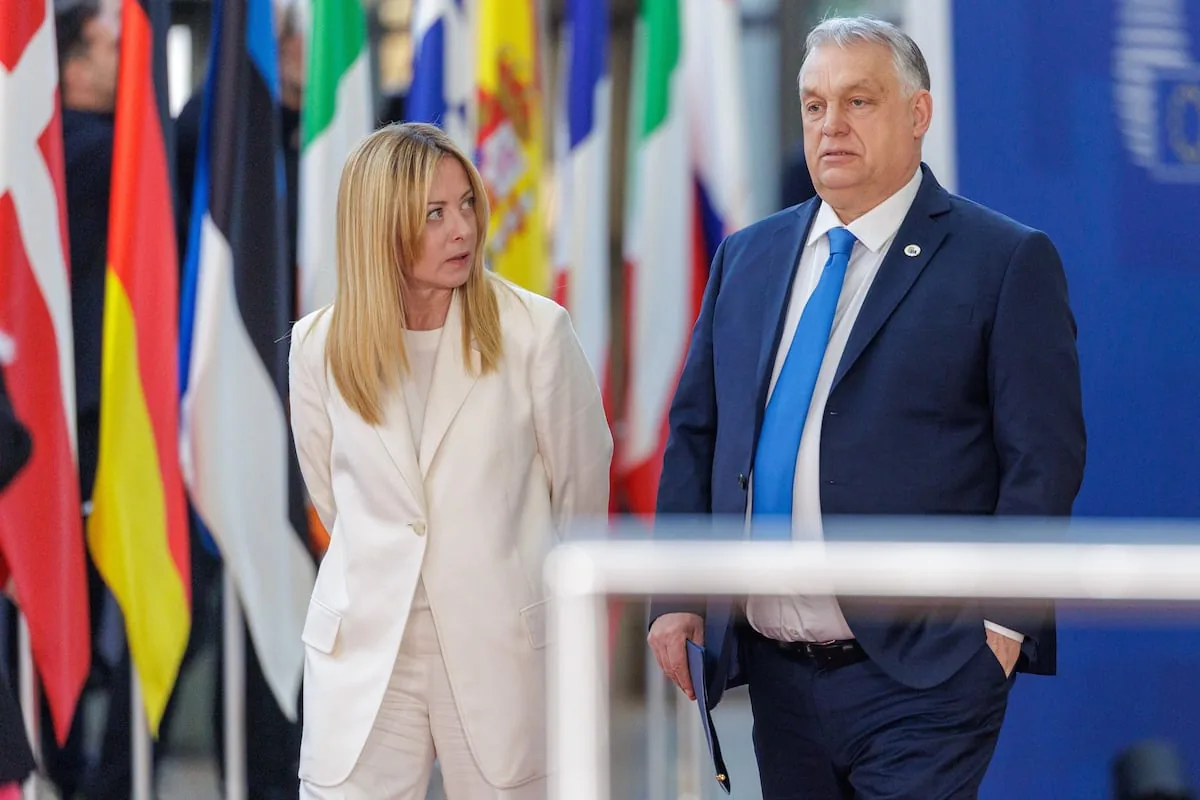
The idyll has been cut short, and there is no more eloquent example than the spat this week between the US president and Giorgia Meloni, who until recently was one of his privileged allies in Europe. “I thought she was brave, but I was wrong,” Trump complained after Meloni called the US president’s criticisms of Pope Leo XIV “unacceptable.” The Italian prime minister has also distanced herself from Trump’s war in Iran.
The European nationalist right has realized that Trump’s support comes at a cost, as seen in the April 12 elections in Hungary. Vance’s visit during the campaign to support Viktor Orbán, prime minister and candidate for re-election, did not decide the outcome, but “it was a kind of political kiss of death, and it didn’t help,” explains Daniel Hegedüs, deputy director of the Institute for European Politics in Berlin.
And now the same Chrupalla who in February last year celebrated Vance’s words directly demands the withdrawal of United States troops from Germany, and sets socialist Pedro Sánchez’s Spain as a model for having said “no” to Trump. “We are a party of peace,” Chrupalla proclaimed a few days ago at a local AfD congress, before criticizing “wars contrary to international law, such as those of the US and Israel” in the Middle East.
“Donald Trump’s war aims in Iran are erratic,” corroborated Jordan Bardella, Marine Le Pen’s protégé at the head of France’s National Rally (RN), in a television interview. In 2017, when Trump had just won the presidential election for the first time, Le Pen made a pilgrimage to Trump Tower in New York, although the magnate did not receive her. A year later, Steve Bannon, a Trumpist ideologue and then an inner circle advisor to the president, was the guest star at a congress of the French far-right party. It’s over, and the change, in the French case, is explained as much by White House policies as by traditional French sovereignism, and the distrust of Washington, which is transversal in this country. Now Bardella says about the Iranian crisis: “No one is able to say what the ideological backbone of this war is, the end of which is not in sight.”
This is the majority opinion of parties in Western Europe who not long ago believed that Trump’s blessing served to normalize them, get them out of the corner of proscribed ideologies, and help them conquer power. There are exceptions, some who find it harder to distance themselves from the White House, such as Spain’s Vox. And Trump and the US are too powerful and influential for the European far-right to completely give up an alliance that serves to project themselves as parties of power, and which will continue to be useful, depending on the circumstances. But the distancing has not happened overnight; it has been brewing for some time, and may have permanently changed the relationship with the leader and pioneer of the new global populism.
First came the tariffs, which could hit European industry and the workers or farmers who are an electoral stronghold for parties like the RN in France. Then, the operation in January in Venezuela and the US president’s idea of conquering Greenland, an autonomous territory of the Kingdom of Denmark, a violation of national sovereignty, which is a red line for many of these parties. And now Iran. Meanwhile, the Trump Administration published its National Security Strategy in December. The document encouraged “cultivating, within European nations, resistance to Europe’s current trajectory.” At the time, it seemed like good news for far-right parties, and having Washington’s backing will never cease to be an asset. Now, the asset turns toxic.
“For populist parties, Trump appears almost as a liability,” says Dominique Moïsi, special advisor to the French think tank Institut Montaigne. “The image of Trumpian America has deteriorated in Europe. Populist parties relied on the idea that the United States opened the way by electing a populist president, and Europe would be next, but now this idea is questioned.”
Canada and Australia discovered that excessive closeness to Trump can be counterproductive in a few days, when elections were held between late April and early May 2025. In both countries, conservative parties, more or less aligned with Trumpism, started with an advantage, and it was, among other reasons, due to the Trump effect that moderate or center-left candidates, Canada’s Mark Carney and Australia’s Anthony Albanese, turned the result around. The case of Canada became an example that is kept in mind in Europe at every election. The Liberals reversed the polls after the US president threatened to annex Canada and make it the 51st state of the Union. The favorite candidate, conservative Pierre Poilievre, collapsed. Carney’s resounding “no” to Trump yielded clear electoral dividends.
Although the effect is not always clear or direct, Trump is on the minds of many voters every time they go to the polls, even far from the US. Meloni lost the referendum on judicial reform in Italy in March, a result partly explained by “the growing gap between her sovereignist stance, which has led her to approach President Donald Trump, and the economic damage caused by her American ally,” assesses Arturo Varvelli of the ECFR think tank (European Council on Foreign Relations) in a report. When the Republican threatened to destroy Iranian civilization a few days ago, his British ally Nigel Farage reacted: “I am baffled to hear this. It is over the top by any measure.”
In the recent Hungarian elections, Orbán, apostle of illiberal democracy and European Trumpism, a politician who had woven close networks with the MAGA movement (the Trumpist Make America Great Again movement) like few others, and who received the backing of prominent figures from the Trump Administration, was defeated. It didn’t work.
“The attention paid by the US, particularly by figures like Vance, represented more of a distraction than a help, taking away time that Fidesz [Orbán’s party] should have spent campaigning directly with voters,” says Frank Füredi, executive director in the European capital of the Mathias Corvinus Collegium, a think tank and training center in Orbán’s orbit, in Brussels.
“Although we cannot know if Trump harmed Orbán, probably not, he certainly didn’t help him, or didn’t help him enough,” says Nathalie Tocci, director of the Institute of International Affairs in Rome. “Trump’s toxicity is clear,” she adds. “But something that can be said not only of the far-right in Europe, but also of Friedrich Merz’s Christian Democratic Union [German Chancellor] or Starmer’s Labour Party [Keir, British Prime Minister], who tried to be friends with Trump, and this has a political cost, and it is increasingly clear.”
Tocci underlines a fundamental contradiction in the alliances of the global far-right: they are nationalist parties whose creed, on paper, is the defense of national sovereignty, but they are forced to cooperate with leaders who want to undermine this sovereignty, like Trump. By definition, they end up clashing with each other. “The nationalist international,” she says, “has more developed networks than liberals and progressives, but being nationalists, they pursue policies that harm each other.”
One of the parties that has most developed these international networks, in addition to Fidesz in Hungary, is Vox. The Spanish party has forged an alliance with Washington that projects into Latin America, explains Guillermo Fernández-Vázquez, professor at Carlos III University in Madrid and author of What to do with the far-right in Europe. The case of the National Front (2019, Lengua de Trapo). This intimate link distinguishes it from formations like the French RN and perhaps explains why Vox finds it harder to cut ties with the Republican leader.
“It’s as if Vox and the Trump Administration had formed a marriage, but an unbalanced marriage, because Vox is more interested than Trump. Now Vox is handcuffed. It has no room for maneuver, because it is at the mercy of Trump’s whims,” says Fernández-Vázquez. “I see Vox tied to him and at the same time bewildered because it didn’t expect this war and it puts them in a difficult position.”
Another factor that distinguishes Vox from parties like the RN or AfD is that the Spanish party is weaker in the polls. Although it participates or has participated as a junior partner in regional governments, it is still behind the major parties in the polls, PP and PSOE in the Spanish case, and perhaps does not yet see the need to center itself, or to de-Trumpify itself. This is not the case for the French RN, which has options, according to polls, to conquer the Élysée in the 2027 presidential elections.
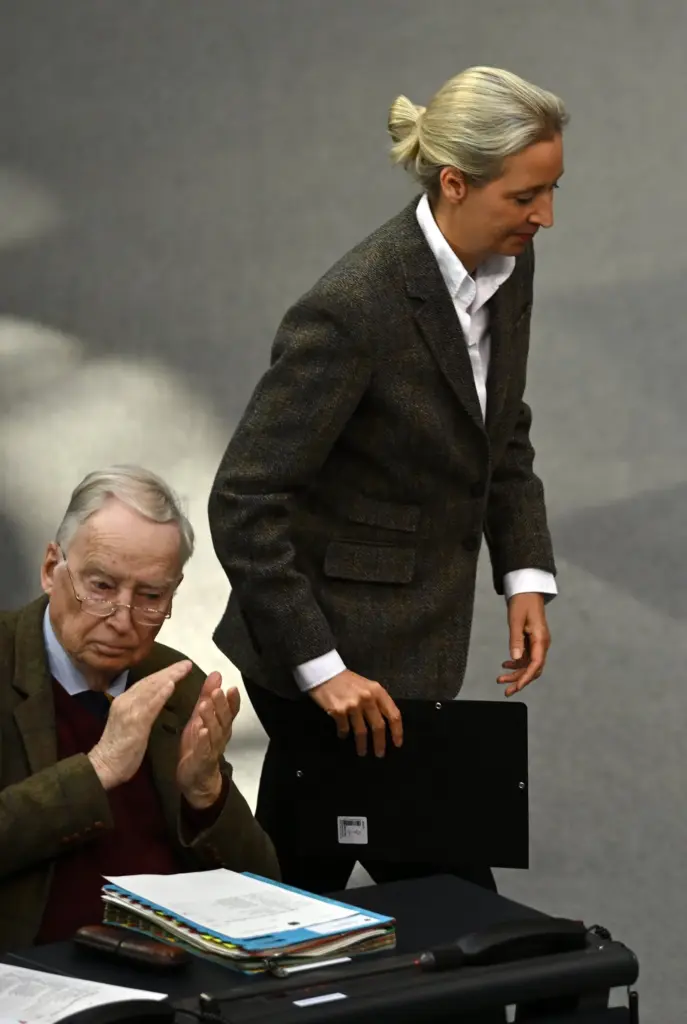
AfD, in Germany, leads some polls for the still distant 2029 elections, but is divided by the relationship with the US. There is a faction rooted in the territories of the former German Democratic Republic, more anti-American, anti-liberal, and pro-Russian. Chrupalla, the co-chairman of this party who cited Spain as an example in the Iran war, is the head of this faction. There is another, more pro-American and liberal, rooted in the West, more linked to the MAGA movement and led by the other co-chair, Alice Weidel, who is now also distancing herself from Trump. “It’s a catastrophe,” Weidel said at an internal meeting when the American demanded NATO’s help in the war, as reported by the public broadcaster ARD.
“Proximity to Donald Trump and the US Administration, simply because of their erratic, unpredictable, and unfriendly behavior, can cause harm [to these parties],” summarizes Hegedüs of the Institute for European Politics. “But there is another structural aspect,” he adds, referring to Hungary, “and that is that they went too far with international support, and they are not credible as political forces focused on national interests.”
Dominique Moïsi believes that “if European populism wants to continue advancing, it must distance itself from American populism.” “The image of Trumpian America has become so unpopular in Europe that being close to Trump is not a source of legitimacy,” he adds. “In the recent clash between Trump and Meloni,” observes Nathalie Tocci, “she probably expected his reaction, and must have calculated that it would be beneficial for her if he lashed out at her.” For the Republican president’s allies in Europe, confronting him today can even be profitable.
Bulgaria heads to the polls with pro-Russian former president Rumen Radev as favorite