








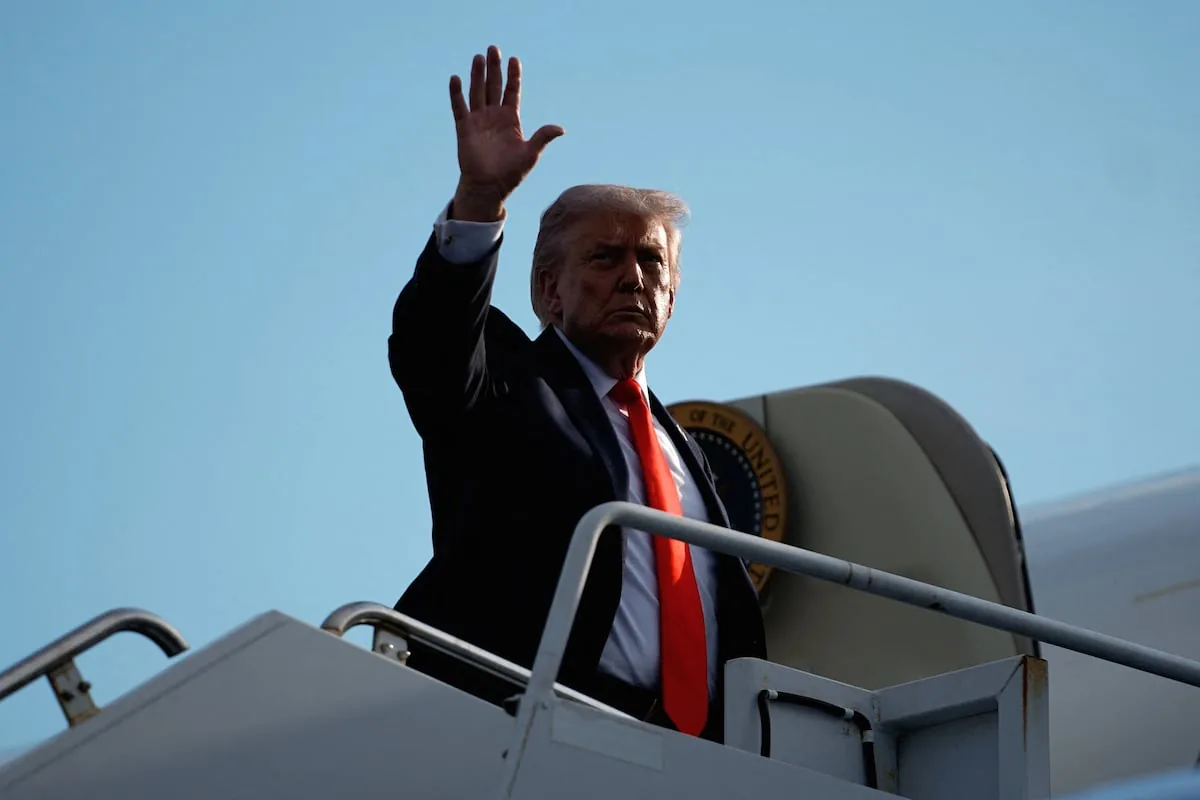
The President of the United States, Donald Trump, has sharply worsened his rift with European allies. After weeks, and months, of threatening to take measures to reduce his country’s role within NATO – and basically turn it into a walking corpse – his Department of Defense confirmed late Friday afternoon that it will withdraw 5,000 of the soldiers it has deployed in Germany.
Read more How much do you know about the players called up to the Mexican national team?
The measure comes as retaliation for Germany’s position on the war against Iran in general and, specifically, for the statements made by German Chancellor Friedrich Merz this week in which he considered that Tehran is “humiliating” the United States in the conflict. In a meeting with students, the head of government said that Washington had “no strategy” and that “an entire nation” was being “humiliated” by Iranian authorities, “especially by the so-called Revolutionary Guard.”
Immediately after those comments, Trump responded with a harsh attack against Merz. “He thinks it’s no big deal if Iran has a nuclear weapon. He has no idea what he’s talking about!” he wrote on his social network, Truth. “No wonder Germany is doing so badly, both economically and in other respects!” On Wednesday night, he hinted that he was considering withdrawing part of the U.S. troops from the allied country.
Defense Secretary Pete Hegseth has ordered the measure “after a thorough review of the deployment in Europe and in recognition of the needs and conditions on the ground. We estimate that the withdrawal will be completed within the next six to twelve months,” Pentagon spokesperson Sean Parnell said.
Although Trump has threatened on various occasions to take retaliatory measures for what he considers resistance from allies in assisting the United States in its war against Iran – or, in the past, for not wanting to cede sovereignty of the semi-autonomous island of Greenland, among other things – this is the first time he has taken a tangible measure. In recent days, also following clashes with allies over the war in the Persian Gulf, the Republican has hinted that he might also close military bases in Spain or Italy, or recognize Argentina’s sovereignty over the Falkland Islands, controlled by the United Kingdom, which calls them the Falklands.
Just this Friday, Trump again lashed out, in response to a journalist’s question, against Italy and Spain, whose governments he accused of allowing Iran to “end up having a nuclear weapon.”
According to the Department of Defense’s calculations, the departure of that contingent will place the number of U.S. troops in Europe at about 80,000 soldiers, approximately the same figure as before the Russian invasion of Ukraine in 2022. But legally there are limits to the reduction Washington can apply to its military footprint in Europe: the U.S. Defense Authorization Act passed late last year prohibits the government from reducing its military presence in the Old Continent below 76,000 soldiers.
Read more At least 11 dead and 31 injured in a bus accident in Nayarit
Lawmakers introduced that measure precisely to prevent the volatile Trump from unilaterally deciding on a drastic cut to the U.S. presence that would harm security on both sides of the Atlantic. The Defense Authorization Act also prohibits the government from relinquishing the post of Supreme Allied Commander, the highest military command of NATO, which has traditionally always been held by an American.
Russia’s war against Ukraine forced Washington from 2022 to reinforce its forces in Europe again, which by the end of 2025 were estimated at about 84,000 personnel. Of these, the vast majority, about 68,000, are permanently assigned to bases in various countries: about 36,400 in Germany, the main U.S. support point in Europe; 12,600 more in Italy, another 10,000 in the United Kingdom, or nearly 4,000 in Spain, according to official December figures. They are joined by thousands more troops sent as part of rotational deployments — such as the 10,000 personnel stationed in Poland or 1,700 more in Romania — or for temporary missions, according to the U.S. Department of Defense.
In total, the U.S. has 31 “persistent” military bases — which it has used continuously for at least 15 years and over which it exercises some degree of operational control — in Europe (mostly in Germany, Italy, and the United Kingdom) and another 19 facilities to which the U.S. Department of Defense — renamed the Department of War by Trump — has “access” in the Old Continent. Most are interoperable with NATO’s actions and needs.
These are air bases, naval bases, army garrisons, missile defense systems, and surveillance centers that allow Washington to maintain on European territory ground units, Navy warships (including destroyers and an amphibious command ship, based in Spain and Italy), and aircraft of the Army, Navy, and Air Force (including helicopters, fighters, electronic attack planes, bombers, transport and tanker planes, and other types of aircraft). The command center of U.S. forces, EUCOM, is headquartered in Stuttgart, Germany.
The U.S. forces in Europe are also responsible for managing the American nuclear arsenal deployed on the continent during the Cold War as a deterrent against the Soviet Union, but also to prevent the proliferation of atomic weapons among NATO allies, recalls the Council on Foreign Relations in a report on the state of U.S. forces in Europe. The U.S. once had nearly 7,000 nuclear weapons in Europe. Currently, it is estimated to maintain about a hundred gravity thermonuclear bombs, the B61s, at bases in Belgium — in Kleine-Brogel, which at the end of last year suffered several incidents with suspicious drones that flew over its airspace — Italy, the Netherlands, Germany, and Turkey. None of these countries can use these weapons without Washington’s permission.
Read more The railway company Canadian Pacific Kansas City files an international arbitration against Mexico