

The United States’ tutelage plan over Venezuela has undergone a first reshuffle. Laura Dogu led the restoration of relations after Washington militarily attacked Venezuela and took its president prisoner. She has now been replaced in the position, just under three months after arriving in the country. She is succeeded by John Barrett as chargé d’affaires. This Wednesday, in a message on the embassy’s social media, Dogu reported that her “temporary assignment” has come to an end and that she will return to her position as advisor to the Chief of the United States Joint Chiefs of Staff.
Read more Dutch and Catalan students forced to kneel and threatened with possible firearm in the Netherlands
“I am deeply grateful to President Trump and Secretary [Marco] Rubio for entrusting me with the task of leading the implementation of their plan here in Venezuela and representing the United States at this historic moment,” reads the message in which she assures that her team will continue working on the three phases of stabilization, reconstruction, and transition that Washington has proposed for the South American country.
John Barrett had been appointed chargé d’affaires in Guatemala in January 2026. He is a career diplomat with more than 20 years of experience in the United States Foreign Service. Among his previous positions, he served as Deputy Chief of Mission at the U.S. embassy in Panama (2023-2026), where he led the “recovery of control” of the Panama Canal to counter Chinese presence, a battle that Donald Trump made a central part of his strategy in Latin America. He was economic counselor in Peru and El Salvador and consul general in Recife, Brazil.
His profile focuses on security issues, migration control, combating drug trafficking, and the America First agenda. During his brief time in Guatemala, he had disagreements with President Bernardo Arévalo, who denounced the influence of the U.S. embassy in the integration of the Constitutional Court, a key milestone in resolving the long institutional conflict in the Central American country. The president claimed that magistrates who, in his view, were not suitable were being promoted.
In a hectic few weeks of work since settling in Caracas in early February, Dogu received a handful of senior White House officials, such as Energy Secretary Chris Wright, Undersecretary of Defense Joseph Humire, as well as heads of oil and mining companies. Dogu also raised the U.S. flag on a hill in Caracas, brought medicines for Venezuelans and vehicles for her officials, and announced vacancies to hire plumbers and electricians to refurbish the huge embassy building that had been closed for seven years and was being eaten away by mold.
When Delcy Rodríguez met for the first time with the U.S. chargé d’affaires, she emphasized the need to establish a functional diplomatic relationship. “Respect takes nothing away from anyone, it adds,” she said referring to dialogue for normalization of relations. But in less than a hundred days as a diplomat, it seems she has reached the ceiling of the political openness allowed by Chavismo.
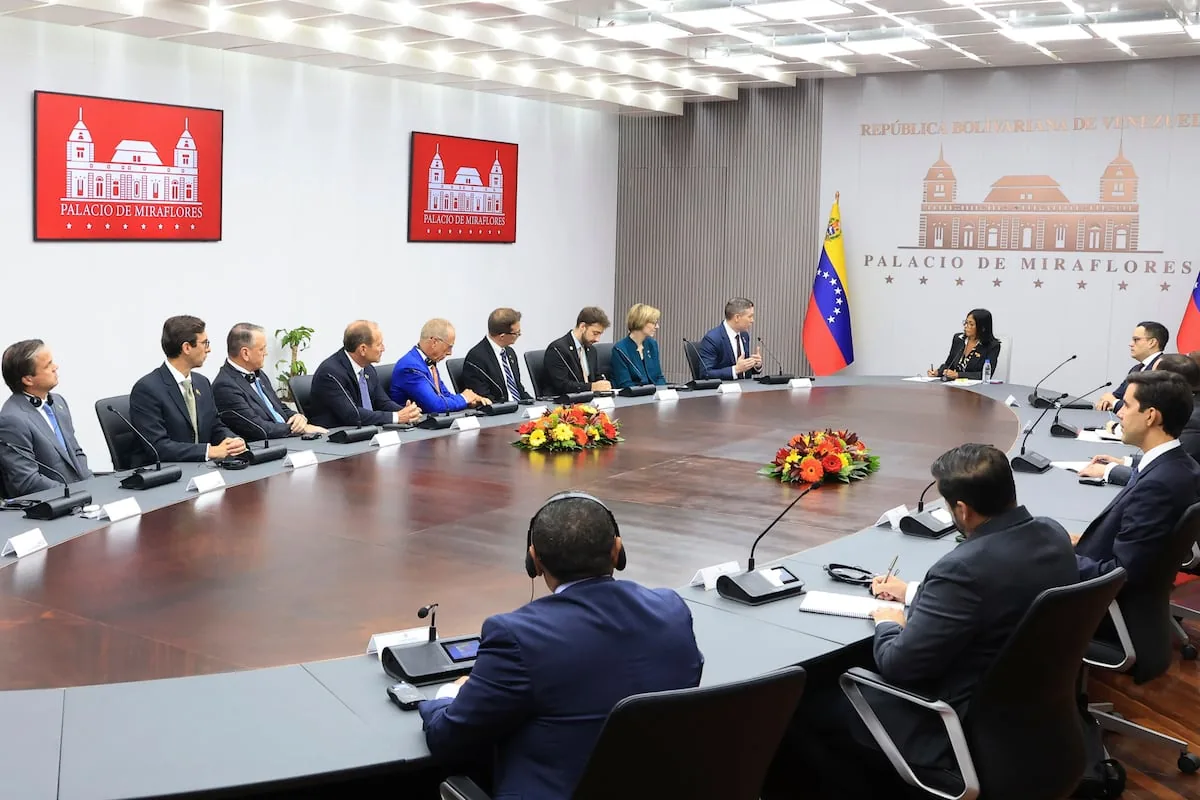
Dogu was a frequent visitor to Miraflores. The day before the announcement of her departure, she was with the acting president, Energy Undersecretary Kyle Haustveit, and dozens of oil businessmen. The official tried to make her management transparent with an active presence on social media where she showed the embassy interior and introduced her team, which still operates from a hotel in Caracas while the rehabilitation of the headquarters is completed.
Her mandate was the three phases of stabilization, reconstruction, and transition that Secretary of State Marco Rubio decided to lead Venezuela through. For this, licenses were expanded for Chevron and other U.S. companies, restrictions on gold were lifted, Rodríguez was removed from the list of sanctioned Chavista officials, and this week the possibilities for Chavismo to make transactions have been significantly expanded after the issuance of a new license to the Central Bank of Venezuela that unlocks its operations.
The Venezuelan Parliament approved hydrocarbon and mining laws to open the subsoil to foreign capital and offer the guarantee of international arbitration in case of conflicts to investors, even though it is a provision contrary to the Constitution.
Politically, repression has eased, political prisoners have been released, but institutional changes—such as the appointments of the new attorney general and ombudswoman or the cabinet reshuffle—have not generated trust. Changes in the composition of the Supreme Court of Justice and the electoral arbiter are yet to be seen. But, for now, it is a reshuffle among the same Chavista leaderships. Economic improvements have also not yet reached the pockets of Venezuelans.
From the government of the acting president, the demand for the total lifting of sanctions has again become a challenge thrown onto the field to the United States. Rodríguez announced that from Sunday, April 19, Chavismo will also hold a national mobilization for its cause: the fight against the economic blockade and Washington’s sanctions. “A license does not provide security because it is subject to temporality,” the president said in front of Dogu on Tuesday.
Just as the opposition insists that the country’s recovery is not possible without elections, the arguments of Chavismo—which prefers to postpone the election—place sanctions as the stumbling block for everything. The protest agenda against U.S. sanctions was presented from the government along with a series of economic measures, including the increase of the salary frozen for four years. With the announcement, they tried to reduce social pressure due to the economic crisis on the eve of a march by unions and guilds that intended to reach Miraflores and was stopped by police with shoves and blows. The protesters plan to mobilize this Thursday to the U.S. embassy to present their demands “to those who truly rule in Venezuela.”
Read more Water and calm slowly return to Alcalá de Henares after a cut of more than 24 hours