










Citizen mobilization to vote this Sunday in the elections of the German land of Saxony-Anhalt promises to be one of the highest in its history. AfD, the far-right party, aims for an absolute majority that would give it power for the first time in a German state. Much is at stake, both for its voters and its detractors, and the first turnout data prove it: by noon, 34.7% of the 1.6 million people called to the polls had already voted, well above the previous elections in 2021, when at that time 22.4% had cast their vote. That year turnout reached 60%.
Read more Video analysis| The pattern that repeats and condemns the citizen
The election day proceeds without reported incidents, with a huge police presence since Saturday in the state capital, Magdeburg. Law enforcement forces from other regions of Germany have also settled in the city to prevent potential disturbances. On Saturday, a demonstration against AfD gathered about 15,000 people, according to the organizers.
“It has to change now or never, this country is going downhill,” says Birgit, a 67-year-old woman who voted for AfD at a polling station in Magdeburg. Both she and her husband do not want their last name published. They both say they would vote for the CSU, the Bavarian Christian Socialists, “but since they do not run in Saxony-Anhalt, we opt for AfD.” There are two reasons, they explain, to justify their vote. The first is that society is increasingly poor. “In the German Democratic Republic (GDR) I was able to have five children thanks to the excellent state assistance network, this is now impossible,” says Birgit, who was a kindergarten teacher. When Germany reunified, she lost her job and opened a restaurant until her retirement.
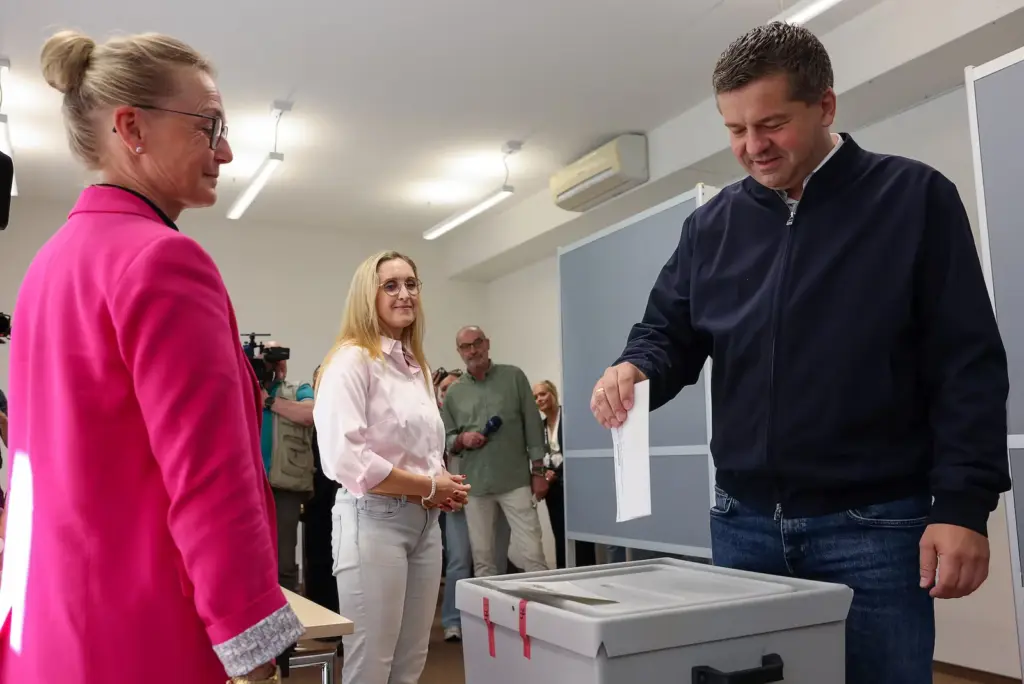
The second reason, Birgit and her husband state, is the excess of foreigners: “There are some who are good, who work and do not live off the system, like the Czechs.” Asked if they approve, for example, of the presence of Spaniards in their city, they admit they are not sure. Saxony-Anhalt has one of the lowest rates of foreign population in Germany, 7% of the total compared to the national average of 15%.
A few minutes behind Birgit and her husband arrived Norman Smudzenski, 42, dressed in a T-shirt with an antifascist logo. He only specifies that he will vote for the left and that the ideal result of the day is that the more parties surpass the 5% vote threshold, the minimum to win a seat, the more fragmented the regional parliament will be and therefore the fewer chances AfD and its candidate, Ulrich Siegmund, will have to govern. Polls have given up to 43% of the vote in favor of the radicals, approaching what would be an absolute majority in seats.
If AfD does not obtain an absolute majority of deputies, it is likely that an alliance of the other parties will support the CDU candidate, Sven Schulze, to renew the presidency of the land. The far right has focused its last days of campaigning on calling for high turnout to prevent the so-called sanitary cordon from leaving them out of power again.
The problem would be to reach an agreement between the Christian Democrats of the CDU and the left-wing party Die Linke, bitter rivals. “The CDU is no solution,” adds Smudzenski, “during this legislature they have carried out antisocial policies that have only served to give AfD reason.”
This engineer, married and father of two girls, warns that the rise of the far right is not only a reality in East Germany but throughout the country. “I lived 10 years in Stuttgart, in the west, in Baden-Württemberg, and there AfD keeps growing, and the more companies close due to the industrial crisis, the more votes they receive,” says Smudzenski, “the situation in Saxony-Anhalt will reach the West, it is a matter of time.”
Read more An internal war in Brazil’s Supreme Court puts the presidential elections on edge