







This is a newsletter from Kiko Llaneras, an exclusive bulletin with current data and explanations: sign up here to receive it.
Read more Save turtles to keep alive the legacy of an environmentalist murdered in Costa Rica
Nine days before the Andalusian elections, our average of polls places the PP as the leading force with 43% of the votes, followed by the PSOE (23%), Vox (14%), Por Andalucía (8%), Adelante Andalucía (6%) and SALF (2%). The PP maintains its support from 2022, when Juanma Moreno won the first absolute majority for the Populars. But beware: with the same votes, the balance of forces does not guarantee him to renew his majority.
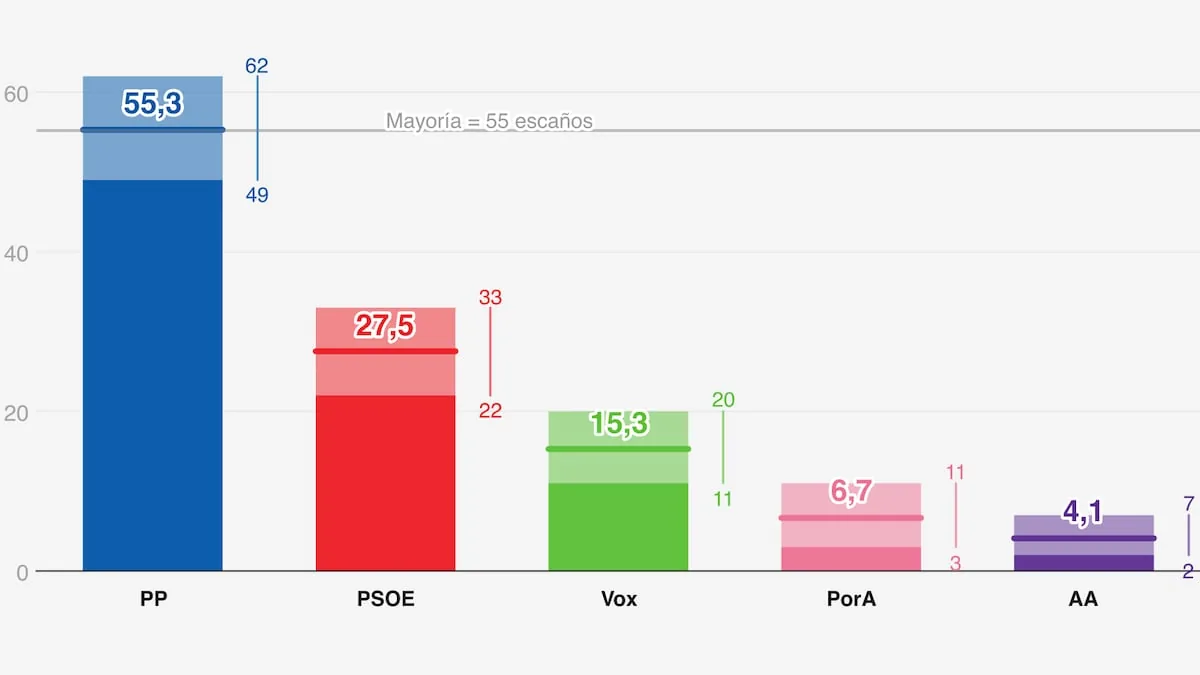
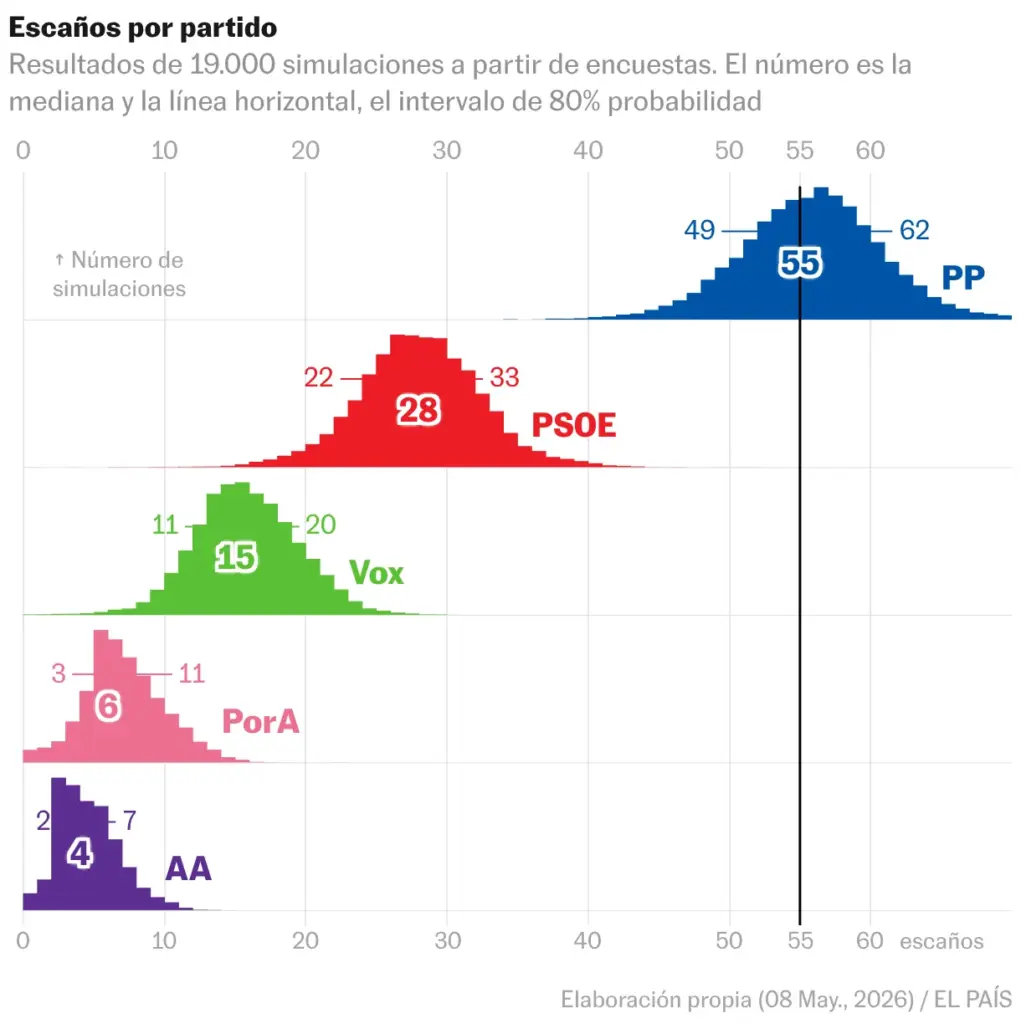
How does this translate into seats? The following chart shows our prediction based on the polls and 19,000 simulations. The central result leaves the PP with 55 seats (it currently has 58), followed by the PSOE (27 or 28, two or three less than in 2022), Vox (15, one more), Por Andalucía (7, two more) and Adelante Andalucía (4, two more). In this scenario, Moreno would renew the absolute majority just at the limit —55 seats— with a minimal margin.
The PP can lose the absolute majority through different paths. One is that the PSOE ends up taking more votes from Por Andalucía and Adelante Andalucía: it could reach 34 seats and leave the PP with 54. The main one, however, is simpler. It would be enough for Vox to grow by just one point at the expense of the PP (Vox at 15%; PP at 42%) to leave Moreno with 54 seats and without an absolute majority. It is a small movement, within the normal margin of error in polls.
We can specify these scenarios with the model simulations. What they say is that Moreno’s absolute majority is almost up in the air: the PP achieves the 55 seats needed 57% of the time. Slightly more likely than heads or tails, but not by much. In the other 43% of the simulations, it falls short and needs Vox. The uncertainty range is wide: the PP can fluctuate between 47 and 63 seats depending on how the polls refine.
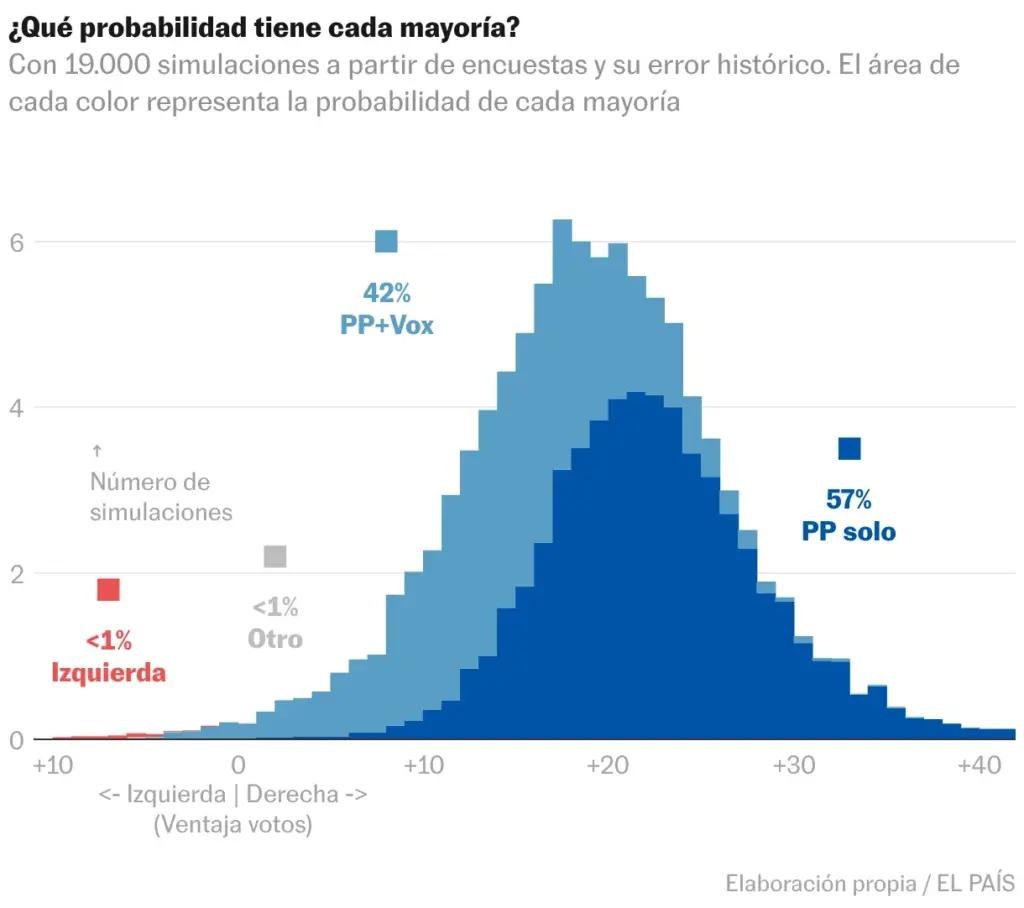
What does seem certain is that the sum of PP and Vox will have a majority: this occurs in more than 99% of the simulations. That is, the conservative bloc will govern Andalusia with almost total certainty. The only unknown is the form of government.
The model also allows estimating the chances of the small parties. Por Andalucía and Adelante Andalucía almost always obtain representation; they enter in 98% and 97% of the simulations, respectively. SALF, on the other hand, is almost always out: it gets seats with a 9% probability.
In Andalusia, the rightward shift recorded in Extremadura, Aragón, and Castilla y León could end. In 2022, the sum of PP, Vox, and Ciudadanos was around 60% of the Andalusian vote, and now the polls point to 59% for PP, Vox, and Se Acabó La Fiesta (SALF). That is, there would be no advance of the conservative bloc. There is a rightward shift within the bloc, because SALF occupies the space left by Cs, but the sum does not grow. One possible explanation: in Andalusia, the rightward shift was already intense in 2022.
Methodology. Our seat calculation results from a four-step process: 1) we start from the vote estimated by a recent average of polls; 2) we estimate the vote in each province based on that average, using the 2022 results and the provincial data from the 2024 European elections as reference; 3) we incorporate the uncertainty of the polls considering their historical accuracy; and 4) we simulate 19,000 elections, varying the votes in each and distributing the seats according to D’Hondt with a 3% threshold per constituency. A more detailed version of our methodology can be read in the description of the 2023 general elections model.
Read more Trump drives, despite himself, support for the Catholic Church in the United States
Other stories
🦠 1. What’s going on with hantavirus?
On Wednesday we published a visual explanation of the MV Hondius outbreak. Patient zero, a Dutchman, boarded in Ushuaia without knowing he carried the virus inside: hantavirus incubation lasts up to six weeks, so symptoms did not appear until days after departure. The WHO hypothesis is that he and his wife were infected on land, before boarding the ship.
This Saturday we also published another story telling the efforts to trace the contacts of the sick. Several passengers disembarked before the outbreak was detected and one infected person was on two planes.
There are two readings of the situation. The reassuring one: despite almost 200 people sharing a closed space for many days, only 8 cases are known. Hantavirus transmits poorly between people. It is a known virus, rare, and this season no unusual incidence has been detected. The one that keeps us vigilant: the strain involved is Andes, which does transmit between people — even without close contact — and has a case fatality rate close to 30%.
🔮 2. In favor of prediction markets?
This week we debated in EL PAÍS about prediction platforms like Polymarket or Metaculus. Economist Santiago Carbó highlighted their problems: opacity, gambling addiction, potential influence on democratic processes. I defended their virtues: these platforms are an efficient, accessible, and often unbeatable tool to predict the future. For me, the balance is to regulate the markets without amputating them as an instrument.
🪪 3. Being born with nationality reduces crime
Does it matter for a child of immigrants to be born already with nationality? A lot, according to a new study. In 2000, Germany changed its law so that children of immigrants automatically received citizenship at birth. Taking advantage of the natural experiment, a group of researchers compared kids born just before and just after the reform, identical in everything except their passport.
Result: those who received nationality at birth commit 70% fewer crimes during adolescence. The effect is especially clear on property crimes and drug-related offenses. The mechanism? The authors believe nationality opens better educational and labor paths for young people, keeping them away from crime.
This is a newsletter from Kiko Llaneras, an exclusive bulletin with current data and explanations: sign up here to receive it.
Read more A Spanish clothing brand uses the symbols of the Zapatista Army on a soccer jersey