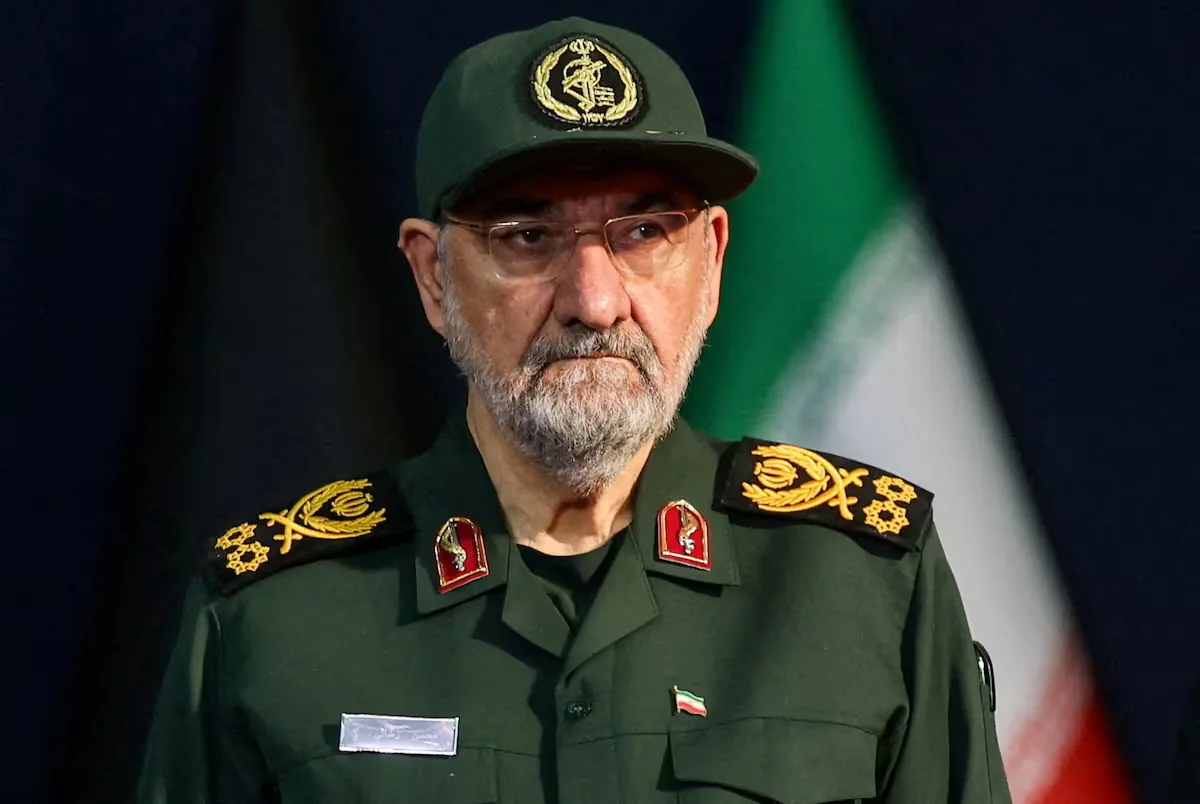
The Iranian regime wants to maintain and intensify pressure on the United States and its allies after more than five months of war. Iran’s Supreme Leader, Mojtaba Khamenei, has appointed this week the replacements for six senior military commanders killed during the early days of the offensive launched by the Israeli and U.S. armies on February 28. Among them is General Ali Abdollahi as Chief of Staff of the Armed Forces and General Ahmad Vahidi as Commander-in-Chief of the Revolutionary Guard. Of all the appointments, the most significant is Mohsen Rezaei as the new Secretary of the Supreme National Security Council, the highest decision-making body in the country after the Supreme Leader.
Rezaei, former Commander-in-Chief of the Revolutionary Guard, a 71-year-old military veteran and politician, replaces Mohammad Bagher Zolghadr, who left the post just four months after assuming it. His arrival at the Supreme National Security Council places him at the head of a body that plays a central role in decisions about the war, diplomacy, and the confrontation between Tehran and Washington.
His appointment makes internal differences in Iran over the strategy regarding the war and negotiations more visible. In a message broadcast on June 18 after the signing of the memorandum of understanding between Tehran and Washington, Khamenei said about the agreement: “In principle, I had a different opinion.” Two days later, Rezaei echoed the Iranian leader’s words in an interview with local media and emphasized that “the opinion [of Khamenei] would have been more successful,” explaining: “I opposed the ceasefire. Let’s negotiate. But why did we have to accept a ceasefire?”.
The statements suggest that Khamenei advocated negotiating while the confrontation continued. In practice, Rezaei’s appointment is interpreted as a shift in the balance of power within the Iranian political system: from supporters of “negotiating during a ceasefire” to those who defend “negotiating under the fire of war.”
Rezaei himself stated in July that “control of the Strait of Hormuz was more important than dozens of atomic bombs.” In practice, however, the implementation of the memorandum during the ceasefire has failed.
Half a century of experience
Rezaei’s presence in Iranian military, security, and political structures dates back almost half a century. He began his political activity before the 1979 revolution in the Mansouroun circle, an armed Islamist group whose members later came to hold some of the main positions in the Islamic Republic. Many of their names appear today among those appointed by the new leader. Rezaei played an active role at that time in creating the intelligence services structure of the Revolutionary Guard and, at just 27 years old, was appointed commander-in-chief of this force by Ayatollah Ruhollah Khomeini.
It was during that period that he met Mojtaba Khamenei, then 17 years old, during the latter’s brief stay on the fronts of the Iran-Iraq war in the 1980s. At that time, tensions had increased between his father, Ali Khamenei, then president of Iran, and the country’s prime minister, Mir-Hossein Mousavi. Rezaei sided with Khamenei, which helped him gain the trust of both Mojtaba and his father.
Read more Where to watch the solar eclipse in Spain? Hourly map and visibility at each point in the country
Rezaei remained in the Revolutionary Guard for 16 years, between 1981 and 1997. The victories of the early years of the war against Iraq, especially the liberation of Khorramshahr on May 24, 1982, which allowed expelling Saddam Hussein’s army from much of Iranian territory, decisively contributed to consolidating his military prestige. That prestige survived the ups and downs of the last years of the war and controversies over his responsibility in some of Iran’s defeats.
In his recent appointment decree, the current Supreme Leader, Mojtaba Khamenei, described him as “one of the pioneers of the glorious eight-year Sacred Defense period,” the Iran-Iraq war (1980-1988). In it, Rezaei was part of the group of commanders who advocated that the conflict continue until the complete defeat of Iraq by their troops.
Political career
In 1997, Rezaei left behind the military uniform. That year, Ali Khamenei appointed him Secretary of the Expediency Discernment Council, a position he held for 24 years, until 2021. The body was chaired by the influential cleric and political rival of Khamenei, Akbar Hashemi Rafsanjani. During that period, Rezaei acted as a trusted man of the then Supreme Leader and played a role in monitoring and containing Rafsanjani.
It was also during those years that he began his studies at the University of Tehran and obtained a doctorate in Economics. Rezaei thus tried to distance himself from a career almost exclusively associated with the military field and build a broader political and management profile.
But the most ambitious part of his political career was also the least successful. Rezaei ran for president four times. In 2021, in his fourth attempt, he finished second, behind Ebrahim Raisi, who appointed him Vice President for Economic Affairs.
Rezaei’s career is not without controversial episodes. One of the most serious is the attack carried out on July 18, 1994, against the headquarters of the Argentine Israelite Mutual Association (AMIA) in Buenos Aires. Argentine justice accused several senior officials of the Islamic Republic at the time, including Rezaei, of having participated in decision-making about the attack. In 2007, Interpol issued a red notice against six people, including Rezaei.