








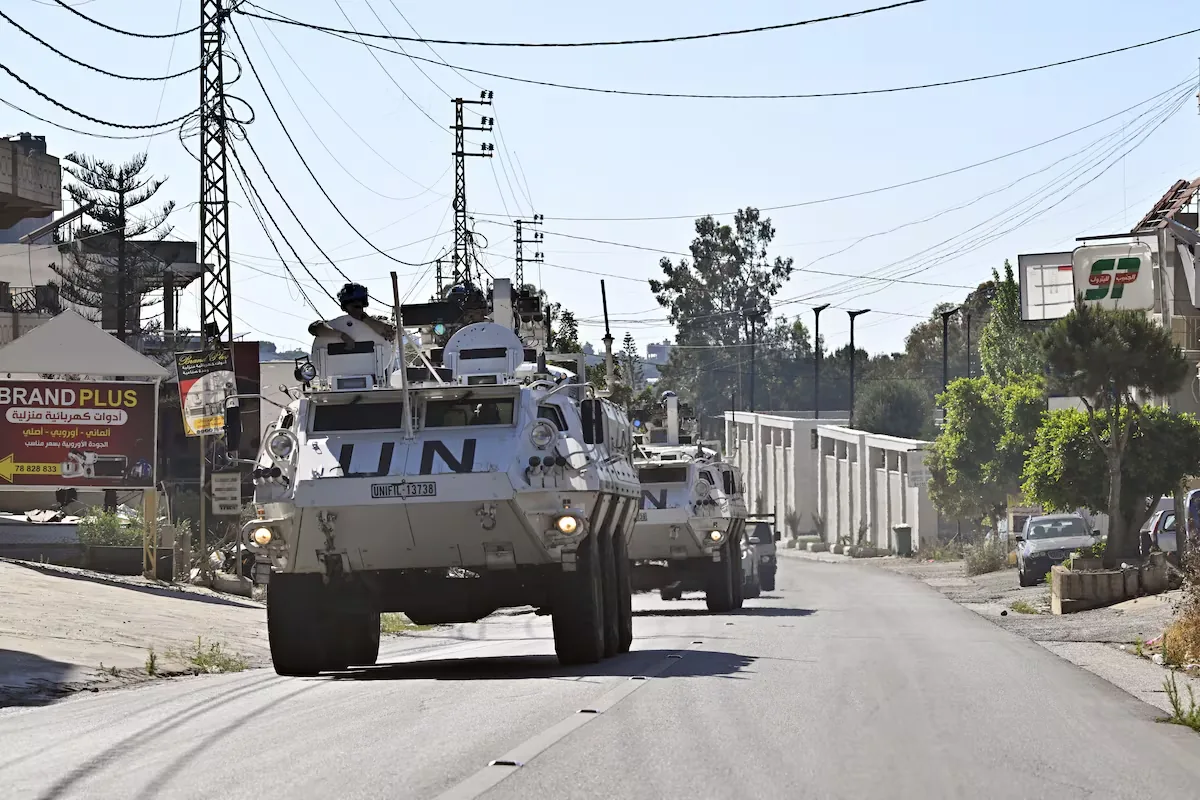
The German government of Chancellor Friedrich Merz proposed this Friday that a force with a European Union mandate replace the United Nations stabilization mission (UNIFIL) in southern Lebanon, in order to prevent a “security vacuum” in the region when UNIFIL, whose mandate expires at the end of this year, leaves the country invaded by Israel.
In an interview with the German media Redaktion Netzwerk, German Foreign Minister Johan Wudephul states that this European deployment would create the necessary conditions for the Israeli army to withdraw from the territory without the pro-Iranian militia Hezbollah “returning to its terrorist acts.”
“In Lebanon, with its government in the process of stabilization, one of the most hopeful advances in the region is currently taking place. Europeans must do everything possible to ensure this process continues positively,” Wudephul says in the interview. “In the EU, we should consider whether, after the UNIFIL mission, we can guarantee, through a European mandate, that a security vacuum does not occur […] and create the necessary conditions for the Israeli Army to withdraw without Hezbollah returning to its terrorist acts,” he adds.
The UN peacekeeping force in Lebanon was created to oversee the withdrawal of Israeli troops from southern Lebanon after the Israeli invasion of 1978. It is composed of about 10,800 soldiers from 47 different countries. Of these, 650 are Spanish.
In August last year, however, the United Nations Security Council decided not to extend its mandate further, which will end on December 31, 2026. UNIFIL soldiers must leave the country starting January 2027. At that time, according to the UN, the Lebanese government will become the “sole guarantor of security” in southern Lebanon, north of the so-called Blue Line drawn by the United Nations between Israel and Lebanon.
And although the Lebanese and Israeli governments are, for the first time in decades, holding direct political talks to consolidate the ceasefire in the conflict between Israel and the pro-Iranian militia Hezbollah, cross-attacks between the latter continue to occur. And the Israeli army maintains its occupation of the south of the neighboring country.
Proposals on the table
Already last June, during a meeting of EU foreign ministers in Luxembourg, Spanish Minister José Manuel Albares announced that he would request the launch of a European mission. “We have to go beyond the Gulf region and look at the whole Middle East. This is a great opportunity to advance towards peace and stability. We need to guarantee Lebanon’s sovereignty and territorial integrity. And the European Union can play a fundamental role there. I am going to propose a European Union mission that can take over from UNIFIL once its mandate expires,” Albares said.
This debate exists within the EU, but so far no deployment of European soldiers on the ground has been proposed; what is being studied is sending a training mission to train or instruct the Lebanese army. The proposal now put forward by Germany also does not make clear what type of peace force would be responsible for guaranteeing security.
Since March 2, when Israel launched a new invasion of southern Lebanon, seven UN peacekeepers (four Indonesians, two French, and one Serbian) have died in various attacks by Israel and Hezbollah.
The Israeli occupation, the destruction by Israel of most of the Shiite towns to create a buffer zone following the model applied in the Gaza Strip, and the exchange of fire between the Israeli army and Hezbollah have caused UNIFIL troops in recent months to be unable to fulfill their mission and spend much of their time in bunkers.
However, the United Nations wants to maintain its presence in southern Lebanon to prevent a greater escalation and also to monitor the Israeli occupation, so it is studying several options to deploy a new operation. The problem is that this operation would have to be approved by the UN Security Council, where the US has veto power.
As an alternative, the EU is studying launching its own mission which, unlike the current one, would not be interposition between Hezbollah and Israel but training members of the Lebanese Armed Forces (LAF). Spain supports any of the options and is willing to participate in them, although it insists that the only solution is to strengthen the LAF so they can take control of the south of the country and replace the Shiite militia in an area where it occupies the vacuum left by the Lebanese state.
The situation is worsened by the hardship of the Lebanese army, whose soldiers go months without receiving their salary and resort to multiple jobs, if not corruption, so it is not enough to train them but the EU should commit to providing strong financial support, military sources warn.
In an interview with EL PAÍS on July 5, Spanish Defense Minister Margarita Robles limited herself to saying that “the UN is considering several options [to replace UNIFIL] and a EU mission is also being considered.” “The essential thing is that we all support the LAF, because there has to be a real police force in the area,” she emphasized.
Spain is in charge of the southeastern sector of UNIFIL, where it has deployed 650 soldiers, although under Spanish command there are also Indian, Nepalese, Serbian, and other nationality soldiers.