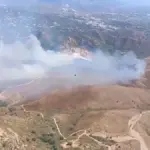






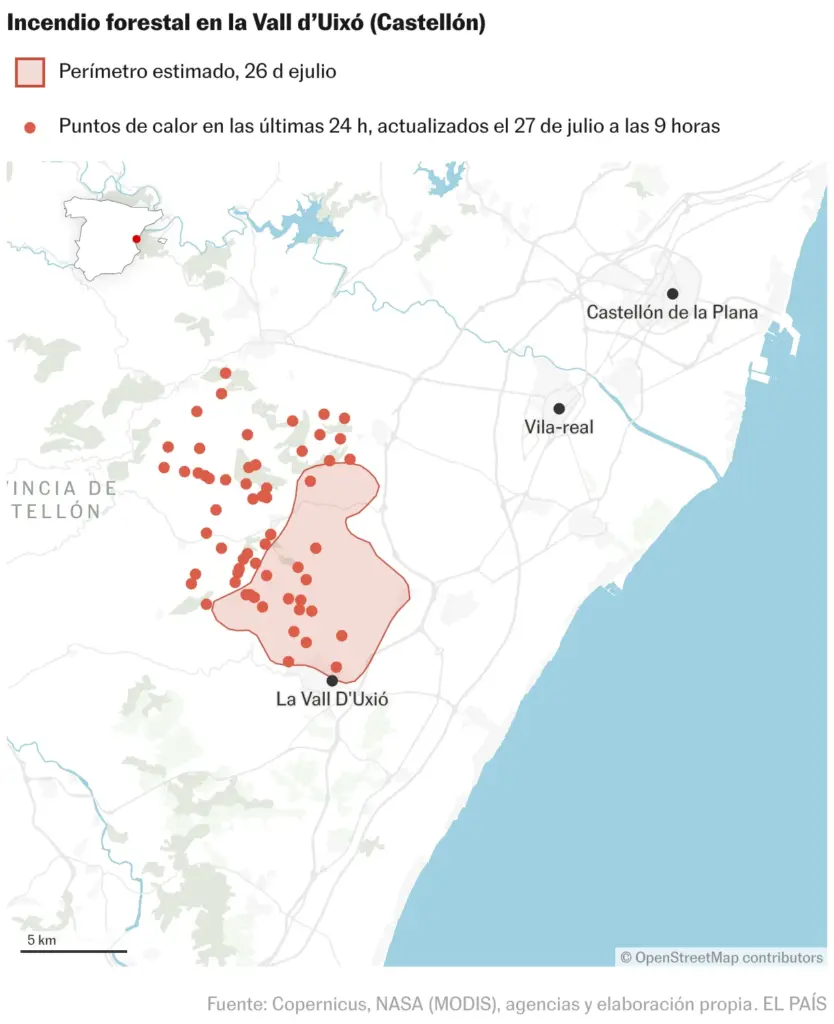
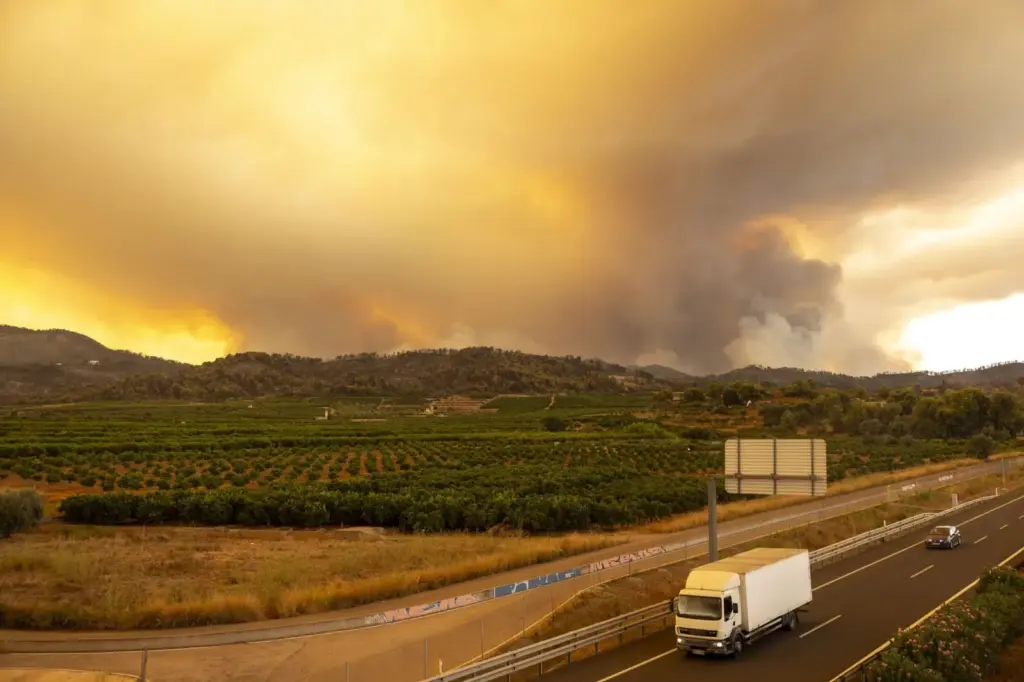
The fire declared last Saturday morning in a neighborhood of La Vall d’Uixó (Castelló), close to the mountain, remains active after burning 6,500 hectares and with a perimeter of 48 kilometers, according to Sunday’s latest count. The Generalitat maintains evacuation measures for 18 municipalities and confinement for Vall d’Uixó (32,000 inhabitants), Betxí (5,700) and Onda (26,200) for this Monday, although it is hoped that significant progress will be made in its stabilization between today and Tuesday, if meteorological forecasts of increased humidity (up to 80%) and reduced wind strength are met.
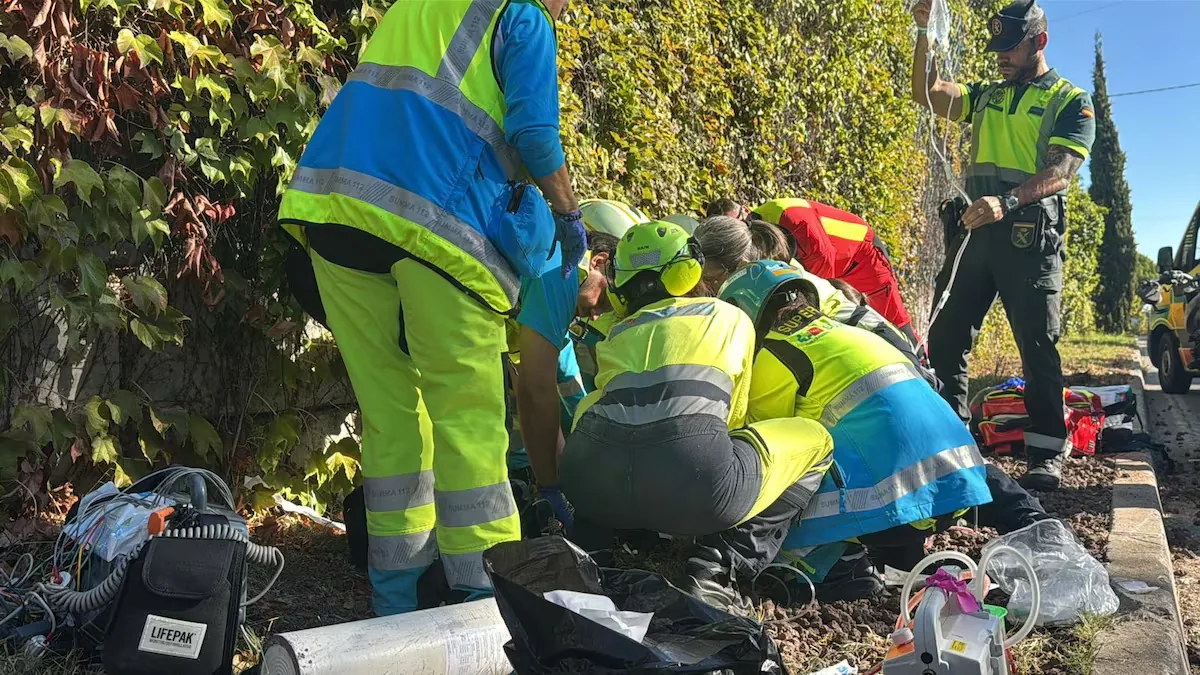
Between evacuees and confined residents, the fire affects around 75,000 people, according to the sum of the registered population in the affected localities. 43 people have been treated in health centers, mainly for smoke inhalation and some with burns. 19 remain hospitalized and 10 suffer from a chronic illness requiring oxygen and are in the La Magdalena Hospital for Chronic and Long-Stay Patients.
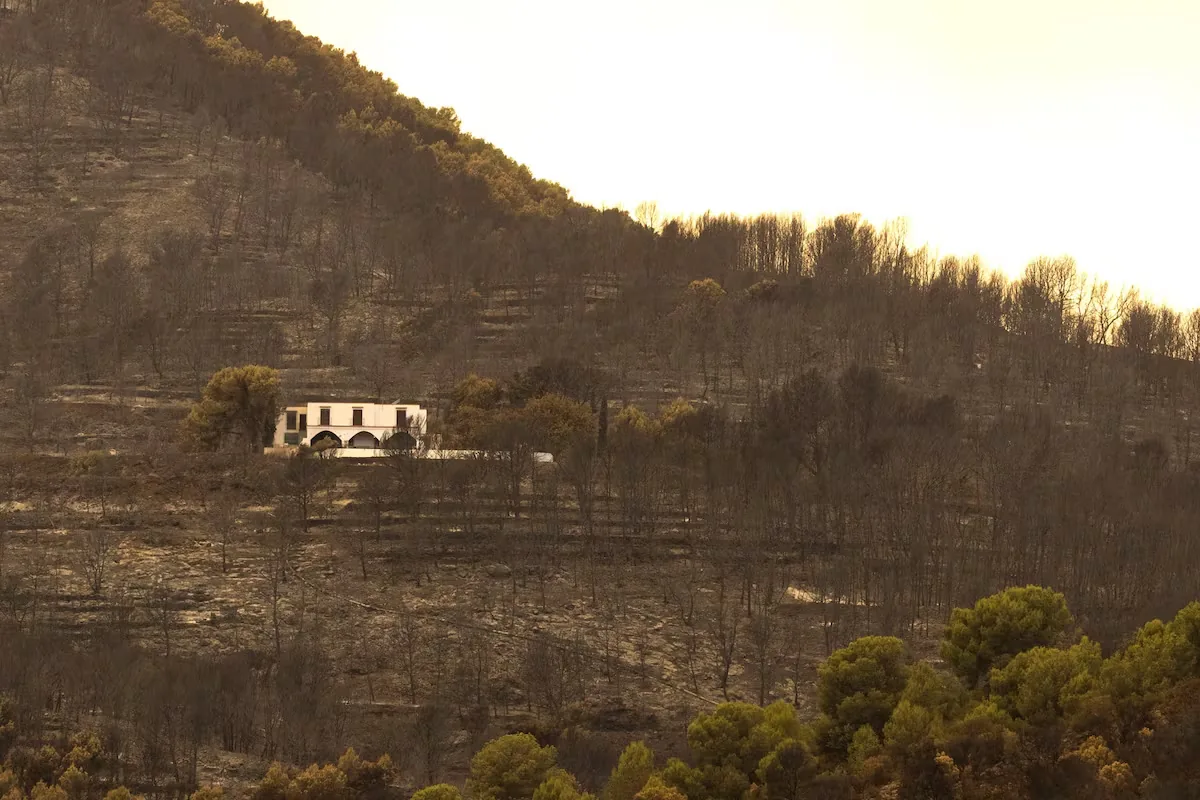
The fire has entered the Sierra de Espadán natural park, Castellón’s green lung, and the second largest protected natural area in the Valencian Community (after the Hoces del Cabriel). However, the real impact of the flames on its valuable forest mass, which includes lush cork oak forests, is currently unknown.
Saturday’s strong westerly wind pushed the flames towards the sea, towards the foothills of the mountain range and the tile industry towns like Onda, which are located in the La Plana Baixa region of Castellón, but Sunday’s sea breezes fanned them towards the park.
The natural park comprises a total of 19 localities within its 31,180 hectares, most of which are privately owned. 12 of the small municipalities preventively evacuated are part of the park; eight of them have their entire municipal area within the limits of the protected space (Aín, Eslida, Azuébar, Almedíjar, Chóvar, Fuente de Ayódar, Alcudia de Veo, Villamalur) and four are partially included (Alfondeguilla, Artana, Sueras, and Tales). In addition, the municipalities of Vilavella, Ayódar, Torralba, the hamlet of Artesa de Onda, and the neighborhoods of Toledo, Carbonaire, Sant Antoni and Sant de Josep de la Vall d’Uixó, and the Montserrat and Solaig urbanizations of Betxí have been evacuated.
🔥 #IFLaVallDUixó
— VOST Comunitat Valenciana (@VOSTcvalenciana) July 26, 2026
Status of #roads affected by the fire.
🚫 Avoid driving on any road in the area.
Check here 👇🏼#Etraffic @InformacionDGT https://t.co/gv49fdA3cl pic.twitter.com/4izhcfiZG9
The fire has not entered the small urban centers, which have been evacuated as a preventive measure, but it remains to be seen how it has affected their territories, which form “one of the best-preserved natural areas in the entire Valencian Community,” according to the Ministry of Environment on its website. As is logical and mandatory, the priority of the Generalitat and the firefighting services is the safeguarding of the population and, subsequently, material assets. For now, there has been no mention of the impact on the natural park, while the fight against the fire continues, whose origin is suspected to be intentional, as several consecutive outbreaks were detected on Saturday morning in La Vall d’Uixó.
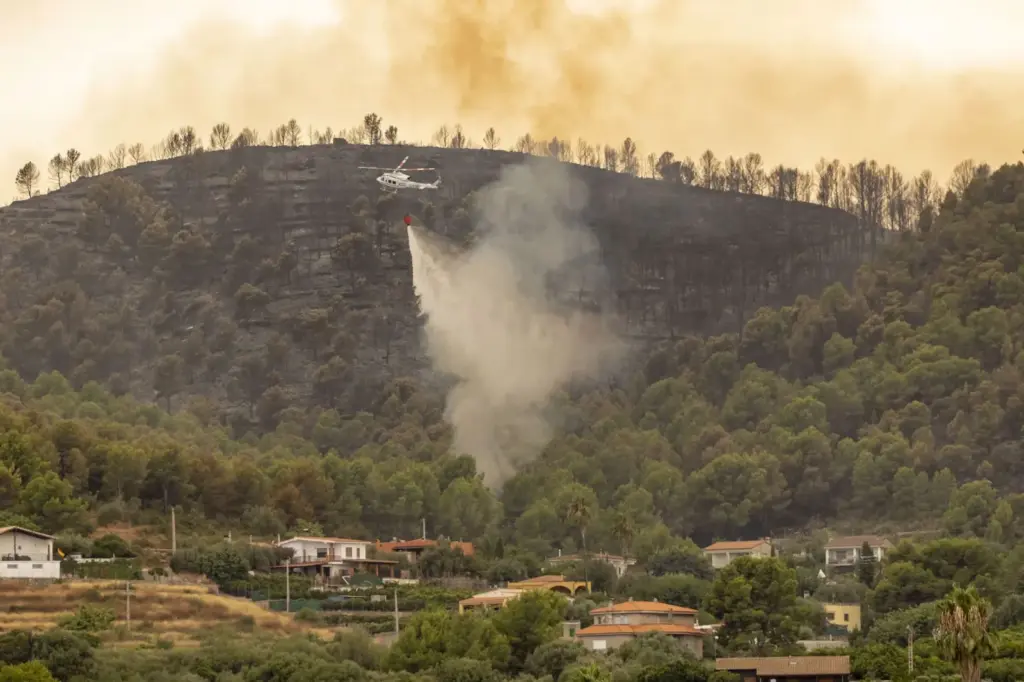
The evacuation and confinement order is valid until 23:59 on this Monday, July 27, “but the Emergency Plan management may extend, suppress or modify it depending on the evolution of the emergency,” states the Generalitat’s note, after the last Cecopi meeting on Sunday. The President of the Government, Pedro Sánchez, is scheduled to visit the affected area this Monday.
Around 700 residents evacuated from these 18 municipalities are housed in the Moncofa Multipurpose Building, the Onda Municipal Sports Center, the Nules Municipal Pavilion, and the Segorbe minor seminary. During the early hours of the morning, 113 people were evacuated from the Novaedat residence in La Vall d’Uixó and transferred to residences in Cullera, Carlet, Borriana, Estivella, and Castelló, using a Generalitat bus and the residence’s own means.
Read more This is not a caña, or how this popular format has been disappearing from all the bars in Madrid