



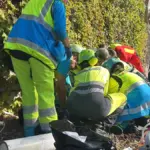


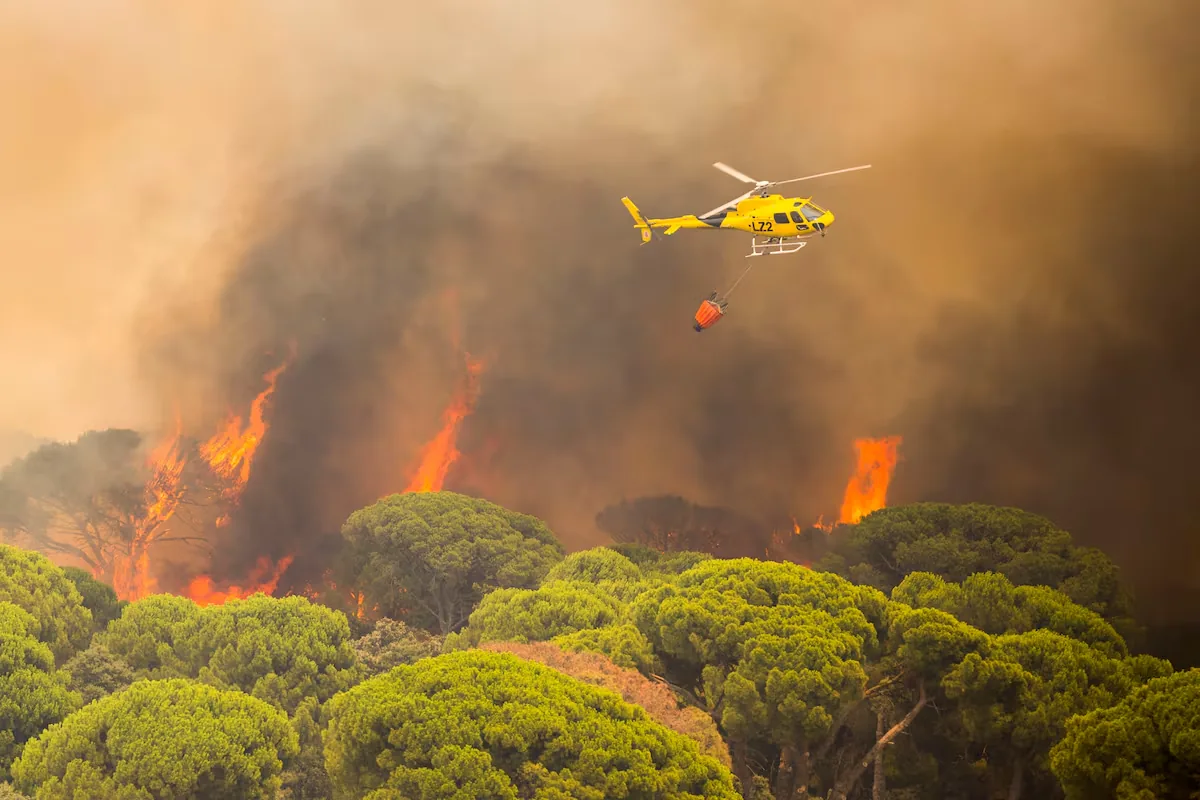
The wildfires raging through the province of Ávila and the Community of Madrid are still active, although their advance is slower. Extinction efforts are complex and have been hampered by strong gusts of wind. After several days of rapid advance, many of the fronts were contained on Sunday, although “several heads” remain active and the fires cannot be considered perimetered. Efforts this Monday will be in that direction: trying to achieve stabilization, protect populations, and prevent a merger of the flames from the two major hotspots. The evolution is positive, but very slow, and the risk of reactivations is high. The Military Emergency Unit (UME) is treating them as a single fire, and the Government extended the national emergency to Toledo, where a new fire in Almorox is causing concern. Between the three regions, 77,000 hectares are already affected, and around 90,000 people have been evacuated or confined. In Ávila alone, 50,000 hectares are affected, making it the largest and “most aggressive” fire in Spain’s history.
During the night, the fourth already, firefighters have worked tirelessly to try to stabilize the fires in Ávila and Madrid, and to gradually tackle the most worrying hotspots. “We still have active hotspots with flames, and there is also a very important factor that permanently conditions our operation: the risk of re-ignitions at any moment,” was the assessment of the Minister of Interior, Fernando Grande-Marlaska, which remains true this Monday. Eyes are on the weather again, with a feeling of cautious optimism. According to the minister, “the weather forecast is not going to be as favorable as they would like either.” Wind gusts will complicate the work again.
The conditions faced by firefighters in the Sierra Oeste of Madrid —25,000 hectares affected— and in Ávila are worse than Sunday’s, but better than those of previous days. “They are still not as bad as when the fire started,” Javier Armenteros, delegate of the State Meteorological Agency (Aemet) in the Community of Madrid, emphasizes to this newspaper. “Sunday was the day with the most favorable conditions. Now we are progressively worsening,” he adds. Temperatures are a concern: this Monday will be the last day below 35 degrees, and from Tuesday, they will rise to 38 degrees, reports Victoria Torres. Another key factor is relative humidity: the air will be “drier than during the weekend,” below 20% during central hours.
Firefighters are working non-stop shifts, and one of the main concerns is that the flames from the Burgohondo fire, in Ávila, do not merge with those advancing from Madrid. The Government delegate in Castilla y León, Nicanor Sen, stated late last night that the fires “have already converged.” Sources from the Ministry of Interior consulted by EL PAÍS clarify that this confluence has occurred “intermittently,” without both fires becoming a single one. Efforts are focused on controlling both fronts.
They have not merged, but they are “monsters” of such magnitude and are so close that they influence each other and are capable of altering the weather. As if they created their own microclimate within and had a life of their own. When this happens, a fire is considered to have become a sixth-generation fire, those that, due to their dimensions, can generate their own meteorological dynamics, such as abrupt and sudden wind gusts that fall and violently hit the ground. This erratic nature is what most worries the technical teams in charge of extinction. Also, their ability to create clouds, which can form a very high column and disperse smoke and ash over long distances.
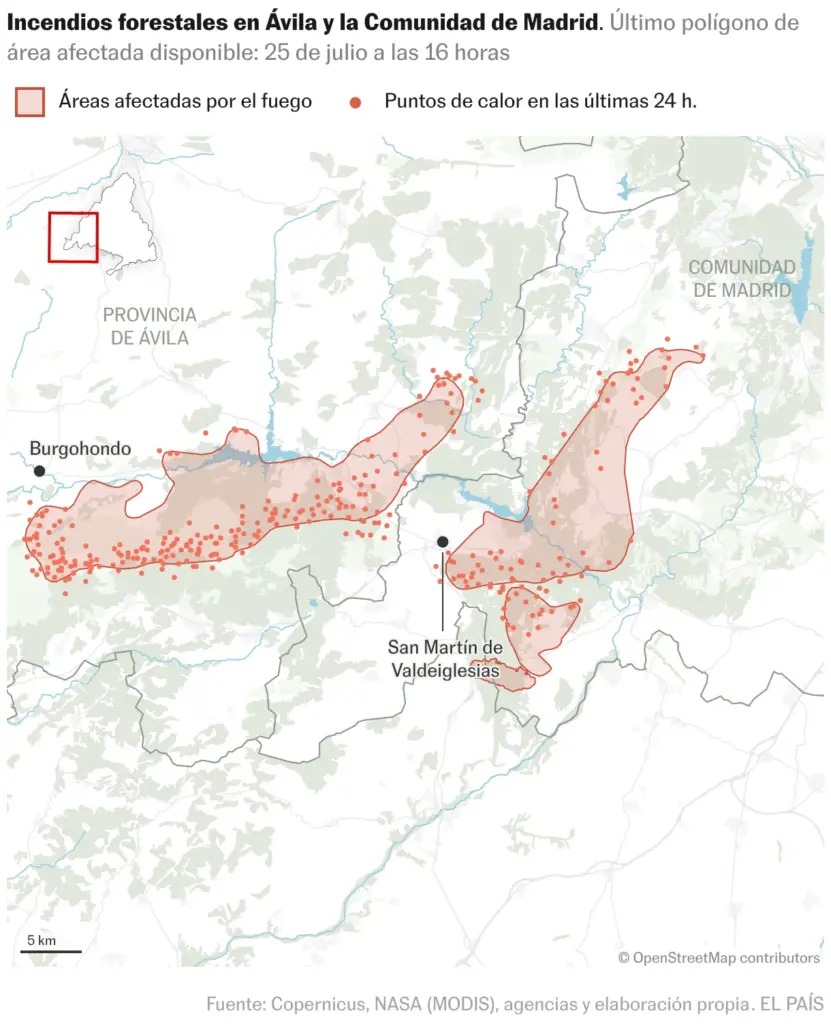
In Madrid, gusts of up to 30 kilometers per hour —weaker than on previous days— “will complicate extinction efforts,” 112 Comunidad de Madrid indicated in its first daily report. Night work has gone well, but three areas are particularly concerning: the area around the Cofio river; the El Encinar del Alberche urbanization, in the town of Villa del Prado, which had to be evacuated for the second time on Sunday since the fires began; and the urbanizations in the southern area of the San Juan reservoir, near the municipality of San Martín de Valdeiglesias. Extinction efforts have been concentrated there these days. “It is true that temperatures have dropped a bit, but wind speed until two in the afternoon can complicate extinction efforts. A sustained speed of 15 kilometers per hour is expected,” details a 112 spokesperson.
For now, the eastern flank has been contained and is not advancing, and firefighters are working to progressively cool the entire burned area. In the western area, closest to Ávila, the fire “is still putting up a fight,” according to the Government delegate in the region, Francisco Martín: “We have had to defend the municipality of San Martín de Valdeiglesias and also carry out a very active defense against a fire that has come from Almorox towards Villa del Prado.” In the region, 12 municipalities have already been evacuated and four confined: in total, 29,609 people are sleeping away from their homes and 21,132 are isolated in their villages.
Read more This is not a caña, or how this popular format has been disappearing from all the bars in Madrid
A positive note, which Martín advanced: the 4,500 evacuees from the El Escorial campsite will be able to return this Monday. The elderly residents of the San Martín de Valdeiglesias residence will also return to the center. And during a still undetermined time slot, livestock farmers from the affected areas will be allowed to access their facilities to feed their animals safely. The mayors of the affected municipalities will communicate the agreed schedules.
The Burgohondo fire, in Ávila, also remains uncontrolled but is moving much slower. The night has been positive, although with moments of tension, such as the one experienced in Sotillo, when embers —fire remnants lifted and carried by the wind— flew across a road that firefighters were trying to protect. This scene has been repeated in other places. The fire intensifies in specific areas and is more or less controlled in others. It is a surgical job, of containing, retreating when the flames flare up, and trying again.
It is moving towards the south of the province, and its advance in the Tiétar Valley, which had to be evacuated, is a concern. Extinction efforts have intensified there since Saturday, and the work of the deployed firefighters focuses on protecting towns. The Civil Guard arrested one person on Friday and is investigating another for using heavy machinery in an area where its use was prohibited, which caused a spark that originated the flames, and the president of the Junta de Castilla y León, Alfonso Fernández Mañueco, announced that the community will appear as an accusation against whoever started the fire.
The largest fire in Spain’s history has forced the evacuation of 25,087 people from 16 municipalities and the confinement of 8,735 from three in the region. Added to this are the affected inhabitants in Toledo, also under national emergency and where a fire in Almorox is a concern; 5,200 people have already been evacuated from 11 localities. For many, this night has been the fourth away from home.
🌙 Another night of intense work.
We continue working tirelessly to combat the large fires of this #NationalEmergency
🎥 Missions in Sotillo de la AdradaRead more Ansu Fati, from football to music as a way of escape
— UME (@UMEgob) July 27, 2026