









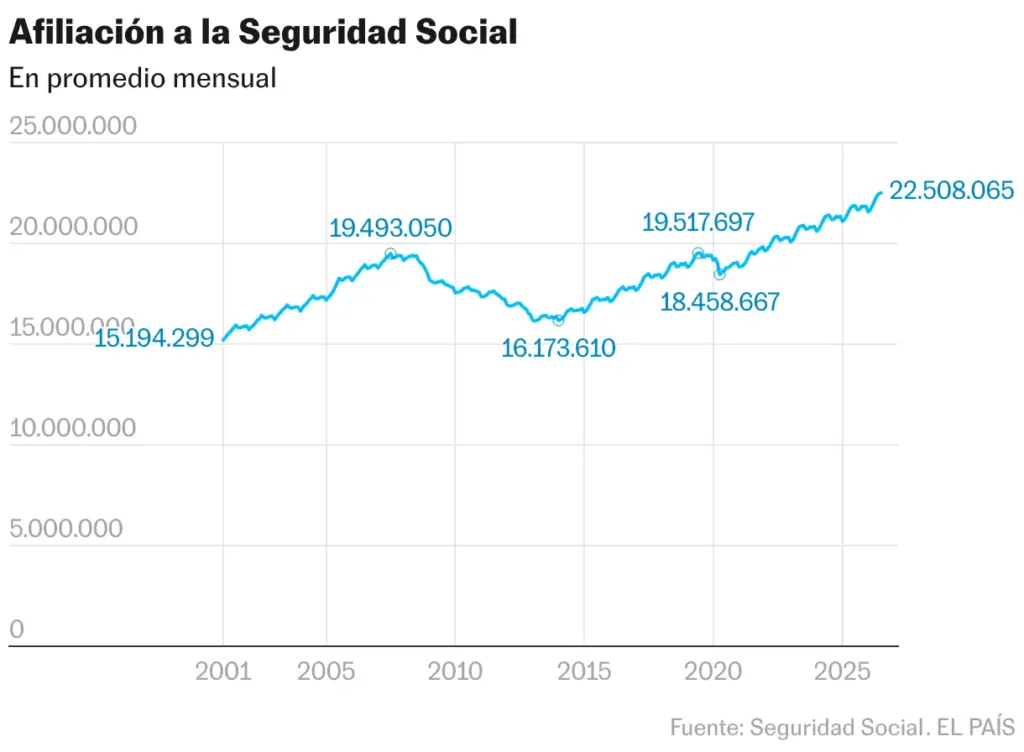
The month of July has been exceptionally good due, among other things, to the impact of the extraordinary regularization of immigrants. Last month, 41,727 new contributors joined Social Security, surpassing the record of 22.5 million affiliates, according to figures released this Tuesday by the Ministry of Social Security. These new workers were, in net terms, all foreigners, as there were 66,045 more contributors of nationalities other than Spanish, compared to a loss of 24,318 Spanish affiliates. Likewise, also taking the net balance, all the new contributors were men, who increased by 84,163 in July compared to June, against a drop in female affiliation in the month of 42,437 women contributing.
Read more Former Economy Minister Jaume Giró confirms his break with Junts and resigns from the party
All in all, the number of new affiliations registered in the last year rises to 642,562, which raises the year-on-year employment creation rate, which is already close to 3%, the highest in a July since 2022 (then it was 3.8%), when the system was recovering from the ravages caused by the covid pandemic. In June, annual employment creation among foreigners exceeded that of Spaniards for the first time and the trend continued in July.
The regularization of immigrants has meant that by the closing date for applications, last June 30, 1,174,978 applications had been registered, of which more than 600,000 had already been admitted for processing in the first weeks. These figures have not yet been fully reflected in Social Security, but partially, because this regularization process is not linked to a formal job offer or commitment. However, the Ministry of Social Security indicates that, as of July 30, the number of foreign affiliates regularized and active through the extraordinary process amounted to 262,475.
Of these 262,475 affiliates, 81.5% (213,883) were enrolled in the General Social Security Regime, while 12,675 (4.8%) were self-employed workers. Also, by gender: 60.3% were men (158,171) and 39.7% were women (104,304).
The impact of this process is also reflected in the seasonally adjusted figures, which remove the seasonal effect and show a gain of 79,567 contributors, the highest — excluding 2020 and 2021, years of the pandemic and its recovery — since 2005, a year in which the other major mass regularization of immigrants took place, incorporating about 600,000 workers into the labor market.
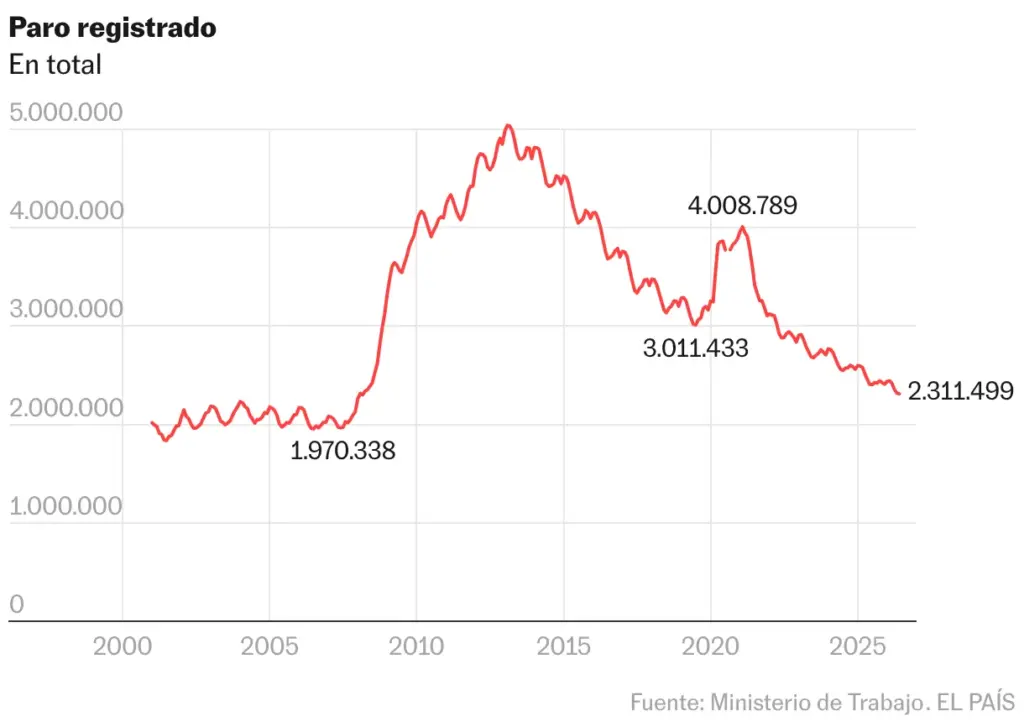
But the process has also partly affected the registered unemployment figures, since the first thing many immigrants did after obtaining a work permit was to register on the SEPE lists. Thus, registered unemployment saw a sharp increase of 19,517 people in July compared to June, reaching a total of 2,311,499 unemployed, according to figures released this Tuesday by the Ministry of Labor. Of this total of new registered unemployed, 15,535 were foreigners and the remaining 3,982 were Spanish nationals, presumably due to the aforementioned impact of the regularization.
In any case, although the largest increase in unemployment in July in more than ten years has occurred (it usually decreases in the seventh month), the total number of unemployed remains the lowest since 2007. Furthermore, the department led by the second vice president, Yolanda Díaz, does not show concern about this increase, which they attribute to an administrative effect due to the regularization and recall that it already occurred in the identical process carried out in 2005, when this effect dissipated in subsequent months.
The regularization, however, had no effect on employment behavior, which in July repeated the typical basic patterns of this month. Education led job destruction, with 124,506 fewer affiliations than in June due to the end of the school year; and there was also a sharp drop in contributors to the Special System for Agricultural Workers, which lost 40,605 affiliations. On the positive side, trade and hospitality led employment gains, with 50,100 and 24,000 more employees, respectively.
Industry and construction covered the field, without large increases in employment, with 13,124 and 10,741 more affiliates each. Although construction activities clearly led annual job creation, with a growth of their workforce of 7.2% in the last twelve months compared to the 3% average employment in this period.
The negative note is set by the higher value-added sectors, contrary to what the Government has been highlighting recently. Thus, scientific and technical professional activities lost almost 5,000 affiliations in July and the telecommunications and IT consulting sector was reduced by 2,177 jobs. Also notable is the sluggishness of a sector that usually drives job creation, such as transport and logistics, which already weakened in the second quarter, according to recent data from the Active Population Survey (EPA) and which in July barely gained 3,600 affiliations.
As for the quality of the new employment in July, it was not especially affected. 38.9% of the contracts newly signed last month were permanent, a percentage lower than the rest of the months of the year so far but usual for a July and even slightly higher than the same month last year.
Read more The controversial plan to create the world’s first octopus farm in the Canary Islands sinks