










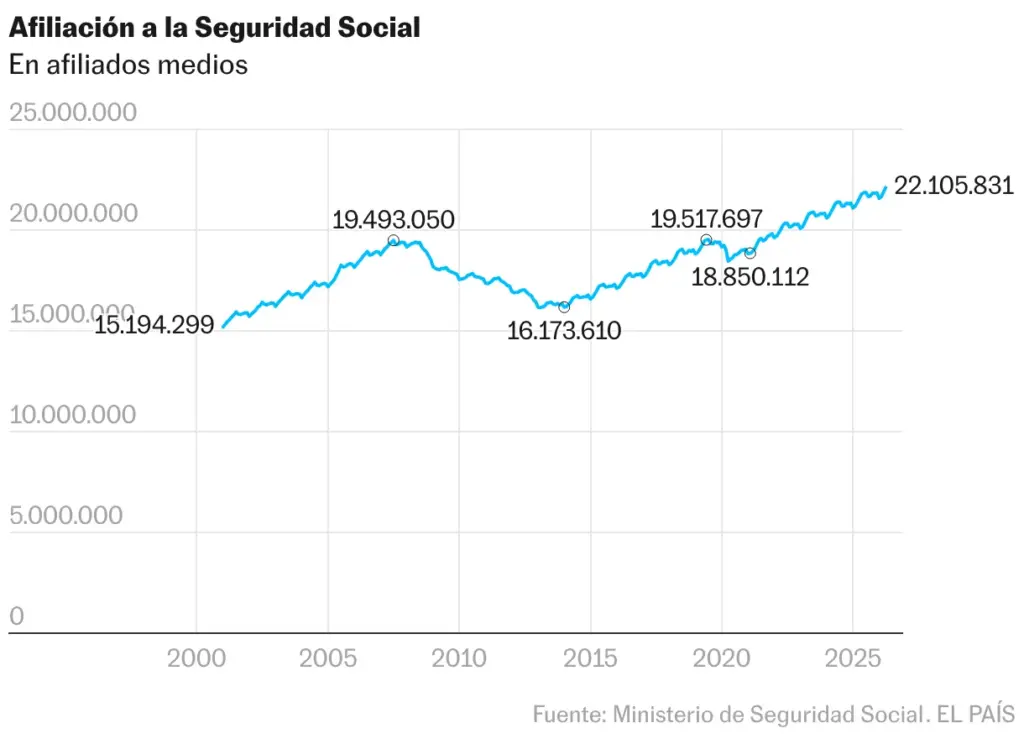
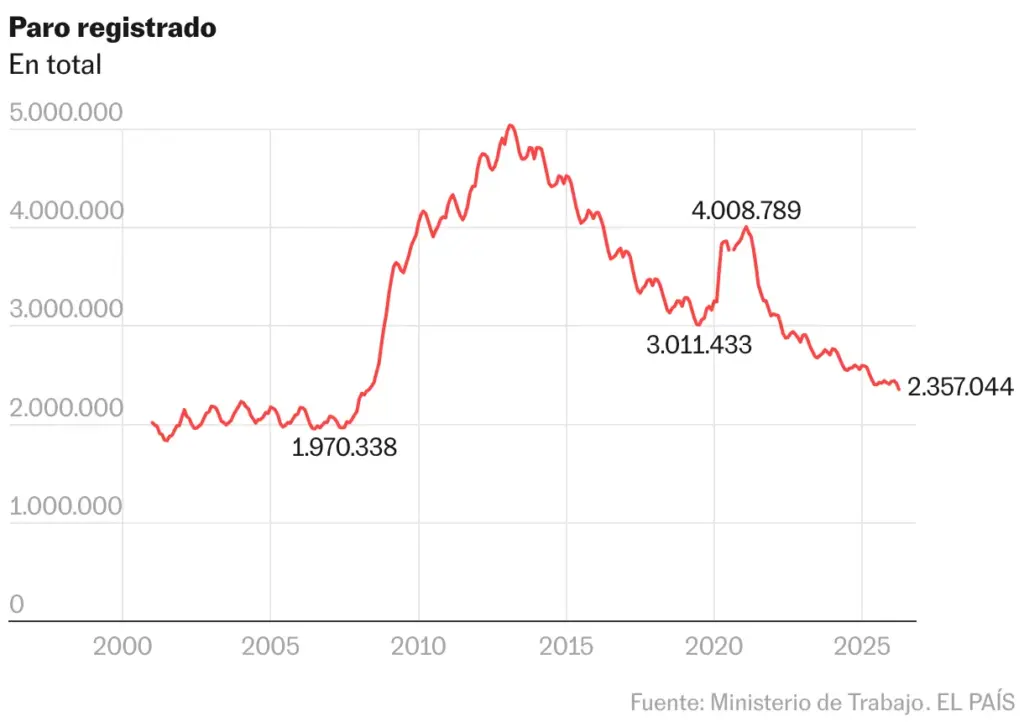
Holy Week hiring has once again saved employment this spring, overcoming the uncertainty generated by the conflict in the Middle East. This year, the week took place between March 29 and April 5, placing the main days of this holiday in the past month. This facilitated a gain of 223,685 Social Security affiliations in April and a decrease of 62,668 registered unemployed in the same month at the public employment service offices (SEPE), with a special boost from hospitality and commerce. With this momentum, according to figures published this Tuesday by the Ministries of Social Security and Labor, the number of contributors exceeds 22 million for the first time (it reached 22.1 million), while the total number of unemployed falls to 2,357,044, dropping below 2.4 million unemployed for the first time in almost 18 years, since June 2008.
The labor market behavior in April was preceded by a record March in job creation, as never before in that month had so many contributors been gained in the historical series (211,510 new affiliates compared to February). This good data —which was already marked by early hiring in the first part of the Holy Week campaign— occurred despite the fact that the impact of the war in Iran had already begun to be felt in prices and, above all, had already generated strong geopolitical and economic uncertainty.
However, the good employment performance driven by the start of Holy Week in March was not enough to offset the official job creation figures for the entire first quarter, measured by the Active Population Survey (EPA), which a week ago reflected a poor start to the year for employment. Specifically, the unemployment rate rose nine tenths compared to the last quarter of 2025 to 10.83%, and the economy destroyed twice as many jobs as a year earlier. These are, nevertheless, different data (one is the Social Security registry and the other, the reference survey to measure labor market evolution).
After these poor data were known, most experts and analysts agreed that it would be necessary to wait for the figures of the following months to confirm whether it was a structural worsening or simply the usual first quarter of the year, which is always negative for the Spanish market for seasonal reasons, further aggravated this year by the consequences of the conflict in Iran.
Now, the Social Security registry figures known this Tuesday indicate that the labor market has held steady in this month of April. Although both the original figures (without discounting the seasonal effect) and those that do correct this effect show a slightly weaker employment behavior compared to the same month in previous years.
It is in the seasonally adjusted figures where this moderation in the market trend is most noticeable: once corrected for the calendar effect, the April figures show an increase of 41,753 new contributions and a decrease of 11,256 registered unemployed. The corrected statistics also reveal other significant data such as the Social Security system having grown for 63 consecutive months. Registered unemployment also decreased in all sectors and in all autonomous communities.
Furthermore, the daily series of registrations and deregistrations shows that during the month, affiliations exceeded 22.2 million, specifically between April 27 and 29. All this consolidates the total number of contributions clearly above 22 million workers, which the Prime Minister, Pedro Sánchez, already announced in March, for which he was criticized, since that threshold was only surpassed in that month according to the seasonally adjusted series. However, as a negative note, at the end of the month a phenomenon that had been dampened in recent months occurred again, reflecting, at least, the high turnover in employment, since on the last day of April more than 170,000 affiliations were deregistered, the highest figure at the end of a month since last October.
Read more Typos as a symbol of prestige: how to write so it doesn’t seem like AI
So far, neither Social Security nor Labor have highlighted the existence in their respective registries of newly regularized migrant workers in the extraordinary process that just began on April 16 and will accept applications until June 30. Despite this, the pace of hiring foreigners remains at the highest levels. Thus, in April, 96,684 new foreign affiliations were recorded. This means that four out of ten new jobs were filled by foreigners.
The most dynamic sectors
Having said all this, the importance of the seasonal Holy Week campaign in last month’s data is seen in the fact that more than half of the new affiliations generated last month occurred in the hospitality sectors (115,284 more) and commerce, with almost 15,000 new contributions. In both cases, summing salaried and self-employed workers in these sectors. Administrative activities (with an increase of more than 16,000 affiliations), construction (11,353 more), and healthcare (8,701) completed the list of the most dynamic sectors in April. The negative note was set by the education sector which, contrary to usual, as it is usually one of the activities with the greatest gain in contributors, experienced a loss of 1,200 salaried workers last month.
The self-employed group also recorded good data, reaching its highest affiliation level: 3,444,973. This represents 15,439 more compared to March and a gain of 42,775 in the last twelve months.
Although attention was drawn to the reduction of self-employment activity in two sectors in April compared to March: in transport, where the number of self-employed decreased by 1,611, and in scientific and technical activities, which lost 2,710 workers. In both cases, the monthly drop approached 1% of total affiliations and could be reflecting the impact of rising fuel prices due to the conflict in the Middle East.
Regarding new contracts registered last month, their total number decreased by 4% compared to March, with permanent contracts falling more sharply, by 6%, double the reduction of temporary contracts (3%). In annual terms, permanent contracts increased by 7% and fixed-term contracts by 13%. The share of new permanent contracts among new contract signings fell by one point compared to what had been usual in previous April months, down to 43%. And within these permanent contracts (543,543 in total), full-time contracts were the majority (229,062) while part-time contracts totaled 129,730, and in both cases decreased by 9% and 12% respectively compared to the previous month. Among permanent contract types, only discontinuous permanent contracts increased in April, adding 184,751 new ones, 4% more than in March.
Read more Between protests and corsets, the Bezos assault hints at the end of an era at the Met Gala