The history of dog domestication began about 33,000 years ago. A conversation made of human gestures has accompanied the lives of these animals ever since. A face can anticipate a caress, a reward, or a threat, and that is why they have evolved to read facial expressions perfectly. An international team of researchers has found new clues about how the canine brain interprets these signals. Their study, published this Monday, uses magnetic resonance imaging to show that dogs can distinguish between happy and neutral human faces, something science already knew. The novelty is that, for the first time, they find evidence that their brain also generates different activity patterns in response to some negative human expressions, such as fear and sadness.
The work, published in the journal iScience, analyzed the brain activity of dogs while they observed photographs of human faces with different emotions. The authors found a region in the right hemisphere, located in the temporal cortex and extending toward the caudate nucleus, that responded especially to happy faces. Later, using analysis techniques, they verified that the activity patterns in that region allowed distinguishing happiness from fear, fear from anger, and from sadness.
According to Laura Cuaya, a postdoctoral researcher at the SCAN Unit of the University of Vienna and one of the main authors of the study, just by looking at people’s faces, “dogs can discriminate emotions and have expectations.”
The experiments that confirmed it
The research was divided into two experiments. The first involved eight dogs, who observed photographs of happy and neutral human faces while the researchers compared the brain activity produced by both conditions.
The result was a broad group of regions in the right hemisphere working. The activity was mainly located in the temporal cortex and extended toward the caudate nucleus. It also appeared in the piriform cortex. “There is a beautiful analogy with resonance. It’s as if the brain lit up and filled with colors,” Cuaya describes.
The location of those colorful lights is important. If the difference had appeared only in the earliest visual areas of the brain, it could have been explained by features such as shapes, colors, contrasts, or movements of facial features. But the activity extended to regions associated with developed visual and social processing. “The activity for happy faces compared to neutral faces was in the temporal region of the brain and from there went to the frontal regions and down to the caudate,” explains Raúl Hernández-Pérez, data scientist and lead author of the study.
The caudate nucleus participates in reward circuits. The authors argue that, in previous studies with dogs, this structure has been activated by stimuli associated with food, words, smells of known people, or signals that anticipate some type of reward.
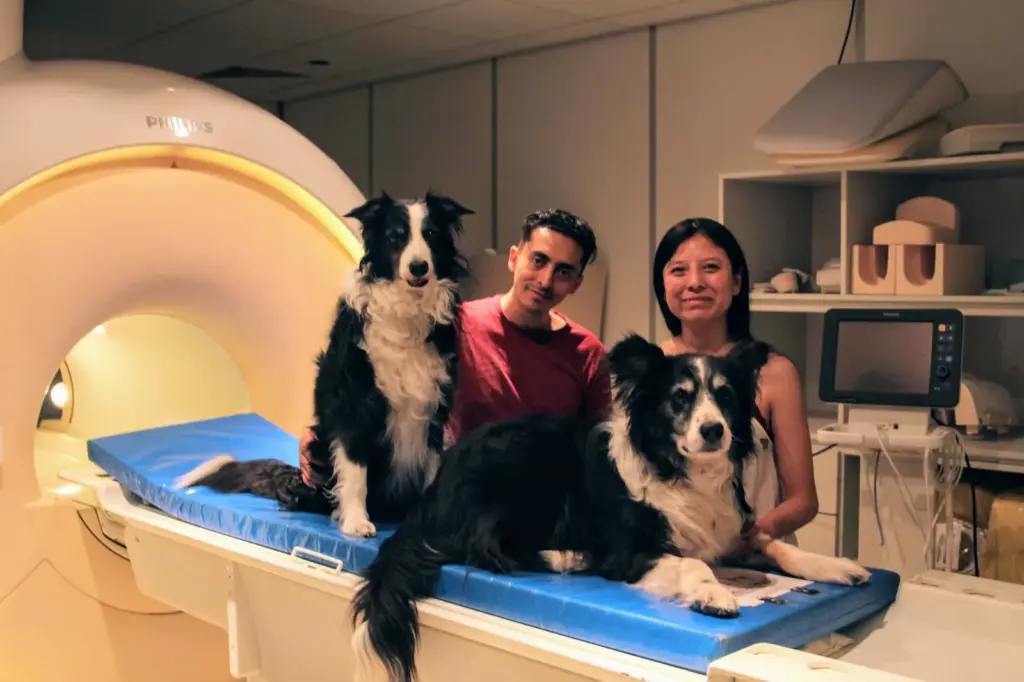
The second experiment, with 12 dogs, allowed verifying how far that effect reached and whether it repeated with other emotions. The researchers used a machine learning technique to analyze distributed patterns of brain activity.
In this second phase of the study, the researchers analyzed the activity of the entire brain. And, to their surprise, they found different patterns between faces showing fear and anger, and between fear and sadness. However, they urge caution when interpreting these results. “We must be very careful about saying that dogs understand human emotions as we do,” adds the author and Mexican biologist.
The names used in the study (happiness, fear, sadness, and anger) describe the expressions shown by the people in the photographs, but, she points out, they do not allow knowing the animal’s subjective experience.
Also, not all emotions were identified. That same brain area that identified negative emotions did not allow differentiating between sadness and anger. “This does not mean that dogs are not detecting that difference. The change may be local and our technique may not detect it,” Cuaya clarifies.
She also adds another possibility: that to distinguish some expressions, dogs need information that a photograph does not provide. “It is very interesting that we find these differences between emotions even within a machine, observing only photos,” Cuaya adds. “Imagine the activity of their brain, which must be complex and highly connected, when you are with your dog showing your emotions and giving them all the clues they need to understand what you want to communicate,” the biologist says.
Read more Trump tightens control over justice in the United States
For Paula Pérez, an ethologist specializing in canine behavior, one of the main contributions of the study is that it allows looking inside what others had not done in the past. “Before we had the dogs’ behavioral reactions, but now we can approach the mechanism and know which brain areas activate, which regions participate,” comments the Spanish veterinarian.
“They have seen that the entire brain activates differently to emotions with the same valence, that is, with negative valence,” Pérez adds. “Just seeing us may, perhaps, make that positive emotion in humans work for them as a good social reward,” the ethologist adds.
Also unknown faces
To prevent familiarity or the bond with a person from influencing the results, the researchers decided to isolate that factor. “From the start, we presented them only with faces of unknown people,” explains Hernández-Pérez. The images came from open databases and different faces were used in each of the two experiments.
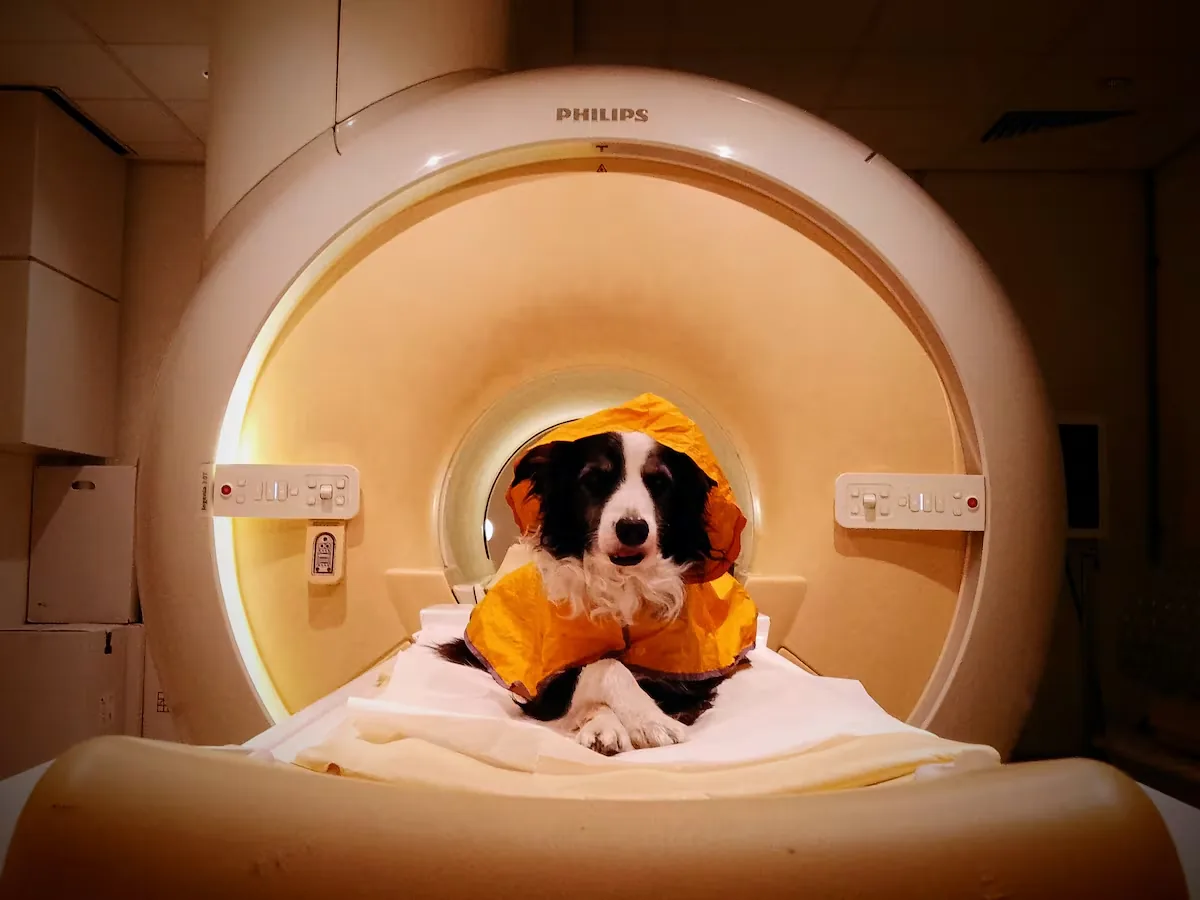
The dogs who participated in the study had been trained to remain still inside the magnetic resonance scanner. And still, in this context, means almost motionless. “If they move more than three millimeters during the six minutes the experiment lasts, we can no longer use that data,” Cuaya explains.
Many of the participants were border collies, a breed chosen, among other reasons, for their size, since dogs that are too small can be difficult to study in the scanner.
The sample also has a particularity that the researchers themselves consider a limitation. “They are dogs that have lived in a privileged environment and possibly part of that explains our results,” Cuaya acknowledges. They were healthy animals, without serious behavioral problems, and with owners who dedicated time and resources to their training. “We found that happiness has a particularly robust response and representation. But we can never know to what extent this depends on the dogs’ experience,” adds the biologist from the University of Vienna.
Pérez points out another limitation: “All these magnetic resonance studies have few individuals.” Training a dog to remain awake and practically motionless inside a scanner requires time and patience. For that reason, she considers it understandable that these works end up using small samples and, often, certain breeds.
The role of humans
Dogs and humans belong to very distant evolutionary branches. “The brain structures that primates use to process images, detect objects, and recognize social and emotional signals were not present when we separated from carnivores,” explains Hernández-Pérez, researcher at the University of Vienna.
For the authors, thousands of years of coexistence may have exerted selective pressure on dogs’ ability to interpret our signals. “For them, we are a very important social companion. We are a very relevant social stimulus in their lives,” says Pérez.
Cuaya has a similar opinion. “Dogs always take us as social references. Even though we are another species, we are an important species for them, for their adaptation and for their well-being,” the author points out. And understanding that relationship, she adds, could also help improve daily coexistence between both species. “We can also make a more conscious effort to try to understand what they are communicating to us with their body. They are also emotional beings,” she says.