






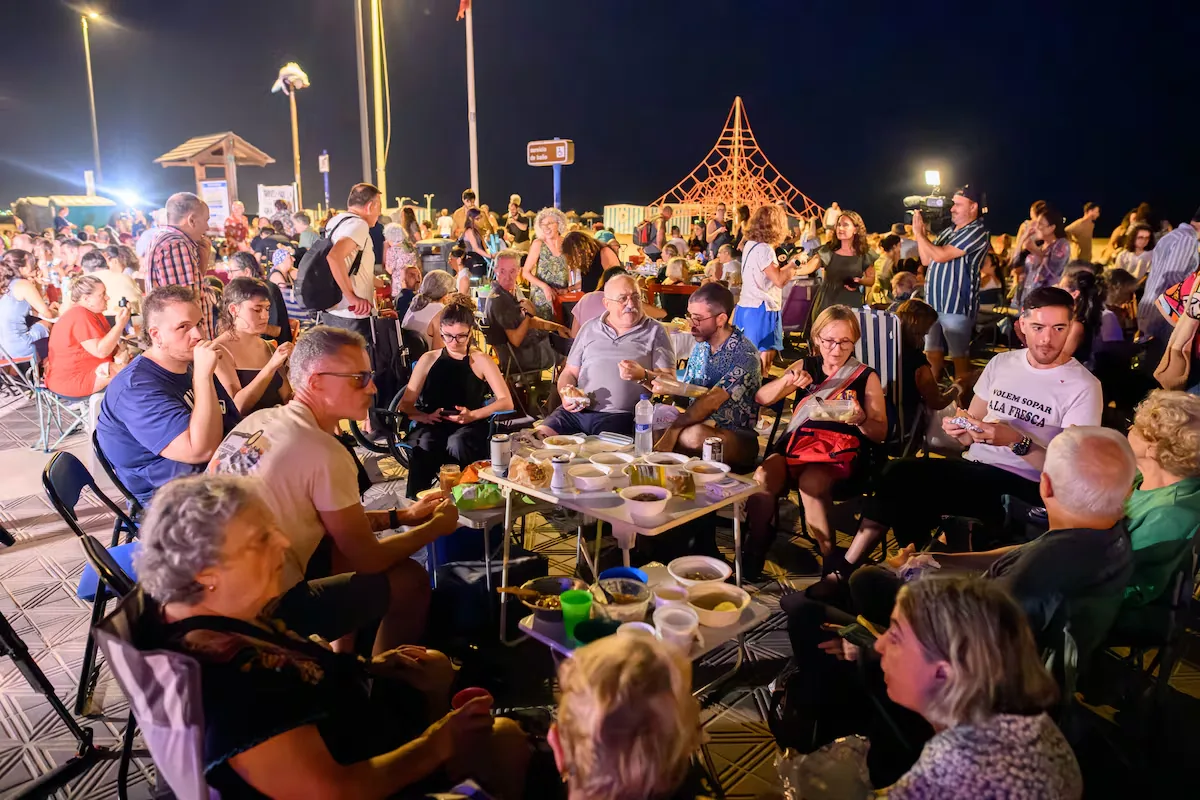
Taking out a table, some chairs, and sitting on the street to have dinner outdoors with friends, family, or neighbors. This popular act, especially in the warmer months, has recently taken on a reivindicative character in various parts of the country. In a social context where cities and municipalities are increasingly strained by mass tourism and public space is experiencing progressive privatization, the option of standing your ground on the street to socialize without paying for it seems almost revolutionary. Perhaps that is why various groups have chosen outdoor dinners as a tool to make their demands visible.
Among those that have had the most impact this summer are those of the Mallorcan collective Brunzit, which on August 19 filled Palma’s Plaza Mayor with people dining outdoors. This dinner was the culmination of a series of actions, called Sopars a la Llesca, which they have been organizing since the summer of 2025 to demand that city spaces can be inhabited by the people who live in them. At the outdoor dinners they convene, not only is food and drink shared, but beach coolers, folding tables, and plastic chairs mix with music, dance, poetry, and games. Their actions are part of a wave of demonstrations and protests that have been taking place in recent years in Mallorca against tourist overcrowding.
View this post on Instagram
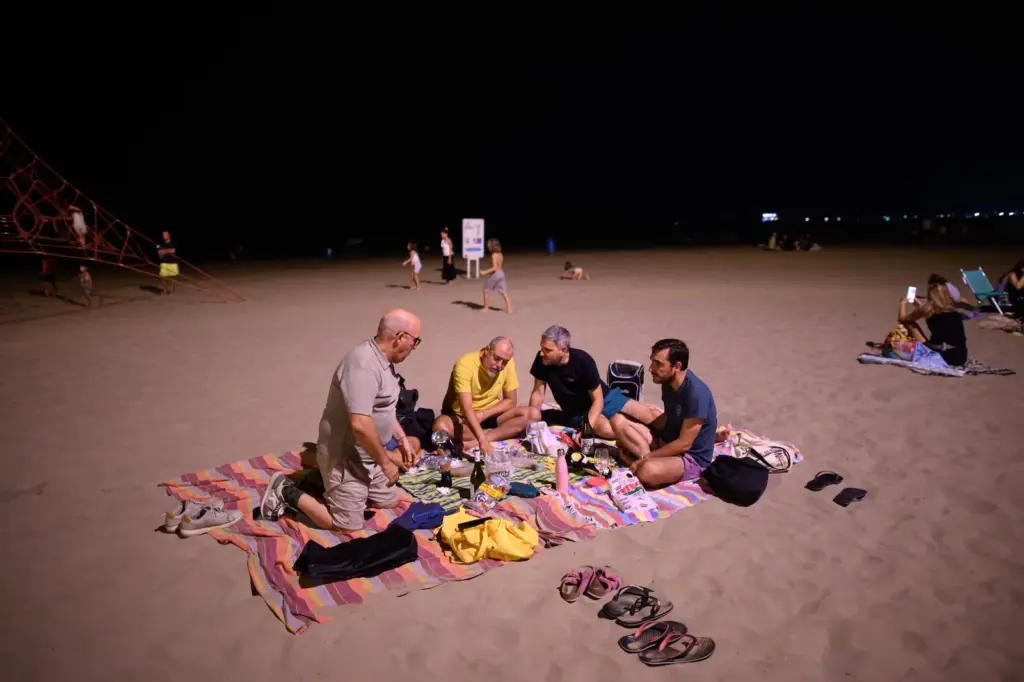
In Valencia, where residents of the maritime settlements regularly go out to dine outdoors, they have recently mobilized against the threat of limiting this popular tradition. The trigger? Comments that set off alarms in several associations. “This summer, a restaurateur made statements criticizing people for going out to dine on the Paseo Marítimo because they left everything very dirty and it looked bad to tourists,” explains Pau Diaz, a member of the Associació de Veïns Amics de la Malva, one of the five associations that called the big reivindicative outdoor dinner on September 5 on Valencia’s Paseo Marítimo.
In response to these statements — made after the announcement by Mayor María José Catalá of the plan to renovate the Coastal Front, which will include the renewal of the Paseo Marítimo — several associations from the maritime settlements began to mobilize to make it clear that public spaces belong to the citizens. “The Paseo Marítimo does not belong to the restaurateurs, it belongs to the people and to anyone who wants to use it,” says David Verdoy, president of the Associació de Veïns Amics de la Malva. Verdoy assures that these outdoor dinners have been organized in Valencia “forever” and they had never had any problems with the restaurateurs. In fact, he knows that many of them also did not like those statements that ended up sparking the neighborhood protest.
The municipal ordinance on the use of beaches and adjacent areas in Valencia does not prohibit outdoor dinners. The only references to food in these spaces relate to the prohibition of leaving waste or the regulation of the sale and consumption of alcoholic beverages. In the face of the controversy, the Valencia City Council announced that restricting this tradition is not in their plans. “Neighborhood associations have to be vigilant to ensure that this is the case,” emphasizes Pau Diaz.
Diaz also stresses the importance of these outdoor gatherings: “These are spaces that neighborhood associations claim in a context of evident increase in touristification.” And beyond the neighborhood meeting, he points out another determining factor to defend the survival of this tradition. “We are in a moment of climate crisis and it is necessary to find spaces where we can stay cool. The neighborhoods of the maritime settlements are working-class neighborhoods, where energy poverty exists and not all homes are air-conditioned. So there are reasons, not only of coexistence and occupation of public space by citizens, but even vital needs.”
In Madrid, this August, the Lavapiés neighborhood also hosted an outdoor dinner during the San Lorenzo festivities. On Dos Hermanas street, a long continuous table was set up covered with a colorful polka-dot tablecloth where neighbors sat down to eat what each had brought from home. The platform Lavapiés al límite, which brings together several groups united “in the face of the exhaustion and alarming institutional abandonment of the neighborhood,” as explained by Lucía López, one of its members, promoted this dinner. “It seems they want us all in our homes, not to protest, when the city is increasingly hostile, with fewer places for meeting and citizen participation,” says this neighbor, who adds that they feel they are being robbed “even of the popular festivals.” Out of this discontent came the slogan “without neighbors there is no party” and the celebration of this outdoor dinner.
Read more Moria Casán, the immortal erotic myth: “Sex at 80 involves many devices. Batteries are a must”
The dinner is actually part of a series of actions that the platform carries out once a month to “recover the public space as a place for neighborhood gathering,” whether through demonstrations, street games, or planting trees in empty tree pits. In Lavapiés, it was not the first time such a gathering had taken place. The collective Vecinas a la Fresca already organized similar activities in the summers of 2023 and 2024 in the streets and squares of Lavapiés, such as neighborhood snacks or contests of tortilla, gazpacho, or tapas with seasonal vegetables. “In those cases, we did not make a formal authorization request as we did for this summer’s dinner, so the police always ended up coming, because apparently we were super dangerous with our tortillas in hand,” Lucía recounts ironically.
View this post on Instagram
During the dinner last August, they organized a “neighborhood bingo” so attendees could show how well they knew Lavapiés. “It was things like ‘I bought fish at Alofer’ [the legendary fish shop on Esgrima street, which closed this year], ‘I had a picnic at Esta es una Plaza’ [one of the few green spaces in the area], or ‘I know where there is a mosque or a consumer group in the neighborhood.’ It was a way to get to know each other, to talk and enjoy. And it was a wonderful, glorious, incredible night,” Lucía recalls emotionally.
Food to share and get to know your neighbors
“Potato tortilla is always a hit at these dinners,” says Pau Diaz from the Associació de Veïns Amics de la Malva, who explains that the idea of these sopars a la fresca is to bring things to share. “Potatoes, breaded meat, maybe a ratatouille…”. “Salads, esgarraet, some cold cuts,” adds the association president David Verdoy. “Very interesting dynamics are generated, which have nothing to do with the commodification of public spaces. For us, that is one of the keys, because we bet on the common and also because shared food tastes better,” Diaz assures.
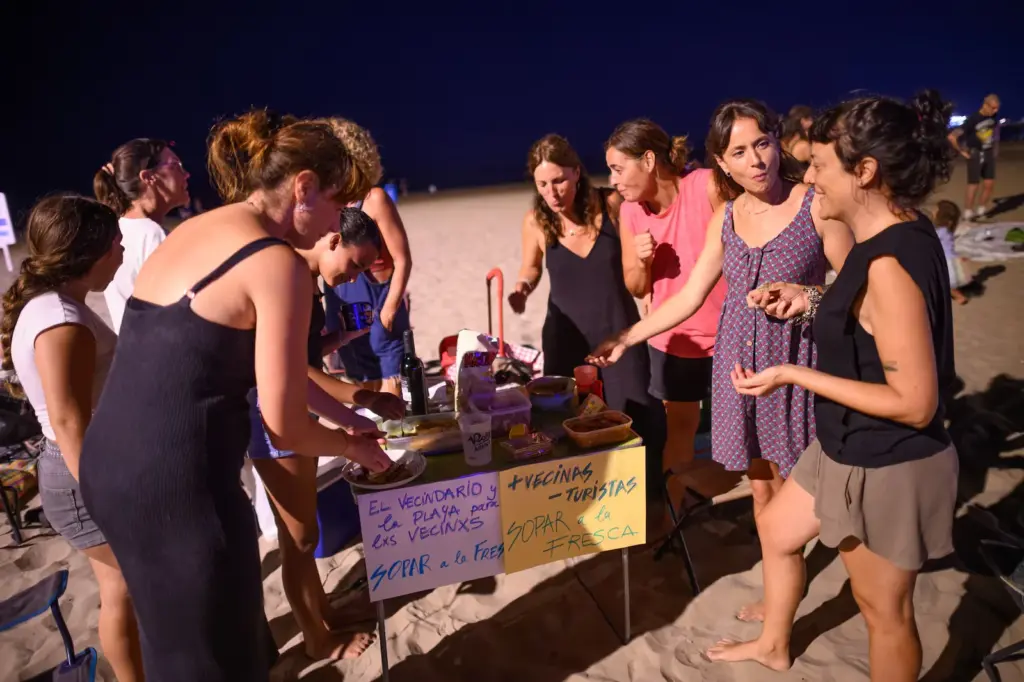
Lucía López remembers how beautiful it was to see the neighbors of Lavapiés come down to the street with their dishes and containers. “There was even someone who brought a fideuá in a pan.” Many of the cultures that inhabit this Madrid neighborhood were also represented at the table: “There was food from Bangladesh, Senegal… The bakery Panifiesto gave us the bread, the pastry shop La Barra Dulce the dessert. That is, the merchants, the neighborhood fabric also got involved in this dinner.”
Lucía is clear that food is part of culture and gathering, and that in a place like Spain, where people usually meet to eat and drink, it is a way to create bonds and community. “The fact that everyone brings something generates a conversation. ‘What is this? How did you make it? What ingredients does it have?’” She also says that in the days after the dinner, many people approached them to tell them the memories they had of when they used to go out to dine outdoors in the past. “There is nothing like being on the street and having a drink with your neighbors. There is no better plan.”