


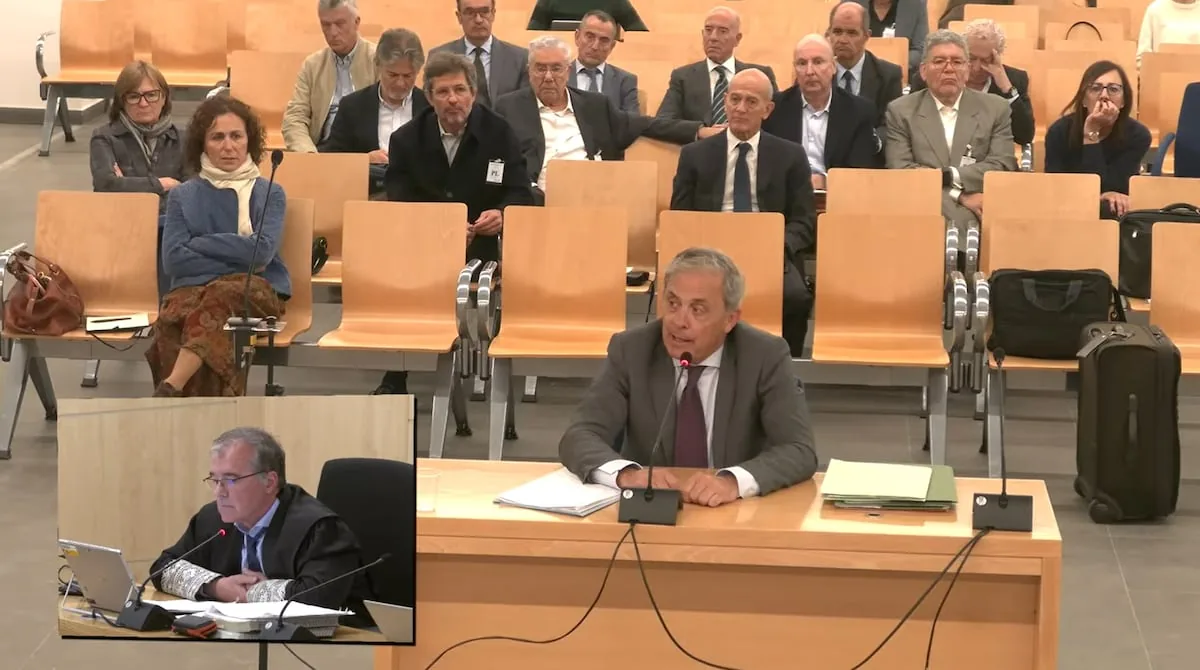
The contrast between the father and the firstborn could not be more pronounced. Jordi Pujol has been absent from the trial for the family fortune and, despite personally attending the National Court this Monday, he was not even seen: he entered through the car park, was examined by a forensic doctor, and left after the court decided to exonerate him due to his state of health. Jordi Pujol Ferrusola, on the other hand, has been the absolute protagonist of the process since its beginning five months ago, and has attended almost all sessions, listening carefully to witnesses and taking notes in a notebook. This Monday, while the 95-year-old former Catalan president returned to his home in Barcelona, the eldest son sat at the microphone and did not let go for three hours. With astonishing ease, he defended the reality and legality of the “consultancy” he provided to various companies; the success of his businesses, he said, was based on “passing on privileged information.”
The firstborn arrived more than prepared for the peak moment of the declaration and was able to circumvent the attempts of the anti-corruption prosecutor, Fernando Bermejo, to question the reality of the work for which he collected millionaire invoices. The Public Prosecutor’s Office’s thesis is that the payments to Pujol Ferrusola, known as Júnior, were a cover-up to camouflage the payment of commissions from companies to the Generalitat in exchange for the awarding of public works under the government of Jordi Pujol. But the business life of the eldest son is much more complex, as it includes international connections and his dealings extend in time long after his father’s long presidency (1980-2003) ended. The accused explained, in fact, that he dedicated himself to doing business around the world to avoid friction with the public sector in Catalonia and that he turned his attention back to Spain at the turn of the millennium, when, as he said paraphrasing José María Aznar, “Spain was doing well.”
With a difficult-to-contain verbosity, Pujol Ferrusola presented himself as a man of a thousand and one connections in the economic sphere, who has sought business opportunities everywhere. He is not an expert in the usual sense and, nevertheless, provided services to companies in sectors as disparate as engineering, construction, photovoltaics, refineries, and the real estate sector. Prosecutor Bermejo wondered how this was possible, and if a certain “knowledge of the subject” was not required. Júnior‘s answer was blunt: “No.” His thing was not “knowing about kilowatts” (in allusion to an electrification project in Gabon), but rather connecting people, proposing businesses, and locating opportunities.
The investigation found invoices for intermediation services, but in many cases, not the contracts. Pujol Ferrusola defended that this is because his work “is based on trust” and the contracts were verbal. Through different companies, he executed these services and charged a high price for them. The prosecutor went through these businesses one by one that brought him millionaire incomes, trying to introduce the variable of political corruption into the conversation. It was in vain. The eldest of the seven siblings responded that the key to his success was that he knew many people and, therefore, was able to provide “privileged information” to people interested in certain businesses: solar panels in Ciudad Real, a refinery in Cartagena, or the purchase of plots of land in a municipality bordering Barcelona. “It was always based on passing on information that was not public and that no one else knew.”
Read more Support for the doctors’ strike continues to fall, and unions call for Pedro Sánchez’s intervention
From Jordi Pujol Ferrusola’s statement, a portrait emerges of a man always immersed in conversations, dealings, and businesses, seeking opportunities that sometimes ended well and sometimes not so much. The prosecutor reproached him for not having provided data to question witnesses who knew about these businesses. “Every time I say someone’s name, this is a shredder and everyone’s name is destroyed. It’s 15 years of shredding,” he complained, alluding to the very long investigation of the procedure, which began in 2012, culminated in 2014 (with the statement in which the former Catalan president confessed the existence of a hidden fortune in Andorra), and led the firstborn to spend time in provisional prison.
The eldest son also referred to that original sin: the accounts in Andorra. Faced with the Public Prosecutor’s Office, which suspects that the origin of the funds is political corruption, the accused has remained firm in the defense’s thesis: the money comes from a legacy (deixa, in Catalan), which Jordi Pujol’s father left to his family in case things went wrong. “He didn’t trust the country, he didn’t trust my father’s political activities, he was afraid that Spain’s situation was not sufficiently stabilized,” said Pujol Ferrusola, who was entrusted with managing these deposits from 1990 onwards. The profits obtained from the returns on that capital were then redistributed into the accounts opened by the siblings.
Jordi Pujol Ferrusola also alluded to his ex-wife, Mercè Gironès, also accused. During the trial, her lawyer tried to distance Gironès from the firstborn’s businesses. But he insisted that the “control” of one of the companies they shared was “of both” and attributed all responsibility to her in one of the operations under suspicion: the purchase of some properties in Palamós (Girona) for 217,000 euros by his wife, which were later sold for a much higher figure (4.8 million) to a company. Júnior felt so comfortable that he even promised to joke at the end of the day, when he stated that he was tired and asked to continue on Tuesday, as the court agreed. “He’s going to beat me up!” he said when Bermejo showed his intention to question him about the accounts. He even allowed himself a joke when the presiding judge, Ricardo de Prada, asked if anyone was going to testify in Catalan or if the translator, who had come this Monday for nothing, could avoid the ordeal. “Tomorrow, in Catalan!”
Read more Iran proposes a three-stage peace plan that leaves the nuclear issue for last