








Those who attended the conversation this Saturday between writers Giuliano da Empoli and Juan Gabriel Vásquez as part of the festival celebrating the 50th anniversary of EL PAÍS had the opportunity to ride for an hour in a vehicle with two headlights that allowed them to better see the hidden dangers in some corners of the darkness of our time. The dialogue brought to light multiple reasons for concern related to the relationship between technology and power, but also the conviction that understanding of these dangers is advancing and that on this basis a reaction is possible.
A term used by Vásquez in his first intervention —“conspiracy,” referring to the relationship between populists and techno-oligarchs— served as a trigger for the shared reflection. Da Empoli noted that the relationship between the two groups had an initial implicit phase that only later became explicit, a true conspiracy. At first, the techno-oligarchs were simply pursuing a business model that, incidentally — without that being the goal — favored the populists by poisoning public debate, promoting polarization, and the predominance of emotions over reasoned arguments.
But, Da Empoli continued, then there was “a turning point where the business project becomes a power project. And where this alliance is formed, which becomes explicit, between populist leaders and the lords of technological power, who understand that they have the same interests and that, in reality, although they do not always necessarily have the same worldview, in any case they have the same interest in eliminating all limits to their power.”
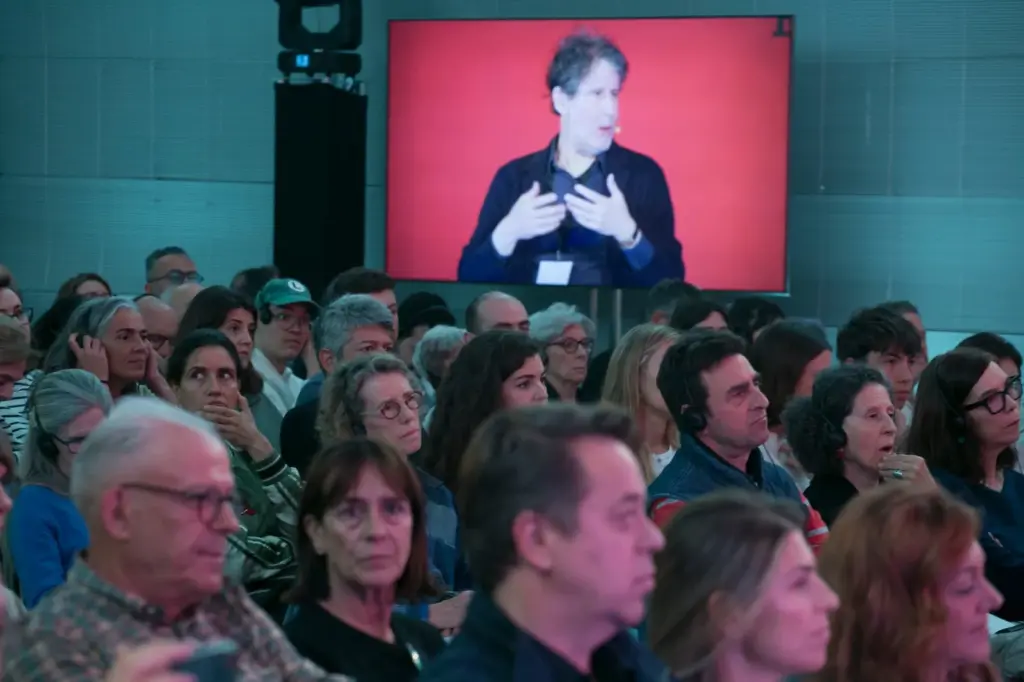
Vásquez, who led the conversation by asking Da Empoli questions in a dialogue conducted in French, emphasized the explicitness of an episode in which the US Vice President, J. D. Vance, connected without much ambiguity the demand to Europe not to regulate the tech sector and the continuation of military protection, highlighting a central strategic element of the Trump Administration, which uses security dependence to extract advantages in other areas, such as commercial as well as technological.
Da Empoli noted that the increasingly evident nature of this alliance, in politicians’ discourse or in the willingness of techno-magnates to show their support for populists, is fostering a greater understanding of the phenomenon. “China immediately understood that this was a matter of power, it was not just a business model, and it closed itself off,” said Da Empoli, opting for a regrettable model due to its oppressive traits but built on the basis of an understanding of what was at stake. Europe, on the other hand, lamented Da Empoli, seemed not to understand for too long.
Now understanding is advancing, Europe has adopted regulations. The problem is that the reaction is incomplete, because those regulations are still not fully applied. “The Commission is afraid,” Da Empoli considered, precisely because of the blackmail capacity that national populism in power in Washington allied with techno-magnates has. “Brazil has been braver,” he considered, referring to the decision to ban Twitter/X for a time.
Vásquez directed the second part of the conversation towards the promise and danger posed by the advent of artificial intelligence, recalling the imaginary clock that the Bulletin of the Atomic Scientists has updated since 1947 and that symbolizes how far we are from nuclear catastrophe. “At that time, there were eight symbolic minutes to midnight, according to scientists. Today, 85 seconds, because of the related risks,” recalled the Colombian writer, emphasizing that one of the concerns marking this deterioration is the risk of misuse of AI.
Da Empoli recalled another episode of regulatory laxity, linked in this case to the emergence of the latest generation AI models. The novelist and essayist recalled that the developers themselves imagined there would be some regulation, but that substantially in the US there was none of relevance. “It’s like in Lord of the Flies. At first, the children still behave because they believe the adults are about to arrive. When they realize they won’t come, everything breaks loose. Here it’s the same. The adults didn’t come,” he stated, succinctly.
“Is a greater degree of civic responsibility needed?”
But public regulation is not the only necessary level of action. Vásquez recalled observations by social psychologist Jonathan Haidt about how Silicon Valley engineers have sought to design their products to maximize the possibility of generating addiction. “Is a greater degree of civic responsibility needed?” asked the Colombian writer, stimulating reflection on the individual level, too often neglected.
Da Empoli emphasized the difficulty of disengaging from devices due to their diabolical magnetic capacity, their warmth, their ability to offer us very useful applications, but he was confident in the possibility that a process of personal “hygiene” can be established, consolidating the understanding of the harm these products inflict just as the calamitous effects of excessive junk food are now well understood. There are other foods, prepared differently, that are beneficial, the writer pointed out. There is journalism, there is culture, there are educational systems that generate democratic health.