








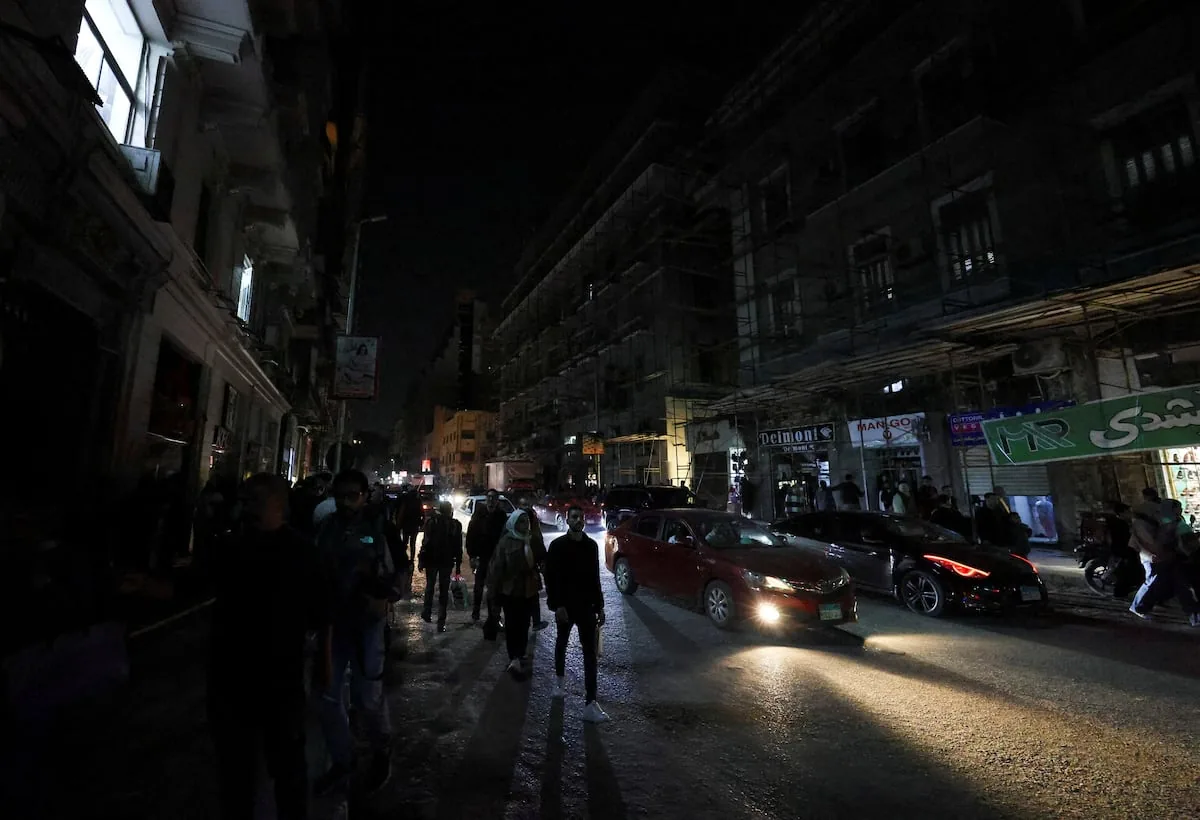
Talaat Harb, in the heart of Cairo, is one of the busiest commercial arteries in the capital of Egypt. Its wide sidewalks are often crowded well into the night by the incessant flow of pedestrians bustling along the street between shop windows of suits and shoes, cinemas, restaurants, book stalls, and traffic that is difficult to manage.
In recent weeks, however, the street presents a different scene. Until night falls, the flood of people that characterizes it still persists, but within minutes the lights of almost all establishments go out. Occasionally, a police car watches to ensure no one breaks the restriction. A little later, the street is practically deserted.
It is the butterfly effect applied to the Middle East: a war in Iran, more than 1,000 kilometers away, turning off the lights in Egypt. Since the last Saturday of March, the Government has imposed early closing hours on non-essential businesses in the country, such as shops, restaurants, and event halls, to reduce energy consumption. Between late March and early April it was at 9:00 PM and only one hour later on Thursdays and Fridays. Since last weekend, and until further notice, the chosen time is 11:00 PM.
Despite not participating in the war and not having suffered attacks from Iran like its Arab Gulf allies, Egypt is one of the countries most vulnerable to the economic repercussions of the conflict, such as the rise in fuel prices and its scarcity, caused by the closure of the Strait of Hormuz, controlled by Tehran. On one hand, it depends heavily on energy supplies and money from the region, and on the other, its financial capacity to cushion the blow is very limited.
Egypt uses natural gas to generate around 70% of its electricity but covers between 15% and 20% of its needs with imports from Israel, which were suspended for almost a month from the start of the war. Additionally, the blockade of the Strait of Hormuz has paralyzed gas from Qatar, another of its major suppliers, and oil from Kuwait, a third key energy partner, forcing Cairo to resort to crude oil from Libya.
The impact of this disruption on the country was immediate, and the Government passed much of the hydrocarbon price increase on to citizens. Just a week and a half after the start of the war, the Executive cut fuel subsidies and raised prices between 15% and 22%, increasing the accumulated price rise over a year to between 46% and 58%. It has also increased electricity rates for high-consumption households and businesses.
Braking megaprojects
Beyond the early closure of non-essential businesses, Cairo has decided to halt for at least two months infrastructure megaprojects that consume a lot of fuel. It has also decreed remote work every Sunday in April in both the public and private sectors and cut fuel allocation to government vehicles by 30%. In March, it also increased metro ticket prices by between 20% and 25% for shorter trips.
Amr Adly, PhD in political economy and professor at the American University in Cairo (AUC), points out that another vulnerability of Egypt lies in its persistent exposure to speculative capital for financing, especially in the form of short-term debt with high interest rates. “This capital tends to leave almost immediately after any crisis. We saw it with the war in Ukraine and with the coronavirus, and now we are seeing it again,” he notes.
Read more AEK Athens — Rayo: schedule and where to watch the Conference League quarter-final match
All this has put great pressure on the Egyptian currency, which has already devalued to its historic official lows and has only begun to recover following the announcement of the truce. Before the war, one dollar was close to 48 Egyptian pounds, while now it approaches 52 after having momentarily exceeded 54, in a depreciation that many analysts attribute to capital flight, interruption of new investments, and the strengthening of the dollar.
Aware that it is walking a tightrope, the Government has so far avoided cutting bread subsidies, which benefit millions of Egyptians below or near the poverty line. It has also not imposed widespread power cuts, as in the past, and has announced a minimum wage increase, although applicable from July. Although no protests have occurred so far due to the economic situation, this coincides with a certain reactivation of Egyptian labor activism after years of financial difficulties.
Some of the measures adopted by the Government, however, have been controversial. The time restrictions on most establishments represent a setback for many businesses and have coincided with the end of Ramadan, during which many businesses already suffer a drop in activity due to changes in schedules and consumption patterns derived from fasting.
Alia el Mahdi, former dean of the Faculty of Economics and Political Science at Cairo University, anticipates that “closing at 9:00 PM means fewer jobs for many people.” “There are many companies that work at night and it is not profitable because we reduce fuel consumption [very little], and in return, we lose a lot [of activity],” she considers. In March, the country’s non-oil private sector experienced its largest contraction in the last two years, according to the latest purchasing managers index prepared by S&P Global.
The rapid increase in fuel prices has also been controversial. “The state chose to pass the cost [of the increase] on to a broader base of consumers through generalized energy price hikes, which will likely translate into greater inflationary pressure and [at the same time] represents a very regressive decision,” Adly indicates. Urban inflation in March rose to 15.2% compared to 13.4% recorded in February.
Collateral damage
Even if the ceasefire between the United States and Iran does not collapse, the Egyptian economy could continue to suffer because its finances also depend heavily on remittances sent by Egyptians working in the Gulf and on direct investments from these countries, which will still need time to absorb and recover from the enormous losses they have suffered.
“Egypt [is] very dependent on Gulf countries to cover its financial needs, through remittances, export markets to the United Arab Emirates and Saudi Arabia, and the huge investments it has received in recent years from the Emirates and, to a lesser extent, Qatar, with plans to attract more from Riyadh,” notes Adly. “In the medium term,” he warns, “this will probably have a great impact on our balance of payments.”
Read more The Dragon Khan social of Carlos Peguer