







At 76 years old, and despite acknowledging that we live in “truly dark” times, the great Mexican chronicler Alma Guillermoprieto continues to maintain hope in Latin America, the complex and diverse region she has been narrating with all its nuances to the American audience for more than four decades in the pages of The New Yorker, The New York Review of Books, or The Washington Post, among other media. “It seems as if everything in the world is wrong. The only thing that is right, despite everything, is the people, who are what moves me and what makes me persist. Because one might think that all Mexicans are narcos. But most of us are decent people. We are very hardworking, very festive people, and that is what I have wanted to capture for Colombia, for Cuba… that capacity to resist joyfully in our countries,” she said this Saturday at the EL PAÍS Festival panel Chronicle of a Continent.
In conversation with Guillermo Altares, international editor of this newspaper, on the occasion of its 50th anniversary, Guillermoprieto, who next Wednesday will present in Spain what she says will be her last book of chronicles (This improbable promised land. Stories of Latin America in this century), also lamented the pain caused by witnessing the failure of the revolutions in Cuba and Nicaragua. She covered both events at the start of her career in the 1980s, when she entered journalism by chance, after pursuing a frustrated dream as a dancer in Havana.
“The deep pain caused by what is happening in Nicaragua and Cuba — what happened in Venezuela was more anger — were the last great dreams of socialism and simply blaming the gringos is not enough,” said the journalist, who received the Princess of Asturias Award for Communication and Humanities in 2018. “Socialism proved incapable of creating wealth, of solving certain key problems in the Soviet Union, in the satellite countries, in Nicaragua, in Cuba, such as the housing problem. It solved the health problem but did not solve the problem of representation and diversity of thought. And by not solving the problem of divergent thoughts, it fell into these authoritarianisms that led to the ruin of Cuba and the disaster of Nicaragua.”
The journalist specifically referred to the case of Nicaragua. In the 1980s, after the triumph of the Sandinista revolution, she got to know Daniel Ortega and his wife Rosario Murillo closely, the presidential couple who have eliminated all opposition and all critical voices in the country and whom she defined as “people capable of any lie and any horror.” “They were quite mediocre. That mediocrity combined with absolute power gave them the ability to eliminate enemies and allies, and today only the family remains.”
For Guillermoprieto, the 20th century was the century of “great utopias” and, in the 21st, we are seeing “their absolute failures”: “The utopia of socialism, that of Nazism. We are also living the failure of the utopia of capitalism. Because none can deal with the problems of modernity.”
Read more José María Cruz Novillo dies, the man who designed the great logos of democratic Spain
“The Latin American edition of EL PAÍS was a revolution”
Although not part of the EL PAÍS staff, Alma Guillermoprieto writes sporadically for this newspaper and has said she also feels it as her own. The journalist recalled the times when the paper edition started being sold on Sundays at Mexican newsstands. “I saw it as something very professional because Mexican newspapers were deeply corrupt, and one did not find out how the country really was,” she said.
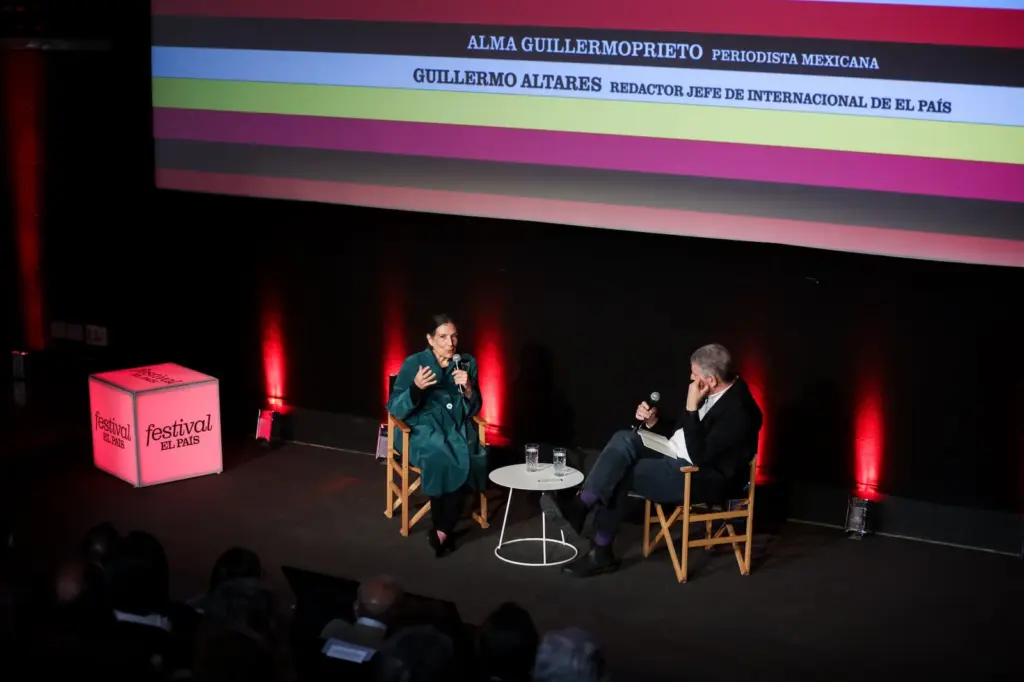
Later, with the implementation of the Latin American edition of EL PAÍS, which now has offices in countries such as Mexico, Colombia, Chile, or the United States, what Guillermoprieto called a “revolution” began. “In Latin America, since the 60s or 70s, journalists from all countries would gather and say: ‘We have to make a Latin American newspaper,’ but it couldn’t be done due to lack of money. When the Latin American edition started, that was the revolution, because we had coverage of what is not a country, but a very united region which is Latin America.”
Guillermoprieto says that the book she will present next Wednesday in Spain will be her last book of reports because, at 76, she no longer has the physical conditions to continue with the profession of reporting. But that does not mean writing will end. “Now I am going to do something that has interested me a lot about Frida Kahlo: how she made the leap from being a great painter to becoming earrings and quilts worldwide,” she jokes.
Read more A man fatally stabs a woman in the street in Esplugues de Llobregat